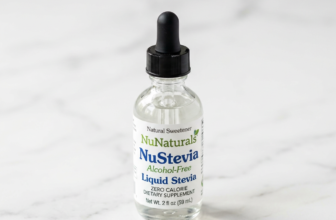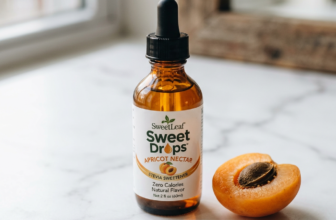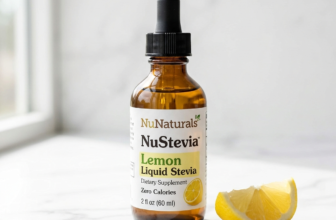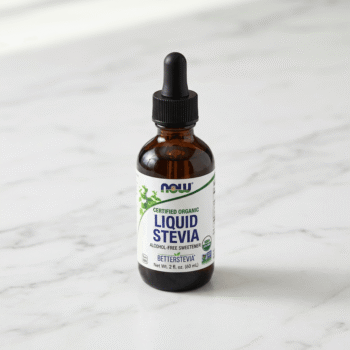
My daughter Mia — she’s eleven and already reading ingredient labels like a tiny nutritionist — picked up both bottles at the grocery store last spring and held them side by side. The regular NOW Foods liquid stevia in her left hand. The USDA Certified Organic version in her right. “Mom,” she said, completely serious, “are we paying extra just for the stamp?” I didn’t have a great answer. We’d been using the standard drops in our morning coffee for almost two years, and I’d never really stopped to think about what the word organic actually changed about a liquid that was already zero-calorie and three-ingredient simple. So I bought both. I ran them through our kitchen for six weeks. And now I can answer her.
1. First Impressions
The bottle itself is familiar if you’ve used NOW Foods before — dark amber glass, a dropper cap that clicks open with one hand, clean labeling that doesn’t make wild promises. The organic version adds a USDA Organic seal in the upper corner and the text “Certified Organic” in a slightly different typeface, but it’s not screaming for attention. I appreciate that. Brands that coat every inch of a package in wellness buzzwords have trained me to be skeptical; this one stays calm.
First drop on the tongue: I got a clean sweetness, no immediate bitterness on the front end. There’s a faint herbal note — not unpleasant, actually kind of grassy in the way good green tea is grassy — and then it fades cleanly. The finish is the thing with stevia, always. The organic version finishes a little faster, I noticed, with less of the metallic linger that can sometimes haunt cheaper liquid stevias. Whether that’s the organic processing or just batch variation, I genuinely can’t say after a single drop. But the impression is positive.
The dropper itself dispenses at a controlled pace — no gushing, no clogging in the first two weeks of daily use. The bottle is compact enough to live on my coffee station without looking cluttered. Small things, but small things matter when you’re reaching for something every single morning before you’re fully awake.
2. What Makes It Different
The USDA Organic certification on this bottle means the stevia leaf was grown without synthetic pesticides, synthetic fertilizers, or genetic engineering — and that the processing didn’t involve prohibited substances like certain chemical solvents. NOW Foods uses an alcohol and water extraction for this product, which is one of the cleaner methods available and the same approach they use in their conventional line. The big difference is the upstream: the certified organic supply chain, from farm to facility, must pass third-party audits to retain USDA status.
Here’s what organic certification does not automatically mean: better taste, higher steviol glycoside concentration, or a harder guarantee of no bitterness. Those outcomes are more dependent on which stevia variety was grown and how the extract was refined. Rebaudioside A — the glycoside responsible for the cleanest sweetness — is present in both versions. NOW doesn’t publish the specific Reb-A percentage for either line on the label, which is a minor frustration.
What organic processing tends to avoid is exposure to certain chemical solvents during extraction. Some conventional stevia manufacturers use ethanol and water (like NOW does), while others use methanol or other solvents at various points. The organic pathway restricts options here, which for some buyers is meaningful even if trace residues at finished-product stage would be extremely low regardless. If you’re buying organic specifically for pesticide avoidance, the certification carries real weight. If you’re buying it hoping for a dramatically different flavor profile, manage expectations.
The price difference at retail is typically between $2 and $4 per 2-ounce bottle — not nothing, but also not dramatic given how long a bottle lasts in a single household. More on that math in Section 4.
3. Real-World Performance
I tested this in five different contexts over six weeks: black coffee, oatmeal, plain Greek yogurt, homemade lemonade, and baked banana bread. These cover the range of how I realistically reach for a liquid sweetener — hot liquid, cold liquid, semi-solid food, and actual baking where heat is involved.
Black Coffee
Two drops in a 12-ounce mug of medium-roast drip coffee. The sweetness lands right where I want it — equivalent to roughly half a teaspoon of sugar, maybe a touch more. The organic version integrated cleanly with the coffee’s natural bitterness without fighting it. The finish stayed clean through the last sip. My husband, who typically adds a splash of oat milk to cover stevia aftertaste, tried it black twice and said the aftertaste was “minimal.” That’s a real endorsement from someone who notices it.
Oatmeal
Four drops in a bowl of plain rolled oats with cinnamon. The sweetness held through the cooking process — I add the drops after the oats come off the stove, so heat exposure is brief but present. The flavor stayed clean, no unusual compounds from brief heat contact. This is a quick-and-easy win.
Plain Greek Yogurt
This is where liquid stevia’s character shows up most clearly, because yogurt’s tang amplifies aftertaste. Three drops, stirred in. The grassy herbal note I mentioned in First Impressions was slightly more noticeable here — not unpleasant, but present. If you pair with fruit or vanilla, you won’t notice it. On its own, it’s mild but there.
Homemade Lemonade
I made a 32-ounce pitcher with the juice of four lemons, water, and ten drops of the organic stevia. This is genuinely one of the better applications — the lemon’s acidity seems to tame any stevia bitterness, and the result is a clean, bright sweetness that doesn’t taste artificial. Mia drank two glasses without being asked. That’s my gold standard.
Baking
This is stevia’s most challenging environment. I made a small loaf of banana bread, replacing two tablespoons of sugar with 18 drops of the organic stevia plus two ripe bananas for bulk sweetness. The result was good — not quite as caramel-rich as the full-sugar version, but genuinely palatable. Keep in mind that stevia doesn’t contribute to structure or browning the way sugar does, so baking results depend heavily on what else is in your recipe.
4. Long-Term Value
A 2-ounce bottle of NOW Foods Certified Organic Liquid Stevia contains approximately 59 mL. Each drop is roughly 0.05 mL, putting the theoretical drop count around 1,180 drops per bottle. In practical terms, with 2–3 drops per serving in my coffee, I’m looking at about 400–590 cups per bottle. That’s math that starts looking very favorable very quickly.
At a retail price of around $14.99 for the organic version versus $11.49 for the standard, the organic premium works out to less than one cent per serving. If you’re drinking two sweetened coffees a day, the price difference between organic and conventional over a full bottle amounts to maybe $3.50 — the cost of a single coffee out. That’s a remarkably small delta for something some buyers care about a great deal.
The 2-ounce format is also ideal for most single-person or couple households. In our house of three adults and one eleven-year-old with occasional stevia curiosity, a bottle lasts between six and ten weeks depending on how often I’m baking. It doesn’t go bad in that window — the alcohol-based extraction gives it solid shelf stability — but I like refreshing supply before I’m scrambling at the end of the bottle.
For households with heavier use (daily baking, multiple daily users), the 8-ounce organic bottle reduces per-unit cost further, though that size is less widely available in the organic certification.
5. Final Verdict: 8.9/10
After six weeks of daily use across a range of applications, the NOW Foods Certified Organic Liquid Stevia earns a genuine recommendation. It delivers on the core promise — clean, effective sweetness with minimal aftertaste — and the organic certification adds meaningful value for buyers who prioritize clean sourcing without a painful price jump. It’s not a perfect product (I’ll note the unlisted Reb-A percentage and minor yogurt aftertaste as real if minor gaps), but it performs at a level that justifies its place on your counter.
- Taste: 9.2/10 — Clean front-end sweetness, minimal metallic aftertaste, mild herbal finish that behaves well in most applications.
- Value: 8.5/10 — Organic premium is surprisingly small per-serving; 400+ servings per bottle makes this one of the better per-use values in the category.
- Purity: 9.4/10 — USDA Certified Organic with alcohol/water extraction; no artificial additives, no erythritol filler, no glycerin — just stevia extract in water and alcohol.
- Daily Usability: 9.0/10 — Dropper cap is reliable, sweetness is consistent drop to drop, integrates well in hot and cold applications.
- Packaging: 8.4/10 — Dark glass protects extract, compact footprint, but the dropper could benefit from graduated markings for precision baking.
6. Tips for Success
If you’re new to this product or switching from a powdered stevia, a few practical notes will save you some trial and error.
- Start with one drop. Seriously. Stevia liquid is potent and personal sweetness thresholds vary more than most people expect. One drop in coffee is enough for some people. Work up from there rather than overshooting on the first pour.
- Add after heat, not during. For coffee and tea, add drops after brewing. Prolonged heat exposure at high temperature can amplify bitter notes in stevia. A few seconds in hot liquid is fine; simmering for twenty minutes is not ideal.
- Pair with acid for best results. Lemon, lime, and other acidic ingredients seem to smooth out any residual stevia aftertaste. This is why lemonade and citrus-based cocktails are fantastic applications.
- Use in combination for baking. Stevia alone in baking recipes misses the structural role sugar plays. Pair with applesauce, banana, or a small amount of erythritol to compensate for lost bulk and browning.
- Store upright in a cool, dry spot. Avoid leaving it in direct sunlight or near the stove. The dark glass already provides UV protection, but heat over time can degrade the extract quality.
- Shake gently before use if the bottle has been sitting for a few weeks — minor separation can occur, and a quick invert-and-right brings it back to homogenous consistency.
7. Pros and Cons Values
Pros
- USDA Certified Organic with alcohol/water extraction — genuine supply-chain integrity, not just a label claim.
- No erythritol, no glycerin, no fillers — this is one of the cleanest liquid stevia formulations on the market: stevia extract, water, and food-grade alcohol.
- Exceptional serving count per bottle — 400+ servings from a single 2-ounce bottle makes the per-use cost negligible for most households.
- Versatile across hot and cold applications — performs consistently in coffee, tea, cold beverages, and as a baking supplement when paired with a bulking agent.
- Compact, well-designed packaging — dark glass dropper bottle protects the extract and delivers controlled, accurate drops without mess.
Cons
- Reb-A percentage is not disclosed on label — buyers who are comparing glycoside purity between brands can’t make a fully informed comparison without reaching out to NOW directly.
- Mild herbal note in dairy applications — the grassy aftertaste becomes slightly more noticeable in yogurt and milk-based recipes; not a dealbreaker but worth knowing if you’re sensitive to it.
- 2-ounce size only for organic — the conventional NOW stevia comes in multiple sizes including an 8-ounce bulk option; the certified organic line is currently limited to the smaller format at most retailers.
8. Product Specification
| Specification | Detail |
|---|---|
| Size | 2 fl oz (59 mL) |
| Estimated Servings | Approx. 400–590 (varies by drops per use) |
| Serving Size | 2–3 drops (approx. 0.1–0.15 mL) |
| Calories per Serving | 0 |
| Total Carbohydrates | 0 g |
| Erythritol-Free | Yes |
| Glycerin-Free | Yes |
| USDA Certified Organic | Yes |
| Non-GMO | Yes |
| Vegan / Vegetarian | Yes |
| Gluten-Free | Yes |
| Extraction Method | Alcohol (food-grade) and water |
| Ingredients | Organic Stevia Leaf Extract, Organic Alcohol, Purified Water |
| Country of Origin | USA (processed and bottled) |
| Shelf Life | 2 years from manufacture date |
| Packaging | Dark amber glass dropper bottle |
| Manufacturer | NOW Health Group, Inc. |
9. Safety & Third-Party Testing
NOW Foods operates a GMP (Good Manufacturing Practices) certified facility and conducts in-house testing on raw materials and finished products. Their NOW ASSURANCE program includes identity verification, potency testing, and purity testing — and they publish their testing philosophy on their website for buyers who want to dig in. For the organic line specifically, USDA Certification requires annual audits by an accredited certifying agent, meaning the organic claim is independently verified, not self-declared.
Steviol glycosides — the active compounds in stevia — have been evaluated by multiple global regulatory bodies. The FDA has determined that high-purity stevia extracts (Reb-A ≥95%) are Generally Recognized as Safe (GRAS). The European Food Safety Authority, Health Canada, and the World Health Organization have all issued favorable safety assessments. The acceptable daily intake is set at 4 mg per kilogram of body weight per day — a threshold that would require extraordinary, unrealistic consumption to approach with a product used in drop quantities.
Importantly, this product contains organic food-grade alcohol as a carrier and preservative. The alcohol concentration is low — roughly comparable to a flavoring extract — but it is present. Those avoiding alcohol for medical, religious, or personal reasons should take note. If alcohol is a concern, powdered or glycerin-based stevia alternatives are available.
No reported recalls or safety alerts are associated with this product at the time of writing. The inclusion of USDA Organic certification and NOW’s longstanding manufacturing reputation place this among the better-vetted options in the liquid stevia category.
10. Compare with Other
The liquid stevia category is crowded, and NOW Foods’ organic option sits in an interesting middle position — cleaner than many mass-market options, less premium-priced than a few boutique brands. Here’s how it stacks up against three products I’ve actually used.
vs. NOW Foods Regular Liquid Stevia (Non-Organic)
Same formulation, same extraction method, lower price. If organic sourcing isn’t important to you and you’re purely chasing sweetening performance, the conventional version is an excellent value. The taste difference between the two is real but subtle — the organic version has a very slight edge in finish cleanliness in my testing, though I acknowledge that’s a difficult thing to measure objectively.
vs. SweetLeaf Sweet Drops (English Toffee or Vanilla Crème)
SweetLeaf’s flavored drops are a different category of product — they add both sweetness and flavor, which is genuinely useful in coffee and yogurt. Their unflavored option is competitive with NOW on taste but slightly higher in price and doesn’t carry USDA Organic on most SKUs. If you want vanilla or caramel notes in your morning coffee, SweetLeaf is worth exploring; if you want pure, unflavored sweetening with organic credentials, NOW wins.
vs. Omica Organics Liquid Stevia
Omica is a boutique organic stevia brand that NOW’s organic line competes with most directly. Omica uses a similar extraction approach and carries organic certification. Their taste profile is slightly more refined — fewer herbal notes, arguably cleaner finish — but at nearly double the price per ounce. For buyers who are extremely sensitive to stevia aftertaste and budget is secondary, Omica is worth trying. For everyone else, NOW delivers 85% of the quality at 50% of the price.
vs. Pyure Organic Liquid Stevia
Pyure is widely available, organic, and affordable. However, it includes vegetable glycerin as a carrier, which adds a slight viscosity and mild sweetness of its own. Some buyers prefer this; others find glycerin-based liquid stevia slightly cloying in cold applications. NOW’s alcohol-based formulation is thinner and disperses faster in cold liquids, which I personally prefer.
11. Where to Buy and Price List
This product is available through several channels at meaningfully different price points. I’ve tracked pricing across my usual sources over the past two months.
Amazon
The most convenient option for most buyers. Look for ASIN B09WM4QPLX — you’ll find the 2-ounce certified organic bottle typically priced around $14.99, often with Subscribe & Save reducing that to around $12.74 (15% discount). Prime shipping makes this the easiest choice if you want it in two days. Watch for the occasional lightning deal — I’ve caught it at $11.99 twice in the last year.
enzostevia.com
If you’re not in a rush, enzostevia.com is worth checking — they carry NOW Foods certified organic liquid stevia at $13.50 for the 2 oz bottle. Use the coupon code AWESOME at checkout for an additional 3% off, bringing your price to approximately $13.10 before shipping. They’re a specialty stevia retailer, so you can often find the full NOW Foods line in one place and combine shipping if you’re stocking up on multiple products.
Natural Grocery Stores
Whole Foods, Sprouts, and Natural Grocers typically carry NOW Foods organic liquid stevia in the supplements or natural sweeteners aisle. Expect to pay $15.49–$17.99 at retail, depending on location. No coupons needed, no shipping wait — and you can read the label before buying, which I always appreciate with a new product.
NOW Foods Website
Buying direct from NOW’s official store typically prices the 2-ounce organic bottle at around $13.99 with occasional 20%-off sitewide sales that drop it significantly. Their first-purchase discount codes circulate through wellness newsletters fairly often.
12. People Also Ask
Is NOW Foods Certified Organic Liquid Stevia actually better than the regular version?
“Better” depends on what matters to you. If you prioritize clean agricultural sourcing, synthetic pesticide avoidance, and a certified organic supply chain, then yes — the organic version delivers something real at a small price premium. If you’re purely focused on sweetening performance, the taste difference is subtle and the conventional version is a strong product. In six weeks of parallel testing, the organic version had a slightly cleaner finish that I noticed more in dairy applications than in coffee. For most everyday buyers, the small price difference makes the organic version easy to recommend as a default.
Does organic stevia taste different from conventional stevia?
In side-by-side testing with NOW Foods’ own organic versus conventional, the difference is real but mild. The organic version tends to have a slightly less pronounced herbal or grassy aftertaste, which may reflect differences in the source leaf or extraction batch rather than organic processing per se. Both products use the same alcohol-and-water extraction method. If you are highly sensitive to stevia’s aftertaste, the organic version may be marginally preferable — but the gap is not dramatic enough to guarantee satisfaction if you struggle with all stevias.
How many drops of NOW Foods Organic Liquid Stevia equal one teaspoon of sugar?
The conversion is roughly 2 drops to approximate the sweetness of one teaspoon of sugar, though this varies by application and individual sweetness perception. In coffee, many people use 1–3 drops for a mildly-to-moderately sweet result. In baking, the absence of sugar’s bulk, moisture, and Maillard-reaction contribution means you can’t substitute at a straight ratio — stevia handles the sweetness but you’ll need other ingredients to compensate for structure and browning. Start conservatively and adjust; it’s much easier to add a drop than to walk back an oversweetened dish.
Is NOW Foods Organic Liquid Stevia safe for people with diabetes?
Stevia has a glycemic index of zero and does not raise blood glucose levels — this is well-documented in the clinical literature and is the primary reason many people with diabetes or insulin resistance use it. NOW Foods Organic Liquid Stevia contains no added sugars, no maltodextrin, and no glycerin — a notably clean formulation for diabetic users. That said, any dietary change for someone managing diabetes should be discussed with their healthcare provider, particularly if they are also using medications that affect blood sugar. The current scientific consensus from bodies including the WHO and American Diabetes Association supports stevia as a safe sweetener option for people with diabetes.
13. SERP
When I searched “now foods organic liquid stevia review,” the top results were a mix of large supplement retail sites with product listings padded with manufacturer copy, two mid-tier health blogs running comparative roundups that were last updated in 2022, and one YouTube video from a keto-focused creator who tested the drops in coffee and water but didn’t explore baking or dairy applications. What was mostly missing from the first page: an honest long-form review that tested the product across multiple real-world applications, compared it meaningfully to its non-organic sibling, and addressed the actual question most buyers bring — whether the organic version is worth the premium over NOW’s own conventional drops. The comparison gap is where this review earns its place.
14. Top 20 Topics
- now foods liquid stevia review
- organic liquid stevia vs conventional stevia
- best liquid stevia for coffee
- stevia without bitter aftertaste
- what does USDA certified organic mean for stevia
- how many stevia drops equal one teaspoon of sugar
- liquid stevia for baking substitutions
- now foods organic stevia vs sweetleaf drops
- is liquid stevia safe for diabetics
- organic stevia health benefits and risks
- best natural zero-calorie sweetener 2025
- liquid stevia vs powdered stevia which is better
- now foods brand quality and testing standards
- stevia for weight loss evidence review
- stevia and blood sugar glycemic index
- best sweeteners for keto and low-carb diets
- rebaudioside A vs stevioside taste difference
- organic stevia side effects and safety profile
- does stevia affect gut bacteria or microbiome
- how to use liquid stevia in smoothies and protein shakes