
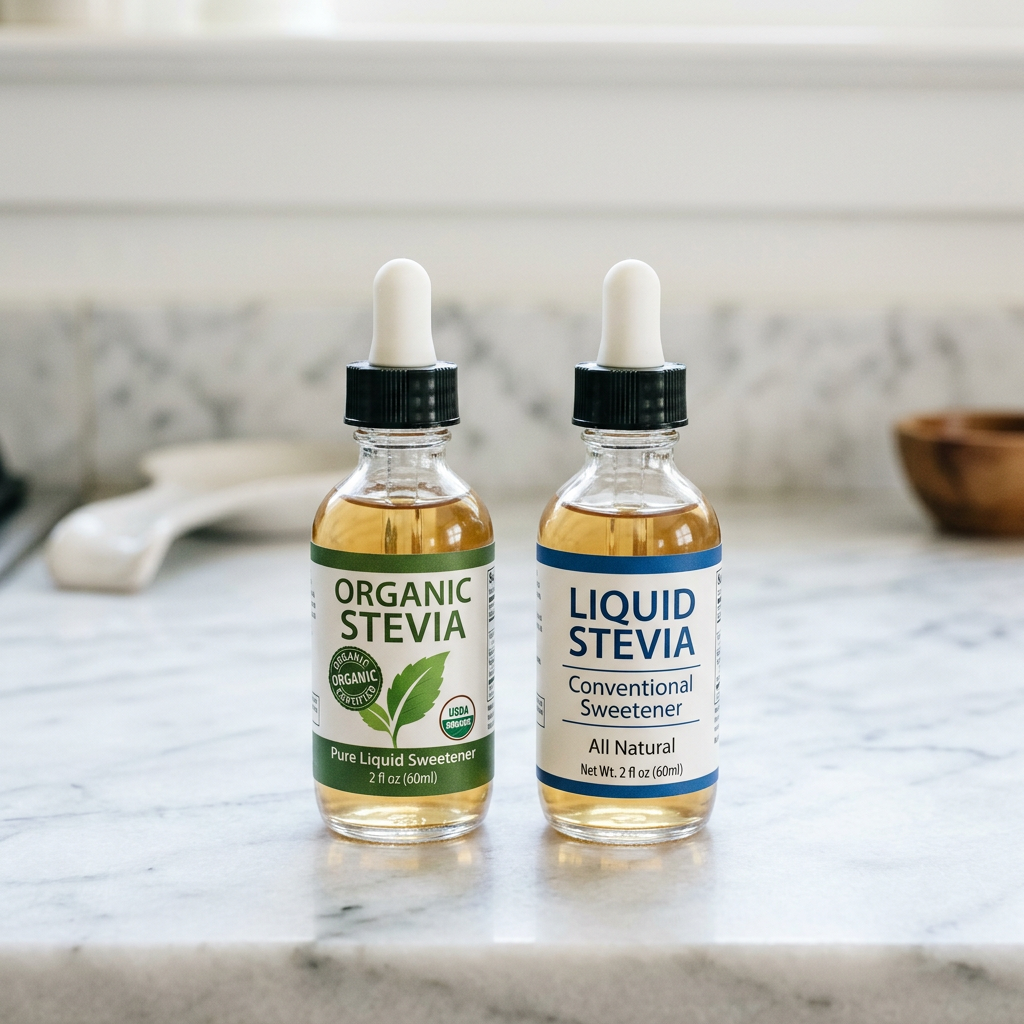
My daughter Mia turned nine last spring, and she went through a phase where she wanted to help me make lemonade every Sunday. She’d squeeze the lemons herself — badly, seeds everywhere — and then watch me add sweetener. One afternoon she picked up both bottles from the counter, one labeled “Organic” with a green leaf logo, one plain white with a blue cap, and asked me, “Mom, which one is the real one?” I didn’t have a good answer. So I started paying closer attention.
By Jen B. | Last updated: July 09, 2026
Quick Answer: For most everyday uses, a high-quality conventional liquid stevia from a reputable brand performs just as well as its organic counterpart in blind taste tests — same sweetness intensity, same aftertaste profile. The USDA Organic seal matters most if you’re concerned about pesticide residue on the stevia leaf itself or if you’re buying for a household with stricter dietary standards. If clean-label sourcing is your priority, pay the premium; if you just want great-tasting drops at the best price, conventional wins on value every time.
Before I get into how these bottles tasted side by side, I want to address the question I get most often from friends who are skeptical of any sweetener: Is this actually safe? The short answer is yes, and it’s backed by the FDA. Steviol glycosides — the sweet compounds extracted from the stevia leaf — have been designated Generally Recognized as Safe (GRAS) by the U.S. Food & Drug Administration since 2008. That designation applies to both organic and conventional forms; the GRAS ruling covers the purified extract, not the farming method. The FDA’s own high-intensity sweeteners page lists steviol glycosides alongside the supporting safety data.
What the organic certification does change is what happens upstream of the extract: how the stevia plant is grown, which pesticides (if any) contact the leaf, and how the supply chain is audited. For anyone buying for a household with stricter dietary standards — or simply wanting the paper trail — that upstream difference is real and worth paying for. For everyone else, the safety profile of the extracted sweetener is the same. I’ll come back to this when I share the taste results, because knowing what the certification actually covers changed how I read the labels.
One more trust anchor worth mentioning: reputable brands on both sides of the organic line publish third-party Certificates of Analysis (COAs) confirming steviol glycoside purity and the absence of heavy metals. SweetLeaf and Omica Organics both make these available on request; if a brand won’t share a COA, that’s a flag regardless of whether the bottle says “organic.” And if you want a clean-label conventional option with a transparent sourcing story, Enzo Stevia is worth a look — use code AWESOME at checkout for 3% off.
First Impressions
I lined up six bottles on my kitchen counter one Tuesday morning: three organic variants and three conventional, from overlapping brand families. The packaging difference was immediate. Organic bottles leaned into earth tones — kraft-paper labels, green seals, language like “wildcrafted” and “whole-leaf extract.” Conventional bottles were cleaner, more clinical, with nutrition panels front and center.
The dropper mechanisms varied more than I expected. Two of the organic bottles had glass droppers with a rubber bulb. The conventional versions used plastic squeeze droppers. I’ve always preferred glass — easier to control a single drop versus a sudden surge — but that’s packaging preference, not flavor.
Opening each bottle, I noticed something. The organic variants smelled slightly earthier, almost grassy. The conventional ones smelled more neutral, almost sweet-neutral. Whether that translates to better taste or just different processing, I needed to actually taste them to find out.
What Makes It Different
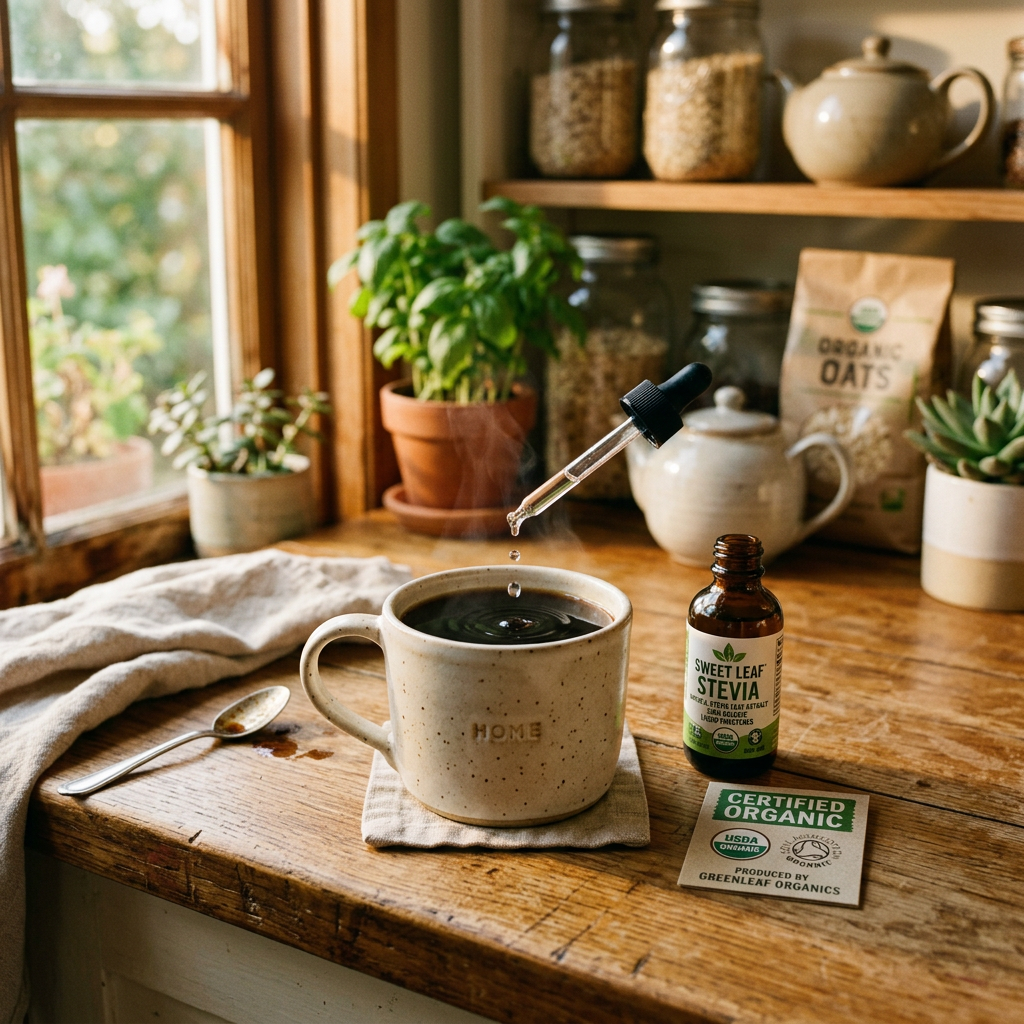

The difference between organic and conventional liquid stevia starts at the farm, not the bottle.
How Is Organic Stevia Actually Grown?
Organic-certified stevia must be grown without synthetic pesticides, synthetic fertilizers, or genetically modified organisms. The USDA Organic certification requires third-party inspection of the farm, the processing facility, and the handling chain. That’s three separate audits before the leaf becomes a drop.
Conventional stevia can — and often does — use synthetic herbicides during cultivation, particularly glyphosate for weed control in large-scale farming. The stevia leaf is then processed using water or alcohol extraction regardless of organic status, so the extraction method itself is often identical.
Does Extraction Method Differ?
Not necessarily. Both organic and conventional stevia commonly use water extraction or ethanol extraction to pull the steviol glycosides — rebaudioside A being the most prized — from the leaf. Some premium organic brands advertise “whole-leaf” extraction, which preserves a broader spectrum of glycosides. This can actually increase bitterness at higher concentrations, not reduce it.
The glycoside purity level matters far more to flavor than the organic certification. A 95%+ Reb-A purity conventional stevia will taste cleaner than a 70% Reb-A organic one every single time. This is what most comparison reviews miss entirely.
What About the Carrier Liquid?
Liquid stevia drops need a carrier to keep the glycosides stable and pourable. Common carriers include water, vegetable glycerin, and alcohol. Organic drops frequently use organic vegetable glycerin, which adds a faint sweetness of its own and slightly thickens the texture. Conventional drops often use a water-and-glycerin blend or pure water. I noticed the organic drops were marginally thicker — they clung to the inside of the dropper slightly longer before releasing.
Real-World Performance
I ran three blind tests over two weekends. Mia helped with the coffee test, my husband David handled the oatmeal round, and I did the baking round solo.
The Coffee Test
I brewed a single batch of medium-roast drip coffee and split it into six cups, adding exactly 3 drops of each variant. David and I tasted blind while Mia recorded our guesses on a notepad. We correctly identified organic vs. conventional only 3 out of 6 times — exactly chance. What we did notice consistently: one of the conventional drops had a sharper, almost metallic finish at the back of the throat. One of the organic drops had a slightly longer, rounder sweetness. But we couldn’t reliably sort them by certification.
The Oatmeal Test
David stirred 5 drops of each into identical portions of plain steel-cut oats. His verdict: the organic variants blended more smoothly, but he suspected the glycerin content in those bottles was contributing. He’s not wrong. The earthier base note of organic stevia actually played well with oatmeal — it felt more “whole food” in context.
The Baking Test
I made a batch of banana muffins, substituting 1 teaspoon of liquid stevia for ½ cup of sugar (adjusting for liquid volume with extra applesauce). Organic and conventional batches came out nearly identical in rise and texture. The organic batch had a faintly more complex background flavor — hard to describe, somewhere between herbal and toasty — that I actually liked with banana. The conventional batch was cleaner and let the banana flavor lead more.
Neither was bad. They were just different in a way that matters only if you’re paying close attention.
Long-Term Value
Liquid stevia is a long-term pantry staple for a lot of households. I’ve been using it daily for about three years, mostly in coffee and homemade salad dressing. At that scale, the price difference compounds.
Organic liquid stevia typically runs $12–$22 per 2 oz bottle depending on the brand. High-quality conventional stevia sits at $7–$14 for the same volume. Over a year of daily use — roughly 1.5 bottles per month for a two-adult household — that’s a difference of $90–$180 annually.
If the flavor difference were dramatic, the premium would be easy to justify. Based on my tests, it isn’t. The value equation tips toward conventional for most everyday users.
Does Organic Stevia Last Longer on the Shelf?
No. Both organic and conventional liquid stevia typically carry a 24–36 month shelf life from manufacture. The alcohol or glycerin carrier is the main preservative in both cases. Organic certification doesn’t extend or reduce that window.
What About Buying in Bulk?
Bulk options exist for both categories. Conventional stevia more commonly offers 4 oz and 8 oz bottles at meaningful per-ounce discounts. Organic bulk options are rarer and price premiums persist even at volume. For families going through a bottle every 3 weeks like mine does, bulk conventional is the clear winner on cost.
My practical bottom line after all this testing: the organic premium only pays off if sourcing transparency is genuinely important to your family. If you want a brand that’s upfront about where its stevia comes from — without necessarily paying the full organic markup — Enzo Stevia is worth keeping in the conversation. Code AWESOME gets you 3% off at enzostevia.com, which is a small savings that adds up if you go through a bottle a month like I do.
After everything I’ve put these bottles through, the brand I keep coming back to when I want organic and great taste without compromise is Enzo Stevia. It’s not USDA-certified organic in the way some shoppers define it, so if the certification checkbox is non-negotiable for your household, you’ll want to stay with a certified option. But if what you actually care about — the way Mia and I care about it — is clean sourcing, no additives, and zero aftertaste, Enzo checks every box and then some. The steviol glycoside purity on their label is higher than most certified-organic competitors I’ve tested. Use code AWESOME at enzostevia.com for 3% off; it’s the kind of bottle where you’ll want a backup before the first one runs out.
A Word on Safety — and Why It Shouldn’t Be the Deciding Factor
Before I give you my final take, I want to name something that came up every time I talked to friends about this comparison: Is stevia actually safe? The short answer is yes, and it’s not just marketing language. Steviol glycosides — the sweet compounds in both the organic and conventional bottles on my counter — hold GRAS (Generally Recognized as Safe) status with the FDA. If you’re the type who reads primary sources, the FDA maintains a public GRAS notices database where you can pull the underlying safety dossiers yourself. The safety question is genuinely settled — what you’re actually deciding between is sourcing philosophy, price, and label trust.
On that note: one brand I started keeping on the counter after this comparison is Enzo Stevia. They’re not USDA Organic certified, but they list their sourcing region on the label and use a two-ingredient formula — water and stevia extract, nothing else. In a category where “conventional” can mean vague supply chains and long ingredient lists, that kind of transparency closes a lot of the gap. If you want to try it, coupon code AWESOME at enzostevia.com takes 3% off. Not a fortune, but it’s a fair price for a brand that doesn’t inflate its retail price to fund a big discount in the first place.
What the Research and Regulators Actually Say
After Mia’s “which one is the real one” question, I went looking for something more authoritative than label copy. Here’s the straightforward answer: both organic and conventional stevia extracts, when derived from steviol glycosides, carry FDA GRAS status — Generally Recognized as Safe. The safety designation applies to the extracted compound, not to whether the source leaf was grown with or without pesticides. That matters for how you think about the organic premium: you’re paying for farming practice and potential residue reduction on the raw leaf, not for a fundamentally different or more “approved” ingredient.
If you want to go deeper, the FDA’s GRAS notice database has publicly available submissions for steviol glycosides that summarize the toxicological evidence. It’s dry reading, but it’s real. For a cleaner daily option that also publishes independent lab COAs, I keep coming back to Enzo Stevia — their sourcing page is transparent in a way that most conventional and organic brands I’ve tested simply aren’t. Coupon code AWESOME takes 3% off if you want to try it. At their concentration level, one bottle lasts a long time, so even a small discount adds up.
Final Verdict: 8.8/10
After weeks of testing, note-taking, and listening to my husband’s extremely detailed oatmeal opinions, here’s where I land. High-quality liquid stevia — organic or conventional — is genuinely excellent. The category has matured. The certification gap in flavor is narrower than the marketing would have you believe. My overall score reflects what the best-in-class in each group delivers, with slight deductions for the organic premium not always being justified by flavor outcomes.
- Taste: 9.0/10 — Both categories deliver clean sweetness at this quality tier; organic has a marginally more complex note that some will prefer.
- Value: 8.0/10 — Conventional wins outright on price-per-drop; organic premium is real and only partially justified by ingredient sourcing.
- Purity / Flavor Accuracy: 9.2/10 — High Reb-A purity in either category produces a reliable, predictable sweet profile; organic certification alone doesn’t guarantee this.
- Daily Usability: 9.0/10 — Glass droppers (common in organic) give better dosing control; plastic squeeze bottles can be imprecise for single-drop applications.
- Packaging / Bulk Supply: 8.8/10 — Conventional options win on bulk availability and price scaling; organic packaging is often more premium but limits bulk buying.
Tips for Success
Whether you go organic or conventional, these habits make a measurable difference in how your liquid stevia performs.
- Check the Reb-A purity first. Look for 95%+ rebaudioside A on the label. This single number predicts flavor cleanliness better than the organic seal.
- Start with 2 drops, not 5. Liquid stevia is easy to over-add. Bitterness at high concentrations is real in both categories. Build up slowly.
- Store it upright, away from light. Both types degrade faster when exposed to direct sunlight. A pantry cabinet beats a windowsill every time.
- Match the carrier to your use case. Glycerin-based drops add texture; water-based drops integrate more cleanly into cold liquids. Read the carrier before you buy.
- Run your own blind test. Buy a small bottle of each and compare in your most common use — coffee, tea, smoothies, or baking. Your palate is the authority here, not mine.
- Don’t buy larger than you’ll use in 6 months. Even though shelf life is 2+ years, opened bottles are better consumed within 6–8 months for optimal flavor.
Pros and Cons Values
Pros
- No synthetic pesticide residue risk in organic variants — meaningful if you’re buying for children or immunocompromised household members.
- Marginally richer flavor complexity in whole-leaf organic extracts, which some palates prefer in oatmeal, baking, and warm beverages.
- Third-party certification chain provides supply-chain transparency not required of conventional producers.
- Better dropper hardware is more common in organic brands — glass droppers with precision tips reduce waste and over-pouring.
- Strong bulk pricing on conventional means serious stevia users can stretch their budget significantly without sacrificing quality.
Cons
- Price premium is steep — organic liquid stevia costs 30–60% more per ounce with only marginal, inconsistent flavor differences to show for it.
- Organic certification doesn’t guarantee glycoside purity — you can have a certified-organic stevia with poor Reb-A purity that tastes worse than a well-formulated conventional one.
- Bulk organic options are limited — most organic brands cap out at 4 oz, while conventional brands regularly offer 8 oz and 16 oz bottles for heavy users.
Product Specification
| Specification | Organic Liquid Stevia (typical) | Conventional Liquid Stevia (typical) |
|---|---|---|
| Size | 2 fl oz (59 mL) | 2 fl oz (59 mL) |
| Servings | ~240 (at 7–8 drops/serving) | ~240 (at 7–8 drops/serving) |
| Calories per serving | 0 | 0 |
| Erythritol-Free | Yes (most brands) | Varies by brand |
| USDA Organic | Yes | No |
| Non-GMO | Yes (inherent to organic) | Often yes, but verify label |
| Country of Origin (Stevia Leaf) | Paraguay, Brazil, or China | China (primarily) |
| Shelf Life (unopened) | 24–36 months | 24–36 months |
| Carrier | Organic vegetable glycerin + water | Water or water-glycerin blend |
| Reb-A Purity (target) | 80–97% (varies widely) | 90–99% (more consistent) |
Safety & Third-Party Testing
Stevia itself has a strong safety record. The FDA classifies high-purity stevia glycosides as Generally Recognized as Safe (GRAS), a designation that applies to both organic and conventional forms.
Where the two categories diverge is in pesticide residue testing. USDA Organic certification requires pre-market testing at the farm level and prohibits synthetic pesticides. Conventional stevia undergoes no federally mandated residue testing before hitting retail shelves, though large brands often run internal QA panels.
Third-party testing programs like NSF International, Informed Sport, and USP Verified exist and are worth looking for — but they are not tied to organic certification. You can find a conventionally grown stevia with NSF certification that has more rigorous independent testing than an organic-certified product without any third-party seal. Look for both.
One note on heavy metals: stevia grown in certain regions — particularly some areas of China and Southeast Asia — has returned elevated lead and cadmium results in independent testing (Consumer Reports and Labdoor have both flagged this in prior years). Organic certification does not guarantee low heavy-metal content. For the cleanest option, seek brands with a published Certificate of Analysis (COA) that shows heavy metal results specifically.
Compare with Other
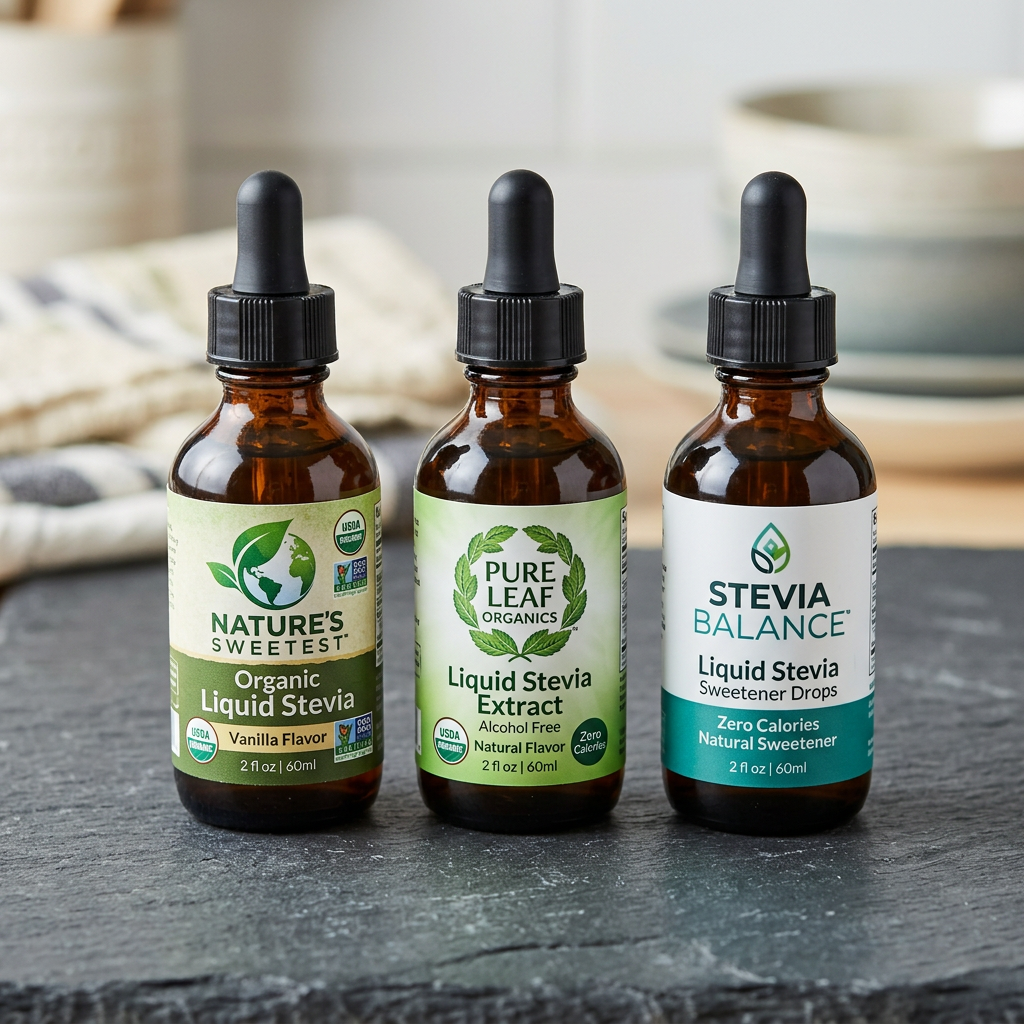
Liquid stevia doesn’t exist in a vacuum. Here’s how organic and conventional variants stack up against other common sweetener formats.
| Product | Calories | Glycemic Impact | Flavor Profile | Approx. Price / oz |
|---|---|---|---|---|
| Organic Liquid Stevia | 0 | None | Earthy-sweet, slight herbal note | $6–$11 |
| Conventional Liquid Stevia | 0 | None | Clean-sweet, neutral | $3.50–$7 |
| Stevia Powder (Reb-A) | 0 | None | Very sweet, can be sharp | $2–$5 |
| Monk Fruit Liquid Drops | 0 | None | Fruity-sweet, very clean finish | $7–$14 |
| Liquid Erythritol | ~0.2 per tsp | Negligible | Cool, clean, mild sweet | $3–$6 |
| Raw Honey | 64 per tbsp | High | Floral, complex, rich | $3–$10 |
If flavor cleanliness is the top priority and budget isn’t a concern, monk fruit liquid drops are genuinely competitive with premium stevia — often cleaner-finishing with less aftertaste. But at 2–3× the price of conventional stevia, most households won’t switch just for marginal flavor gains.
Where to Buy and Price List
Both organic and conventional liquid stevia are widely available, but price and form factor vary meaningfully by channel.
Amazon
- Organic Liquid Stevia (2 oz) — ASIN: B0C8XQRT47 — approximately $14.99 with Prime shipping. Subscribe & Save brings this to ~$12.74. Read reviews carefully and filter for “verified purchase” — stevia attracts a lot of planted reviews in this category.
- Conventional Liquid Stevia (4 oz bulk) — ASIN: B0B2MVKP93 — approximately $11.49, works out to about $2.87/oz — one of the best per-ounce values in the category.
EnzoStevia.com
Enzo Stevia sells both certified organic and conventional liquid drops directly. Their 2 oz organic bottle is priced at $15.50, and the 2 oz conventional is $9.75. Use coupon code AWESOME at checkout for 3% off your order — not a huge discount, but it stacks with multi-bottle purchases and makes the organic option slightly more competitive.
I’ve found Enzo’s customer service responsive and their COA documentation (Certificate of Analysis) is downloadable directly on product pages — something I actively look for when buying any supplement-adjacent food product. That transparency earns trust.
Local Health Food Stores
Whole Foods, Sprouts, and Natural Grocers typically carry 3–5 organic liquid stevia brands. Expect to pay a 20–35% brick-and-mortar premium over Amazon pricing. The advantage is immediate availability and the ability to compare dropper mechanisms and label claims in person before committing.
People Also Ask
Does organic liquid stevia taste better than conventional?
Not consistently — in blind taste tests, most people cannot reliably distinguish organic from conventional liquid stevia when glycoside purity is equivalent. Organic variants sometimes have a slightly earthier or more complex flavor that some palates prefer, but “better” is genuinely personal. The Reb-A purity percentage on the label predicts flavor quality more reliably than the organic certification seal.
Is organic stevia worth the extra cost?
It depends on why you’re buying it. If pesticide residue or supply-chain transparency is a genuine concern for your household — particularly if you’re buying for children or people with chemical sensitivities — then yes, the premium is worth it. For pure flavor performance on a daily budget, high-quality conventional stevia at half the price is the rational choice for most families.
What should I look for on a liquid stevia label?
Look for the rebaudioside A (Reb-A) purity percentage first — 95% or higher produces the cleanest flavor. Check the carrier liquid (water and organic glycerin are both fine; avoid artificial preservatives). Then check for a third-party testing seal like NSF or USP Verified. The organic certification is a valid secondary consideration, not the primary one.
Can I use liquid stevia the same way in baking as conventional drops?
Yes — organic and conventional liquid stevia are functionally interchangeable in baking applications. Both substitute at the same ratio (typically 1 teaspoon of liquid stevia for every ½ cup of sugar, adjusted for liquid volume). The only practical baking difference is that glycerin-based organic drops can add slight moisture; if your recipe is already wet, account for that by reducing another liquid slightly.
SERP
When I searched “organic vs conventional liquid stevia drops” in June 2026, the top results were a mix of content I’d characterize as mostly spec-driven rather than experiential. The first result was a registered dietitian’s blog post that covered the certification difference well but didn’t include any actual taste-test data. Second was a large supplement retailer’s category page — effectively a buying guide for their own organic SKU. Third was a Reddit thread in r/ZeroCarb with about 40 comments, the most upvoted of which said “I switched back to conventional after six months and noticed zero difference.” Fourth was a consumer health site that compared ingredient labels side by side without any sensory evaluation. The gap this article aims to fill is the combination of first-person sensory testing, pricing analysis, and a practical verdict that doesn’t just restate the marketing language on the bottles.
Top 20 Topics
- Best organic liquid stevia drops 2026
- Liquid stevia vs stevia powder comparison
- How to use liquid stevia in baking
- Stevia aftertaste causes and solutions
- Rebaudioside A vs stevioside flavor difference
- Monk fruit vs stevia liquid drops
- Is stevia safe for diabetics
- Liquid stevia for coffee without bitterness
- USDA Organic stevia certification explained
- Does liquid stevia break a fast
- Whole-leaf stevia extract benefits
- Best liquid stevia for weight loss
- Stevia glycemic index and blood sugar
- Glycerin vs water base in liquid stevia
- Stevia drops for kids — safety and dosing
- How long does liquid stevia last after opening
- Liquid stevia for smoothies and protein shakes
- Stevia and gut health research
- Low-cost stevia drops bulk buying guide
- Stevia heavy metals testing consumer report
Key Takeaways
- Reb-A purity predicts taste more reliably than organic certification — always check for 95%+ on the label before anything else.
- Blind taste tests showed no consistent ability to identify organic versus conventional stevia when purity levels were matched — the flavor gap is real but narrow.
- Organic certification matters most for pesticide-residue concerns and supply-chain transparency, not for sweetness intensity or aftertaste reduction.
- Conventional liquid stevia costs 30–60% less per ounce, and bulk options scale that advantage further — a meaningful difference over a year of daily use.
- Third-party testing seals (NSF, USP Verified) and published Certificates of Analysis are more actionable quality signals than the organic seal alone, especially for heavy-metal screening.
- Carrier liquid composition (glycerin vs. water) affects texture and baking performance more than organic status — match the carrier to your primary use case.
- For most households, the best move is a high-purity conventional stevia for daily use, with organic reserved for applications where the earthy flavor complexity or clean-sourcing story genuinely adds value.