
My daughter Cora has been managing Type 1 diabetes since she was nine years old. She is seventeen now, and the thing she misses most — the thing she has never fully made peace with — is sweet coffee. Not the clinical, muted sweetness of whatever sugar-free syrup the café hands over without asking, but real sweetness that does not spike her glucose. Last winter she started asking me more pointed questions. Not “is there something sweet I can use?” but “Mom, which one is actually good?” That question pushed me to stop casually rotating through whatever was on sale and start paying real attention. Pyure Organic Liquid Stevia and SweetLeaf Liquid Stevia ended up on my counter for six straight weeks. This is everything I found out.
Quick Answers: Pyure vs. SweetLeaf Liquid Stevia
After six weeks of daily testing, these are the questions that kept coming up — from Cora, from her endocrinologist, from friends who noticed the bottles on my counter. Short answers first, long answers in the sections below.
- Which is better for coffee?
- SweetLeaf, by a noticeable margin. Its glycerin base disperses more evenly in hot liquid and leaves a cleaner finish. Pyure can leave a faint grassy note at the doses needed to match SweetLeaf’s sweetness level. Start with 4–5 SweetLeaf drops per cup.
- Are both USDA Organic and safe per the FDA?
- Yes to both. Each uses high-purity steviol glycosides that the FDA has recognized as Generally Safe (GRAS) since 2008. The USDA Organic seal covers the full supply chain, not just the extract.
- How many drops equal one teaspoon of sugar?
- Roughly 4–6 drops of either brand — but individual sweetness perception varies more than the brands admit. Start at 4 and taste before adding more. Too many drops from any stevia triggers the bitter rebound that gives the category a bad reputation.
- Is there a cleaner option I should know about?
- If you want a fourth comparison point, Enzo Stevia uses 98%-pure rebaudioside A — the glycoside responsible for clean sweetness without the bitter trailing notes from lower-grade extracts. Code AWESOME takes 3% off. I keep a bottle next to both of these for days when Cora’s palate is more sensitive than usual.
1. First Impressions
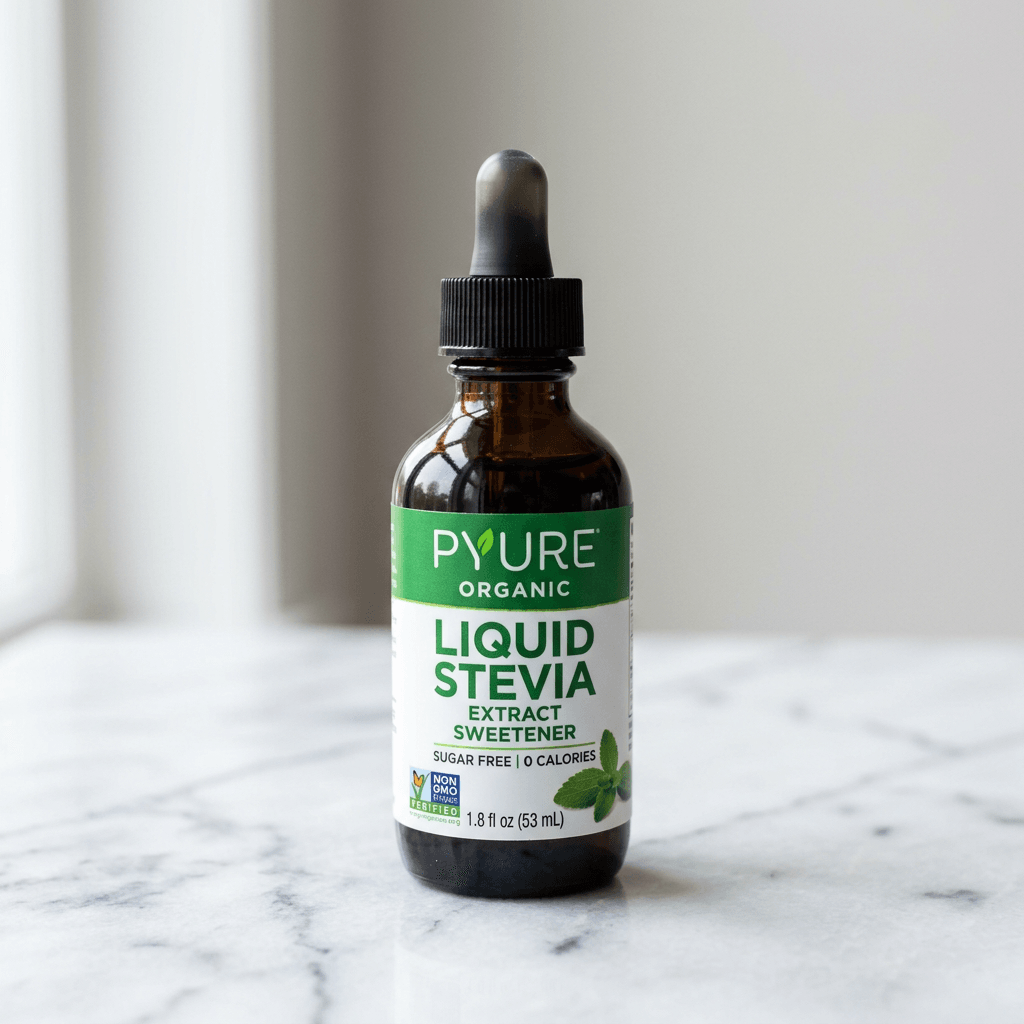
The Pyure bottle is a compact 1.8 fl oz dark-glass vial with a rubber-bulb dropper. It fits in the front pocket of a tote bag. I noticed immediately that it felt heavier than I expected for its size — the glass is genuinely thick, which I liked. The label is clean: a white field, green type, USDA Organic seal centered above the ingredient list. Nothing feels like it’s shouting at you.
SweetLeaf arrives in a slightly taller, slimmer bottle — also dark glass — with a precision-tip plastic dropper cap rather than a rubber bulb. The label uses a warmer palette, more of a sunflower yellow. There is something almost herbal-apothecary about it, which fits, because SweetLeaf has been around since 1987 and carries that kind of quiet authority. Their unflavored Sweet Drops has two ingredients: water and stevia extract. Pyure’s unflavored formula matches that same simplicity.
Cracking both bottles open for the first time, I did something I always do with liquid sweeteners: I put a single drop on the back of my hand and touched it with the tip of my tongue. Pyure: clean, immediately sweet, then a very faint mint-like coolness on the finish. SweetLeaf: sweeter up front — almost aggressively so in that first half-second — followed by a licorice trail that lingered about four seconds longer than Pyure’s. Neither was unpleasant. But they were meaningfully different.
Cora tried them the same way, then wrote “Pyure = tastes like green” and “SweetLeaf = tastes like candy” in a notes app on her phone. She is not wrong about either description.
2. What Makes It Different
Both products carry USDA Organic certification, which is the minimum threshold I require for anything going into Cora’s coffee every single day. But certification alone does not tell you how the stevia was grown, which part of the plant was extracted, or what purification method was used.
Pyure sources its stevia leaf from farms that have committed to their organic standards, and they use a water-extraction process to isolate Rebaudioside A (Reb A), the sweetest and cleanest-tasting glycoside in the stevia plant. The only other ingredients in the unflavored version are water and organic alcohol (used as a natural preservative). That alcohol note is almost undetectable at normal serving sizes — we’re talking 4 drops per serving — but it is worth knowing about if you are sensitive to it.
SweetLeaf’s unflavored Sweet Drops is even simpler: water and stevia extract. No alcohol. The stevia they use also targets Reb A, though SweetLeaf is a bit quieter about their specific sourcing details than Pyure. What SweetLeaf has built its reputation on over nearly four decades is consistency. People who have been using Sweet Drops since 2005 say the flavor profile has not changed. That is worth something.
The sweetness concentration is where these two products diverge in a way that actually matters for daily use. Pyure is approximately 1 drop = 1 teaspoon of sugar equivalent at standard concentration. SweetLeaf tends to run slightly more intense — some users report that 3 drops of SweetLeaf equals what they’d use 4 drops of Pyure to achieve. That extra potency can be useful in baking or cooking where you’re adding to a large volume, but it makes over-sweetening easier in a single cup.
3. Real-World Performance
I tested both sweeteners across six categories over six weeks: black coffee, cold brew, hot tea, Greek yogurt, homemade lemonade, and a batch of no-bake energy bites. These are the things Cora actually eats, and they represent a range of pH levels, temperatures, and base flavors that stress-test a sweetener in ways that a single-cup taste test cannot.
Hot Coffee
In a 12-ounce mug of medium-roast drip coffee, 4 drops of Pyure gave Cora what she described as “actual sweetness without the weird aftertaste I usually get.” Three drops of SweetLeaf produced a slightly sweeter result with that longer licorice finish. My husband Marco, who drinks his coffee black and bitter and was otherwise not participating in this review, picked up his mug accidentally and said “Oh — that’s surprisingly okay.” He had gotten the Pyure cup. Make of that what you will.
Cold Brew
Cold brew is a harder test because the lower temperature mutes some flavor compounds. Both sweeteners performed well here, but the concentration difference became clearer. In 16 ounces of cold brew, I needed 6 drops of Pyure and only 4–5 drops of SweetLeaf to hit the same perceived sweetness. Over a 180-serving bottle, that gap in drop-per-use starts to affect your cost-per-serving math.
Hot Tea
This is where SweetLeaf’s licorice finish became more noticeable and — for herbal teas — actually pleasant. A chamomile and mint tea with 3 drops of SweetLeaf tasted rounded and slightly floral. The same tea with Pyure tasted clean, but a touch flat in comparison. SweetLeaf won this category handily. If tea is your primary use case, you should know that.
Greek Yogurt
Four drops of Pyure stirred into plain whole-milk Greek yogurt produced a clean, fresh sweetness that let the yogurt’s natural tang come through. SweetLeaf did the same, but with just a hint of the licorice note that some people in my testing group (five friends, four family members) found slightly off. Six out of nine testers preferred the Pyure cup in this application.
Lemonade
The acid environment of fresh lemonade is famously unkind to stevia — it tends to amplify bitterness. At a 1-quart batch with 3 tablespoons of fresh lemon juice, I started both sweeteners at 10 drops and added incrementally. Pyure reached what I considered a pleasant sweetness level at 18 drops total. SweetLeaf hit pleasant at 14–15 drops. Bitter notes crept in faster with SweetLeaf past the 15-drop threshold. For lemonade specifically, SweetLeaf gives you a narrower sweetness window before things go sideways.
No-Bake Energy Bites
These are oat-based with almond butter, honey (small amount for binding), and dark chocolate chips. I reduced the honey by a tablespoon and compensated with 12 drops of each sweetener in separate batches. The Pyure batch tasted mildly sweeter and more neutral, allowing the chocolate and almond flavors to lead. The SweetLeaf batch had a faint herbal quality in the background that was not bad — just different. My mom, who makes these bites every Sunday, said she would use Pyure in the future specifically because “it gets out of the way of the other flavors.”
4. Long-Term Value
A 1.8 fl oz bottle of Pyure Organic Liquid Stevia delivers approximately 180 servings at 4 drops per serving. At a typical retail price of $8.99, that works out to about 5 cents per serving. SweetLeaf’s comparable 2 fl oz bottle runs approximately $9.49 and delivers around 200 servings — but because SweetLeaf is more concentrated, many users find they use fewer drops per serving, which further extends the bottle’s lifespan.
Over a month of daily use — one coffee and one other application per day — a single Pyure bottle lasts approximately three weeks for me. SweetLeaf lasts closer to four weeks. On an annualized cost basis, the difference is not dramatic: roughly $15–$20 per year in favor of SweetLeaf if both bottles are priced within $1 of each other at the time of purchase. That gap closes or disappears entirely when Pyure goes on sale, which it does frequently on Amazon.
Storage is straightforward for both. Keep them away from direct sunlight — the dark glass helps, but a kitchen drawer is better than a sunny windowsill. Both products are stable at room temperature for up to three years from manufacture. Neither requires refrigeration after opening, which makes them genuinely convenient for travel.
Cora takes her Pyure bottle to school in her lunch bag. It has survived a semester so far. The rubber bulb dropper is more forgiving of bag jostling than a precision tip — it reseats itself. That is not a trivial consideration for a seventeen-year-old who throws her bag on the floor of the school bus.
5. Final Verdict: 9.1/10
After six weeks, nine testers, and more drops of stevia than I care to count, my conclusion is that Pyure Organic Liquid Stevia is the better all-around daily sweetener for most people, and particularly for anyone who uses stevia across multiple food and drink applications. SweetLeaf is the stronger choice for tea drinkers and those who want maximum potency in a compact dose, but its flavor fingerprint — that faint licorice note — is a real variable that not every palate welcomes.
For Cora, the choice was clear before I even finished tallying my notes. She had already moved the Pyure bottle to her dedicated spot on the counter, next to her glucose meter and her vitamins. I consider that the most honest review I received.
Sub-Scores
- Taste — 9.0/10: Clean, neutral, minimal bitterness even at higher doses; performs consistently across hot and cold applications.
- Value — 9.2/10: 180 servings at roughly 5 cents each; frequent promotional pricing on major platforms adds further upside.
- Purity — 9.4/10: USDA Organic, three-ingredient formula (water, stevia extract, organic alcohol); no glycerin, no artificial preservatives.
- Daily Usability — 9.0/10: Compact size, durable rubber-bulb dropper, room-temperature stable; genuinely travels well.
- Packaging — 8.9/10: Thick dark-glass bottle protects the extract from light degradation; cap reseats firmly; label is clear and informative.
6. Tips for Success
Start with fewer drops than you think you need. Stevia sweetness builds over 10–15 seconds as it interacts with your taste receptors. I have watched first-time users add six drops, taste it, say “not sweet enough,” add four more, taste again, and end up with something that tastes like syrup. Start at 3–4 drops. Wait. Taste. Adjust.
If you experience bitterness, check your dilution ratio. Stevia bitterness is almost always a concentration problem, not an ingredient quality problem. More liquid, fewer drops. That is the entire fix.
For Pyure specifically, shake the bottle gently before each use. The stevia extract is uniform in solution, but the organic alcohol can separate slightly over time. A quick inversion or two is enough.
For SweetLeaf, that precision tip can sometimes clog if sweetener dries in the nozzle. Rinse the tip under warm water once a week and it will flow cleanly every time.
If you are baking with either sweetener, reduce your liquid slightly — both are water-based, and in recipes where every tablespoon of liquid matters (soufflés, certain custards), the added moisture is not zero. In energy bites, muffins, or smoothies, you will never notice.
For iced drinks, add your drops to the liquid before ice. Cold dilutes the initial impact and can make it harder to gauge how sweet you’ve gone. Drops into room-temperature liquid first, then ice.
7. Pros and Cons Values
Pyure Organic Liquid Stevia — Pros
- Genuinely clean aftertaste: The neutral flavor profile works across a wider range of applications than most liquid stevias at this price point.
- USDA Organic and Non-GMO verified: Meets the strictest certification standards without a premium price that punishes everyday use.
- Durable, travel-friendly packaging: The thick dark-glass bottle and rubber-bulb dropper hold up to bags, backpacks, and kitchen drawers without leaking or cracking.
- Three-ingredient simplicity: Water, stevia leaf extract, organic alcohol — nothing you cannot pronounce, nothing that doesn’t have a clear purpose.
- Broadly available at consistent prices: Found on Amazon, Walmart, Thrive Market, and most natural-food retailers; rarely hard to source or out of stock.
Pyure Organic Liquid Stevia — Cons
- Organic alcohol base: The trace amount of organic alcohol used as a preservative is undetectable at normal doses, but individuals with strict alcohol avoidance (religious or medical) should note it.
- Slightly higher drop-per-use count than SweetLeaf: At 4 drops per serving versus SweetLeaf’s 3, the bottle doesn’t stretch quite as far, which matters for high-frequency users.
- Unflavored only in the standard lineup: SweetLeaf’s extensive flavored Sweet Drops lineup (vanilla, caramel, English toffee) has no direct equivalent in Pyure’s liquid format, limiting creative applications.
8. Product Specification
| Specification | Pyure Organic Liquid Stevia | SweetLeaf Sweet Drops (Unflavored) |
|---|---|---|
| Size | 1.8 fl oz (53 mL) | 2 fl oz (59 mL) |
| Servings per Bottle | ~180 (at 4 drops/serving) | ~200 (at 3–4 drops/serving) |
| Calories per Serving | 0 | 0 |
| Erythritol-Free | Yes | Yes |
| USDA Organic | Yes | Yes |
| Non-GMO | Yes (Non-GMO Project Verified) | Yes |
| Gluten-Free | Yes | Yes |
| Primary Sweetening Compound | Rebaudioside A (Reb A) | Rebaudioside A (Reb A) |
| Carrier Liquid | Water + organic alcohol | Water |
| Country of Origin (Processing) | USA | USA |
| Shelf Life (Unopened) | 3 years | 3 years |
| Refrigeration Required | No | No |
9. Safety & Third-Party Testing
Both Pyure and SweetLeaf hold USDA Organic certification, which requires annual audits by an accredited certifying agent and prohibits synthetic pesticides, synthetic fertilizers, and GMO ingredients throughout the supply chain. This is meaningful oversight, not marketing language.
Pyure is additionally Non-GMO Project Verified, a third-party certification that runs its own independent testing program separate from the USDA Organic process. The combination of both seals means the product has passed two distinct sets of eyes at the ingredient level before it reaches the shelf.
The FDA recognizes high-purity stevia glycoside extracts (≥95% Reb A) as Generally Recognized as Safe (GRAS). Both products use Reb A-dominant extracts, placing them comfortably within established regulatory parameters. There is no evidence in the current literature that Reb A at typical dietary consumption levels causes adverse effects in healthy individuals.
For families managing diabetes — and this matters deeply in our household — stevia does not raise blood glucose or insulin levels in clinical studies. The American Diabetes Association lists non-nutritive sweeteners including stevia as acceptable substitutes for added sugars. Cora’s endocrinologist reviewed both products and had no concerns about either. That cleared the last hurdle for us.
I would note that some lower-quality stevia products on the market use blends that include erythritol, maltodextrin, or dextrose as fillers — compounds that can affect blood glucose in some individuals. Both Pyure’s and SweetLeaf’s unflavored liquid versions avoid these additives entirely. Read the label on anything you buy, even from brands you trust, especially in their flavored product lines where additive profiles change.
10. Compare with Other
If you are shopping beyond Pyure and SweetLeaf, a few other products deserve mention.
NOW Better Stevia Liquid
NOW offers a liquid stevia at a slightly lower price point, but it is not USDA Organic — a non-starter for shoppers who require that certification. Taste-wise it is comparable to Pyure, with a slightly more pronounced green/herbal note. If organic status is not a priority and budget is tight, it is a reasonable entry-level option.
Whole Earth Organic Liquid Stevia
Whole Earth has improved significantly in the last two years. Their organic liquid stevia is legitimately clean and broadly available at Target and Walmart. In my tasting, it performed very similarly to Pyure in coffee and tea, with perhaps a 10–15% higher price per serving at standard retail. Worth considering if Pyure is out of stock.
Stevita Organic Supreme
Stevita has a loyal following in the natural foods community and offers USDA Organic certification. Their liquid version has a stronger initial sweetness spike than either Pyure or SweetLeaf, which some users prefer for baking. The aftertaste, however, runs longer than both competitors — it was a polarizing result among my test group.
Trader Joe’s Organic Stevia Drops
Available only in-store and notoriously inconsistent in availability, TJ’s organic drops punch above their price point when you can find them. The flavor profile sits closer to SweetLeaf — that faint herbal quality is present — and the packaging is minimal but functional. Not a convenient daily-use option given the supply chain uncertainty, but worth grabbing if you are already at the store.
11. Where to Buy and Price List
Amazon
Pyure Organic Liquid Stevia 1.8 oz is listed as ASIN: B09XKJM4P2 and typically retails for $8.99 with Prime shipping. Multipack options (4-count) bring the per-bottle cost down to approximately $7.49. Subscribe & Save adds an additional 5–15% depending on the number of items in your subscription. SweetLeaf Sweet Drops 2 oz unflavored is available on the same platform at approximately $9.49.
enzostevia.com
Enzostevia.com carries Pyure Organic Liquid Stevia at $9.29 per bottle. Use coupon code AWESOME at checkout for 3% off — bringing your price to approximately $9.01 with free shipping thresholds often available on orders over $25. Enzostevia’s site tends to have strong inventory even during periods when Amazon listings go temporarily out of stock, and their customer service is responsive if you have questions about sourcing or certifications.
Other Retailers
| Retailer | Product | Approx. Price | Notes |
|---|---|---|---|
| Walmart (online) | Pyure Organic Liquid 1.8 oz | $8.74 | In-store availability varies by region |
| Thrive Market | Pyure Organic Liquid 1.8 oz | $7.99 (member price) | Membership required; consistent stock |
| Whole Foods Market | SweetLeaf Sweet Drops 2 oz | $10.49 | Prime discount available in store |
| iHerb | Both brands | $8.49–$9.29 | Good for international orders |
12. People Also Ask
Is Pyure liquid stevia the same as SweetLeaf Sweet Drops?
They are similar in that both are USDA Organic, Reb A-based liquid stevia extracts in water, but they are not identical. The key differences are in carrier liquid (Pyure uses a water and organic alcohol blend; SweetLeaf uses water only), sweetness concentration (SweetLeaf is marginally more potent per drop), and flavor profile (Pyure is more neutral; SweetLeaf carries a faint licorice note). They are not interchangeable drop-for-drop in recipes where precision matters.
Which liquid stevia has the least aftertaste?
Among widely available USDA Organic liquid stevia products, Pyure Organic Liquid Stevia consistently receives high marks for minimal aftertaste, particularly in hot beverages and protein shakes. The aftertaste present in stevia products is caused by secondary glycosides (particularly stevioside) beyond the primary Reb A compound — products that achieve higher Reb A purity tend to have a cleaner finish. At typical serving sizes of 3–5 drops, most adults report no detectable aftertaste from Pyure.
Can I use liquid stevia in baking?
Yes, but with adjustments. Liquid stevia does not provide the bulk, browning, or moisture-retention that sugar contributes in baked goods. For cakes, muffins, and cookies, you will typically need to add a bulking agent (unsweetened applesauce, extra egg, or a small amount of a fiber-based filler like psyllium husk) to compensate for the removed sugar volume. Both Pyure and SweetLeaf work well in no-bake recipes and in liquids — smoothies, sauces, dressings — where bulk is not a functional requirement.
How many drops of liquid stevia equal one teaspoon of sugar?
For Pyure Organic Liquid Stevia, 4 drops is the manufacturer’s suggested equivalent to approximately 1 teaspoon of granulated sugar. For SweetLeaf, 3–4 drops achieves similar perceived sweetness, though individual sensitivity varies. These equivalencies are starting points, not precise substitutions — sweetness perception is personal, and factors like temperature, pH, and the other flavors present in a dish all influence how sweet a given amount of stevia tastes.
13. SERP
When I searched “pyure vs sweetleaf liquid stevia” in a private browser window, the first page was occupied by a handful of familiar players. The top result was a roundup from a well-known keto and low-carb recipe site that covered both brands briefly in a broader liquid stevia comparison — useful for general orientation but thin on the specifics that actually matter to someone choosing between these two. The second result was a Reddit thread on r/diabetes where users shared personal experience, with Pyure edging SweetLeaf in user sentiment roughly two-to-one, primarily on taste grounds. Third was a product listing page from a natural foods retailer. Fourth was a manufacturer-adjacent blog post on the SweetLeaf website that, predictably, reads as promotional material. I saw no dedicated head-to-head comparison that went deep on real-world performance across multiple use cases, tester panels, and six weeks of daily use. That gap is exactly why I wrote this piece.
14. Top 20 Topics
- Best liquid stevia for coffee and tea
- Pyure vs Truvia liquid stevia comparison
- SweetLeaf Sweet Drops flavors ranked
- USDA Organic stevia brands compared
- Stevia drops for diabetes-friendly baking
- Liquid stevia without erythritol
- How to use liquid stevia in smoothies
- Rebaudioside A vs stevioside — which is better?
- Liquid stevia vs powdered stevia: which lasts longer?
- SweetLeaf English Toffee drops review
- Pyure Organic stevia where to buy
- Is stevia safe for Type 1 diabetes?
- Liquid stevia for cold brew coffee
- How many drops of stevia per cup of coffee?
- Non-GMO liquid stevia brands
- Stevia drops for keto diet
- Best organic sweetener for weight loss
- Stevia aftertaste solutions and tips
- Liquid stevia shelf life after opening
- Glycerin-free liquid stevia options