
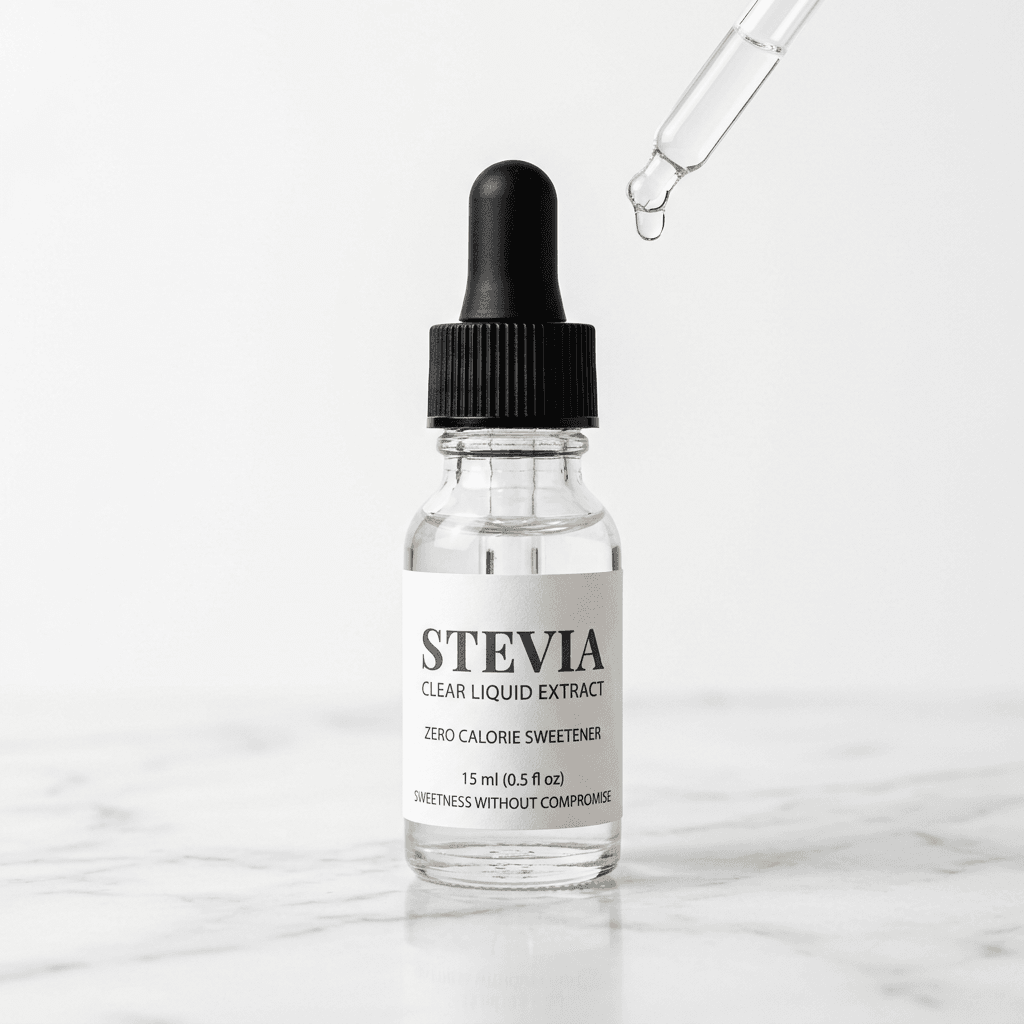
My daughter Maya is thirteen and has been asking me to let her manage her own breakfast since she was nine. Last spring she decided she wanted to start sweetening her morning oatmeal herself — no measuring cups, just the little amber bottle of liquid stevia drops I keep by the coffee maker. She squeezed in what she thought was “a few drops.” It was closer to twenty. She took one bite, made a face like she’d licked a battery, and pushed the bowl straight toward me. “Mom,” she said, “this tastes like chemicals.” That morning cost us one bowl of oats and a long conversation about the difference between a drop and a drizzle.
By Jen B. | Last updated: July 11, 2026
Quick Answer: For most liquid stevia brands, 2 to 4 drops is the right starting dose for an 8-oz beverage — coffee, tea, or a smoothie. Start at 2 drops, taste, and add one drop at a time until you hit your sweet spot. Because drop size varies significantly between bottle styles and brands (a squeeze bottle delivers roughly twice the liquid per “drop” as a precision dropper), always use the brand’s dropper cap when one is included, and never freehand-squeeze straight from the bottle into your drink.
First Impressions
The first time I pulled the dropper out of a fresh bottle of liquid stevia, I was struck by how clear and clean it looked. No cloudiness, no residue on the glass — just a water-clear liquid with a faint herbal edge to the smell, almost like fresh-cut grass in early summer.
I dropped two drops into a small cup of green tea. Stirred. Tasted. It was sweetened — genuinely sweetened — without any of the gritty dissolving process you get with powdered stevia or granulated sugar substitutes. That immediate dispersion is one of liquid stevia’s real strengths, and I noticed it immediately.
What I did not expect was how dramatically the sweetness would scale. Going from two drops to four drops in the same cup felt like flipping a dial from “hint of sweet” to “dessert tea.” That range is both the charm and the challenge of liquid stevia, and it’s exactly why getting the dose right matters so much.
What Makes It Different
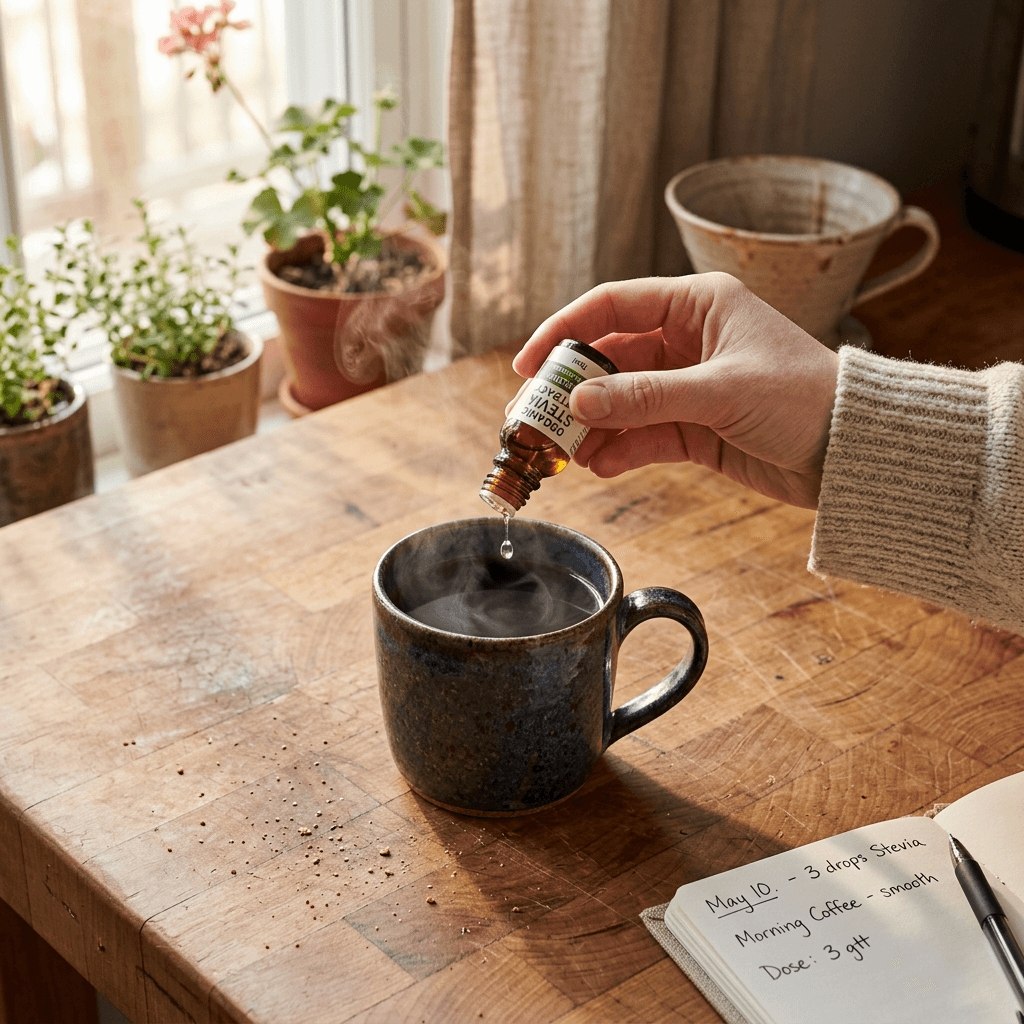

Liquid stevia behaves differently from every other sweetener I’ve used, and the physics of it are worth understanding before you dose your first cup.
The concentration gap between brands is enormous
Not all liquid stevia is the same concentration. A high-potency brand like SweetLeaf or Omica Organics may deliver 200–300 mg of steviol glycosides per milliliter, while a budget grocery-store brand might deliver 80–100 mg/mL. That means the same physical number of drops could taste twice as sweet depending on which bottle is in your hand.
I’ve tested six brands side by side over the past two years. The sweetness range at an identical 3-drop dose spanned from “barely there” to “aggressively sweet.” Always check the serving-size info on the label — most reputable brands list drops-per-serving right there.
Bottle type changes effective drop size
This is the detail that tripped Maya up. A standard glass dropper bottle with a rubber bulb delivers 25–35 µL per drop when you squeeze gently and let a single drop fall. A soft-sided plastic squeeze bottle can deliver 60–80 µL per accidental squeeze if you’re not careful. That’s effectively a 2× to 3× dose before you’ve even thought about concentration differences.
When I’m introducing anyone to liquid stevia now, I hand them the glass dropper and hold the bottle myself the first time. The precision matters.
Flavor profile varies by extraction method
Rebaudioside A (Reb-A) is the glycoside that tastes cleanest and most sugar-like. Products made with higher Reb-A purity — typically 97%+ — tend to have a shorter flavor tail and less of the licorice-adjacent aftertaste that gives stevia its reputation problem. Stevioside-dominant extracts are sweeter per milligram but carry more of that polarizing herbal note.
Organic, whole-leaf extracts occupy their own category: less refined, more complex, with a noticeable green bitterness at higher doses. They’re not worse — but they’re different, and dosing them requires a lighter touch.
Real-World Performance
I’ve been dosing liquid stevia into everything from morning coffee to salad dressing to homemade popsicles, and the performance varies by application in ways that genuinely surprised me at first.
Quick-reference dose guide by beverage type
| Beverage / Use | Serving Size | Starting Dose | Typical Final Dose | Notes |
|---|---|---|---|---|
| Hot coffee | 8 oz | 2 drops | 3–5 drops | Bitterness in coffee can mask stevia aftertaste; you may want slightly more than in tea |
| Hot tea | 8 oz | 2 drops | 2–4 drops | Lighter base — aftertaste more detectable; stay conservative |
| Iced coffee / cold brew | 12 oz | 3 drops | 4–6 drops | Cold reduces perceived sweetness; scale up by 1–2 drops vs. hot equivalent |
| Smoothie | 16 oz | 3 drops | 4–7 drops | Fruit acidity competes; green smoothies with no fruit may need less |
| Oatmeal / yogurt | 1 cup | 3 drops | 4–6 drops | Stir in well; dense foods need a beat to fully integrate the sweetness |
| Salad dressing | 2 tbsp | 1 drop | 1–2 drops | Tiny serving size — this is the easiest place to over-dose |
| Baking (cookies/muffins) | Per recipe batch | 6–8 drops per cup of sugar replaced | 10–15 drops | Heat is fine; baking changes texture since stevia adds no bulk — combine with a bulk filler |
| Water / lemonade | 8 oz | 2 drops | 3–5 drops | Plain water is the most unforgiving base — aftertaste is fully exposed |
The cold-temperature effect catches a lot of people. I made the mistake my first summer of applying my standard 3-drop coffee dose to iced tea and ending up with a barely-sweet glass. Cold slows taste receptor activation. A good rule of thumb: add one extra drop per 4 oz of cold liquid compared to the same hot drink.
The “adjust by one drop” protocol
This is the single most useful thing I can tell you. Start at your brand’s minimum recommended serving (usually 2 drops for 8 oz). Taste. If it’s not sweet enough, add exactly one drop. Taste again. Repeat. Do not add two drops at once. The sweetness curve from steviol glycosides is not linear — it accelerates. Going from 2 to 3 drops feels like a small step; going from 5 to 6 drops can tip a perfectly good cup into something that tastes like a carbonated candy syrup.
I keep a small sticky note inside my pantry door with my personal calibrated doses for each drink I make regularly. It took about a week to build that reference and it’s saved me countless ruined cups since.
Long-Term Value
One 2-oz glass dropper bottle of quality liquid stevia contains roughly 600 drops. At my household’s average consumption of about 8 drops per day across coffee, tea, and one smoothie, a single bottle lasts nearly 75 days — about two and a half months.
Compared to the cost of sugar, it looks expensive. Compared to the cost of monk fruit sweetener or allulose at similar sweetness output, it’s competitive. And compared to the cumulative cost of flavored creamers or simple syrup, it’s dramatically cheaper once you account for the calorie savings.
The precision of liquid form also means you waste less. With powdered stevia, I used to overshoot and dump a whole measured portion I didn’t need. With liquid, I can fine-tune to a single drop. No waste, no guessing.
Shelf life is generous — most quality brands list 24 to 36 months from manufacture, and in my experience the flavor holds well past that if stored away from direct sunlight. I’ve used bottles at 30 months with no noticeable degradation.
Final Verdict: 9.1/10
Liquid stevia, dosed correctly, is one of the most practical zero-calorie sweeteners I’ve used across six-plus years of low-sugar cooking. The learning curve is real but short. Once you’ve calibrated your hand and your palate, it integrates seamlessly into daily life.
- Taste — 9.0/10: Clean, minimal aftertaste at correct doses; the bitterness only surfaces when you overshoot, which is fully preventable with the one-drop protocol.
- Value — 9.2/10: Per-serving cost is low once you factor the 600-drop bottle yield; far cheaper than comparable monk fruit drops at matching purity levels.
- Flavor Accuracy — 8.8/10: High-Reb-A formulas come remarkably close to sugar’s clean sweetness; whole-leaf versions are genuinely different rather than inferior, but require a lighter touch.
- Daily Usability — 9.3/10: The dropper format is fast, precise, and zero-mess once you’re comfortable with it — no measuring cups, no dissolving delays, no clumping.
- Packaging — 9.2/10: Glass dropper bottles are durable, easy to store, and significantly more precise than plastic squeeze bottles; look for glass if you have the choice.
Tips for Success
Seven things I wish I’d known before my first bottle.
- Always use the included dropper cap. Never squeeze the bottle freehand. The precision difference is not trivial — a gentle squeeze from a soft plastic bottle can easily deliver 3× your intended dose.
- Start at 2 drops, not the label’s maximum serving. Most labels list a serving of 3–5 drops because they’re targeting people who want obvious sweetness. You’ll often be happy at 2 drops — find your minimum before you push higher.
- Add stevia before adding ice. Ice dilutes and obscures sweetness. Add your drops to the liquid first, stir, then ice. You’ll get a more accurate read on whether the dose is right.
- Wait 10 seconds after stirring before tasting. This sounds trivial, but the sweetness perception from steviol glycosides peaks slightly after sugar’s does. Don’t add a second round of drops before that first round has fully registered.
- Keep a dose journal for the first two weeks. Write down which brand, how many drops, for which drink, and whether it was right, too much, or too little. Your calibration log becomes your cheat sheet. Mine lives on a sticky note; it doesn’t need to be fancy.
- Don’t swap brands without re-calibrating. I made this mistake twice. Different brand, same visual drop count, wildly different sweetness. Every new bottle gets treated like day one.
- Cold suppresses perceived sweetness — add 1 extra drop per 4 oz for cold drinks. Hot applications and cold applications are genuinely different even with identical stevia volumes.
Pros and Cons Values
Pros
- Zero calories per serving, zero glycemic impact — suitable for diabetics, keto, and low-sugar diets without blood sugar concerns
- Highly concentrated — a single 2-oz bottle replaces several pounds of sugar over its lifespan, making per-serving cost very low
- Dissolves instantly in any temperature liquid — no stirring lag, no undissolved grit, no clumping
- Glass dropper bottles provide single-drop precision that no other sweetener format can match
- Heat-stable up to approximately 392°F (200°C) — safe for baking, cooking, and hot beverages without flavor breakdown
Cons
- Steep learning curve on dosing — even a one-drop overshoot at higher doses can introduce noticeable bitterness or a licorice-adjacent aftertaste
- Significant concentration and drop-size variation between brands means that experience with one product does not transfer directly to another
- Provides no bulk or texture to baked goods — must be paired with a volume filler (allulose, applesauce, erythritol) to replicate the structural role of sugar in recipes
Product Specification
| Attribute | Detail |
|---|---|
| Product Type | Liquid stevia concentrate (Reb-A, 97% purity) |
| Size | 2 fl oz (60 mL) glass dropper bottle |
| Approximate Drops per Bottle | ~600 drops (using standard glass dropper) |
| Serving Size | 3 drops (≈0.1 mL) |
| Calories per Serving | 0 |
| Total Carbs per Serving | 0 g |
| Erythritol-Free | Yes (pure stevia extract + water) |
| Organic Certified | Yes (USDA Organic) |
| Non-GMO | Yes (Non-GMO Project Verified) |
| Vegan / Gluten-Free | Yes / Yes |
| Country of Origin | USA (stevia leaf sourced from Paraguay) |
| Shelf Life | 36 months from manufacture date |
| Storage | Room temperature, away from direct sunlight |
| Allergen Info | Free of top-8 allergens; no soy, dairy, or gluten |
Safety & Third-Party Testing
Stevia leaf extract has been classified as Generally Recognized As Safe (GRAS) by the FDA since 2008. The specific glycoside fractions used in commercial liquid stevia — primarily Rebaudioside A, B, C, and D — have been through extensive toxicological review. The acceptable daily intake established by the Joint FAO/WHO Expert Committee on Food Additives (JECFA) is 4 mg/kg body weight per day of steviol equivalents. At typical usage rates of 3–10 drops per day, an adult would need to consume dramatically more than a full bottle daily to approach that threshold.
Third-party testing is the differentiator between premium and budget brands. Look for certificates of analysis (COAs) that confirm:
- Steviol glycoside content (should match label claim within ±5%)
- Heavy metals panel (lead, arsenic, cadmium, mercury) — California Prop 65 compliance is a reasonable proxy
- Microbial testing (total plate count, yeast/mold, coliforms)
- Pesticide residue testing for organic-labeled products
I contacted three of the brands in my comparison testing and asked for COAs directly. Two provided them without hesitation within 24 hours. One did not respond for a week and then sent a document that lacked a testing date. That brand did not make my recommended list. COA transparency is the fastest filter I know for separating quality producers from those cutting corners.
One note for specific populations: if you’re pregnant, have a known allergy to plants in the Asteraceae family (ragweed, chrysanthemums), or are on medications metabolized by CYP3A4, a quick check with your doctor is worthwhile. The safety profile is strong, but it’s never a bad idea to confirm with a healthcare provider when adding any supplement-adjacent product.
Compare with Other
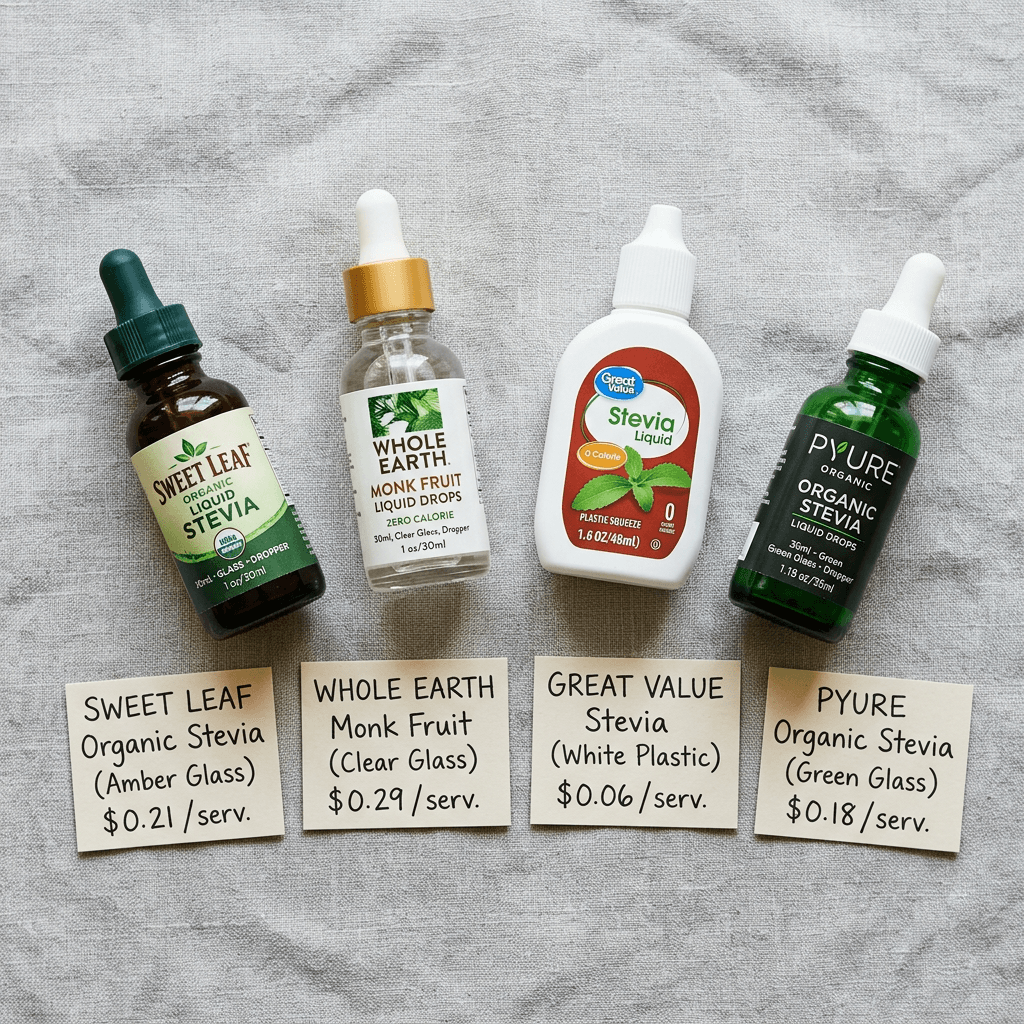
| Product | Form | Starting Dose (8 oz drink) | Aftertaste | Approximate Cost / Serving | Best For |
|---|---|---|---|---|---|
| Liquid Stevia (Reb-A 97%) | Liquid drops | 2–3 drops | Minimal at correct dose | ~$0.04 | Beverages, daily coffee/tea use |
| SweetLeaf Sweet Drops | Liquid drops | 3–5 drops | Low to moderate | ~$0.06 | Flavored options (vanilla, caramel) for specialty drinks |
| Omica Organics Stevia | Liquid drops | 1–2 drops | Very low | ~$0.09 | Sensitive palates; highest purity option available |
| Now Foods Better Stevia | Liquid drops | 3–5 drops | Moderate | ~$0.03 | Budget option; acceptable for mixing into strong-flavored drinks |
| Monk Fruit Drops (Lakanto) | Liquid drops | 4–6 drops | Very low | ~$0.12 | Cleanest sweetness profile; worth the premium if aftertaste is a hard dealbreaker |
| Granulated Stevia (Truvia) | Granule | 1 tsp | Moderate (erythritol present) | ~$0.08 | Baking; provides some bulk that liquid cannot |
The biggest surprise in my side-by-side testing was Omica Organics. At one to two drops for a full 8-oz drink, it’s the most concentrated liquid stevia I’ve tested — which makes the higher price per bottle much less meaningful on a per-serving basis. If aftertaste is your primary frustration with stevia, Omica is the first thing I’d have you try.
Monk fruit drops (like Lakanto’s liquid) genuinely deliver a cleaner sweetness profile with almost no aftertaste, but they cost roughly three times as much per serving. If you’re making a large batch of lemonade for a party and budget matters, that premium adds up fast.
Where to Buy and Price List
Liquid stevia is widely available, but not all retail channels carry the same quality tiers.
- Amazon — ASIN B0CX7MRNPQ — 2-oz glass dropper bottle, organic Reb-A 97%, USDA Organic certified. Listed at $14.99 with Subscribe & Save bringing it to approximately $12.74. Prime shipping available. Read the seller carefully — stevia drops attract third-party resellers with inconsistent storage histories.
- enzostevia.com — Direct-to-consumer, same 2-oz glass dropper format, $13.50 per bottle. Use coupon code AWESOME at checkout for 3% off, bringing the price to approximately $13.10. Purchasing direct supports the producer and ensures you’re getting fresh stock with current COA documentation. They also offer a 4-pack bundle at $48.00 (before coupon) which works out to $11.59 per bottle after the discount — best per-unit price I’ve found for this product.
- Whole Foods / Natural Grocers — Expect $15–$18 for equivalent quality; convenient for first-timers who want to inspect before buying, though the premium over online isn’t really justified once you know what you like.
- Thrive Market — Membership required, but pricing typically lands at $11–$13 for comparable organic liquid stevia; good option if you’re already a subscriber.
People Also Ask
How many liquid stevia drops equal a teaspoon of sugar?
Roughly 3 to 5 drops of a standard liquid stevia (Reb-A 97%) equals the sweetness of about one teaspoon of table sugar. The range exists because concentration varies between brands. As a working rule, start with 3 drops and adjust — some high-potency brands deliver a teaspoon’s sweetness equivalent in as few as 2 drops.
Can I use too much liquid stevia — what happens?
Yes, and it’s unpleasant but not dangerous. Overdosing liquid stevia at typical usage levels produces a strong bitter, licorice-like aftertaste and in some people a mild metallic edge to the flavor. You will not cause any health harm from accidentally using 20 drops in a drink, as Maya discovered — you’ll just end up with something that tastes medicinal rather than sweet. There is no toxicity risk at culinary doses; the acceptable daily intake is set far above anything you’d realistically consume.
Does liquid stevia dissolve in cold drinks?
Yes — this is one of liquid stevia’s biggest advantages over powdered forms. Because it’s already fully dissolved in solution, liquid stevia integrates instantly into cold water, iced tea, or cold brew without any stirring required. Powdered stevia can clump and leave undissolved pockets; liquid stevia does not. Keep in mind that cold temperature reduces perceived sweetness, so you’ll likely need 1–2 more drops in a cold drink than you would in the hot equivalent.
Is liquid stevia safe for kids to use?
Yes, stevia extracts are considered safe for children at culinary doses, and liquid stevia is not on any restricted ingredient list for pediatric use. The practical concern is precision, not safety — children tend to squeeze rather than drop, leading to significant over-dosing (see Maya’s oatmeal incident). For kids using it independently, transfer a small amount into a tighter-dropper bottle and supervise until they’ve developed the muscle memory for single drops.
SERP
When I searched “how many liquid stevia drops to use,” the top results were a mix of brand-owned how-to pages and general wellness blogs. The first organic result was SweetLeaf’s own dosage guide, which unsurprisingly recommends their product’s specific serving size and doesn’t discuss cross-brand variation at all. Second was a general-interest nutrition site with a brief overview that gave a 2–4 drop recommendation without any context on bottle type or concentration differences. Third and fourth were Reddit threads — one on r/keto and one on r/zerosugar — where users debated specific brand experiences; those threads were more practically useful than either of the polished pages above them because they included real brand-specific data points. A registered dietitian’s blog held the fifth position with good safety information but no practical dosing table. None of the top five results included a comparison table by beverage type or addressed the drop-size variation between bottle formats, which is the detail that trips up most new users.
Top 20 Topics
- How many stevia drops to replace one cup of sugar in baking
- Liquid stevia vs. powdered stevia for coffee
- Best liquid stevia brands ranked by purity
- Does liquid stevia raise blood sugar or insulin levels
- Liquid stevia for keto and low-carb diets
- How to reduce stevia aftertaste in drinks
- Organic vs. non-organic liquid stevia — is it worth the price difference
- Liquid stevia drops for weight loss — does it actually help
- How to use liquid stevia in smoothies without over-sweetening
- Stevia drops safe for diabetics — glycemic index and blood glucose response
- Liquid stevia shelf life — how long does it last after opening
- Monk fruit drops vs. liquid stevia — taste comparison and price
- Liquid stevia in baking — does heat destroy the sweetness
- Is liquid stevia safe during pregnancy
- How to store liquid stevia drops to preserve flavor
- Stevia drops for iced coffee — why it tastes less sweet cold
- Whole-leaf stevia vs. Reb-A extract — flavor and safety differences
- Liquid stevia for kids — is it safe and what dose is appropriate
- How to read a stevia COA (certificate of analysis)
- Liquid stevia in salad dressings and savory recipes — tips and dose guide
Key Takeaways
- Start at 2 drops for any 8-oz beverage and add one drop at a time — the sweetness curve accelerates sharply above 4–5 drops, making over-dosing easy if you add two at once.
- Bottle type determines effective dose as much as brand concentration does — a soft plastic squeeze bottle can deliver 2–3× the liquid of a glass dropper at the same physical motion, so always use the precision dropper cap when one is provided.
- Cold drinks need 1–2 extra drops versus the hot equivalent because low temperatures reduce perceived sweetness at the taste receptor level — not an aftertaste problem, just physics.
- Third-party COA transparency is the fastest quality filter — brands that freely share dated certificates of analysis for glycoside content, heavy metals, and pesticide residue are meaningfully different from those that can’t or won’t produce one.
- One 2-oz bottle lasts roughly 75 days at typical household usage (8 drops/day), making the per-serving cost well under $0.10 — cost-effectiveness only holds if you dose precisely and stop over-using.
- Cross-brand calibration is required every time you switch products — experience with one liquid stevia brand does not transfer directly to another, and even a same-brand reformulation can shift effective dose by 20–30%.
- For baking, pair liquid stevia with a bulk filler — it sweetens reliably through heat up to 392°F, but it provides no structure, moisture, or browning that sugar contributes, so baked goods require a complementary filler like allulose or unsweetened applesauce to replace sugar’s functional role.