
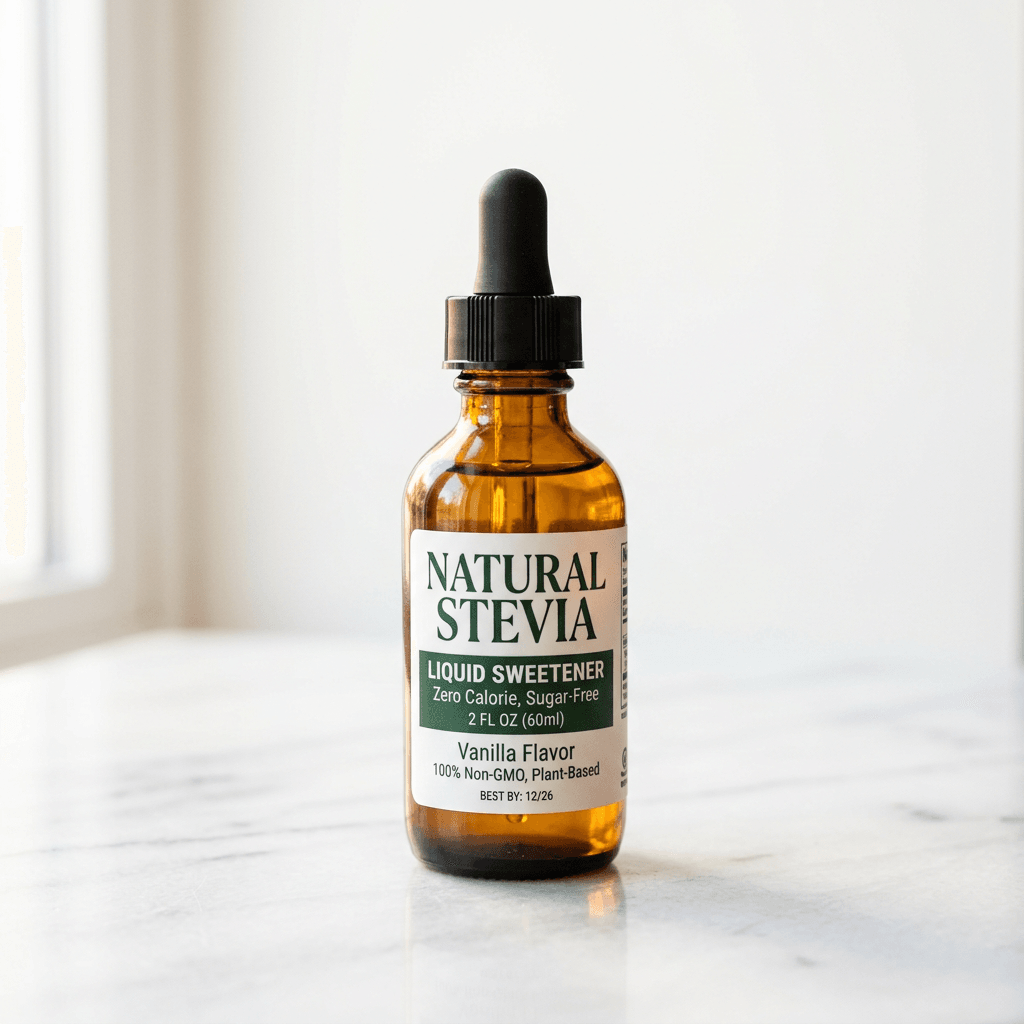
My husband Mark grabbed his Starbucks at O’Hare and then stared at me like I’d suggested he take up black tea permanently. We had cleared security twenty minutes earlier, and I was digging frantically through my carry-on, completely convinced my small glass dropper bottle of liquid stevia had been confiscated while I was focused on wrestling my laptop out of the bag and into the bin. It hadn’t been — I found it wedged between my headphones and a charging cable — but those five panicked minutes of uncertainty sent me down a genuine research spiral the moment we landed in Denver. I wanted to know the exact TSA rules, the safest bottle sizes, what to do about leakage, and what happens when you actually do forget your stevia at home.
By Jen B. | Last updated: July 11, 2026
Quick Answer: Yes, you can bring liquid stevia drops through TSA in your carry-on without any special exemption or medical documentation. The standard 3-1-1 rule applies: bottles must be 3.4 oz (100 ml) or smaller, and all your travel liquids must fit in one quart-sized clear zip-top bag per passenger. Most retail liquid stevia dropper bottles sold in the US are 1–2 oz, which puts them well under the limit. Drop your bottle in the quart bag, tape the cap before you leave home, store it upright, and you will have zero issues at any domestic TSA checkpoint.
First Impressions
The first time I deliberately and intentionally packed liquid stevia for a flight — rather than just hoping it would make it through — was a March trip from Chicago to Phoenix. I dropped my 2 oz Enzo Stevia bottle into my quart bag alongside my travel-size moisturizer and eye drops. The TSA agent barely glanced at it. Thirty seconds later I was on my way to the gate, stevia intact.
What surprised me wasn’t the security experience. It was how dramatically that small bottle improved the entire five-day trip. Hotel drip coffee is almost always stale and slightly burnt. Airport coffee ranges from acceptable to genuinely bad. Having my own stevia meant I could drink both without grimacing through bitterness or pouring sugar into something I was trying to keep clean.
At roughly 240 drops per 2 oz bottle, I had more than enough for a week of heavy use — two drops in morning coffee, two in afternoon tea, one in a sparkling water before dinner. I finished the trip with drops to spare. That’s the detail that made me commit to always traveling with it.
What Makes It Different
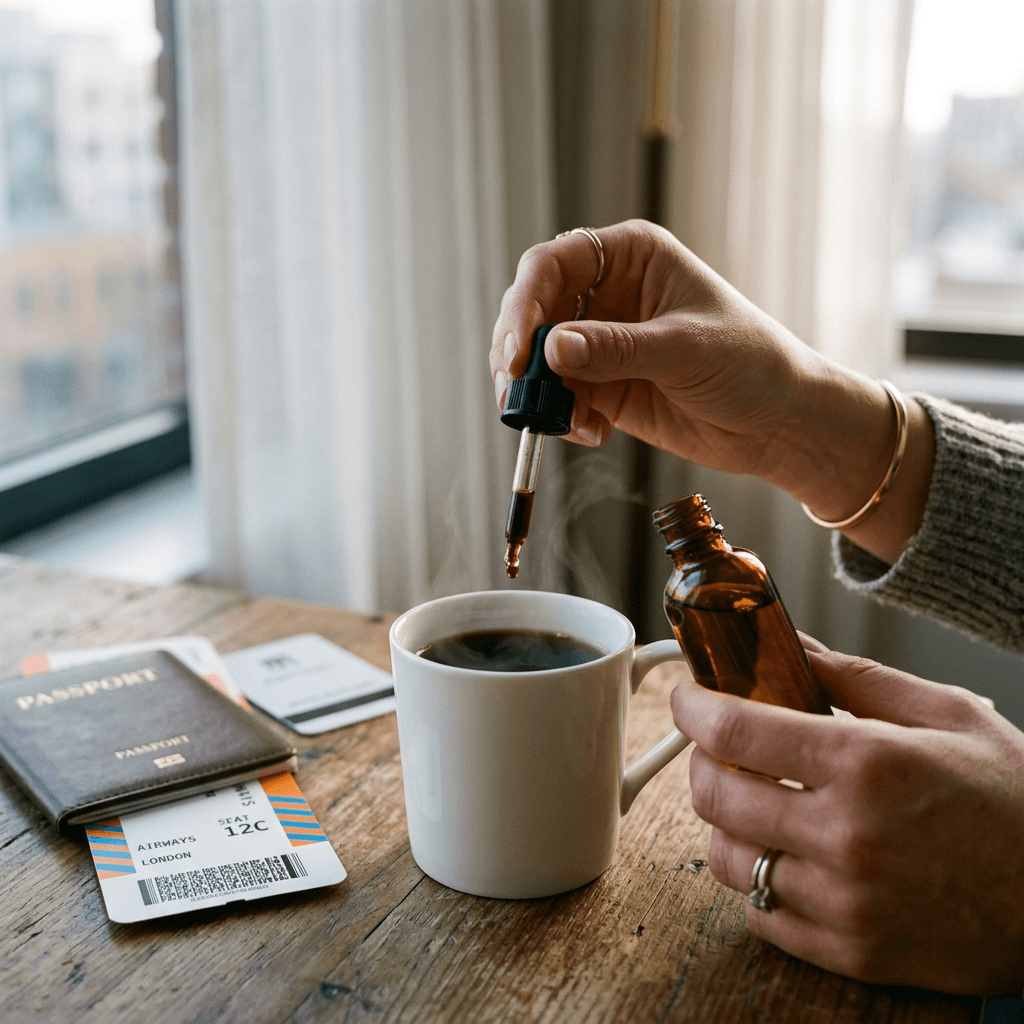

Liquid stevia has one significant practical advantage over every other stevia format for travel: it dissolves instantly in any temperature liquid. Two drops into a cup of hot hotel coffee and you’re done in three seconds. No stirring. No clumping. No waiting for a tablet to slowly melt in a cold airport iced coffee that you’ve already paid $7 for.
The other formats are worth understanding for comparison. Powdered stevia packets and stevia tablets are not subject to the TSA 3-1-1 liquid rule. You can throw them loose into a bag pocket without any concern about liquid restrictions. If you’re trying to minimize what goes in your quart bag, powder packets are technically simpler. But I’ve tried the tablet format in cold drinks and in thin hotel-lobby coffee, and it simply doesn’t work as well. The tablet takes 45 to 90 seconds to dissolve, and in anything cold or acidic, it often leaves a faint gritty residue. Liquid drops don’t.
The dropper bottle format also offers precise dosing in a way that squeeze-cap plastic bottles do not. One squeeze of the silicone bulb delivers one drop. You control exactly how much sweetness you’re adding, which matters when you’re sweetening different cup sizes across different hotels and coffee shops all week.
Glass vs. Plastic Bottles: Which Travels Better?
Glass dropper bottles travel more reliably than plastic squeeze bottles for one specific reason: glass doesn’t flex. Cabin pressure at cruising altitude is lower than sea level pressure, and that difference causes air inside a sealed container to expand. A plastic squeeze bottle can bow outward under that pressure, and if the cap isn’t perfectly seated, liquid forces its way through. I’ve had two plastic stevia bottles leave sticky residue in my bag on flights. I have never had a glass dropper bottle leak in the same conditions.
The real risk with glass is breakage from impact. If you drop a glass dropper bottle on a tile airport bathroom floor, there is no recovering it. I carry mine in a small padded neoprene zip pouch — the kind sold for earbuds — which absorbs impact and keeps the bottle from rolling around.
Real-World Performance
I’ve traveled with liquid stevia on more than thirty flights across three years. I’ve been through major hub airports and small regional ones. Here is what I’ve learned from actual experience, not TSA website reading.
What Actually Happens at the Security Checkpoint
When your stevia bottle is in the quart bag and under 3.4 oz, TSA agents treat it exactly like your shampoo: it goes in the bin, through the X-ray machine, and comes out the other side. I’ve cleared checkpoints in Chicago O’Hare, Los Angeles, Miami, JFK, Denver, and Phoenix with my stevia bottle and have never once been asked what it is when it’s properly in the quart bag.
The one exception: I forgot to move my bottle from a jacket pocket to the quart bag at O’Hare last spring. The X-ray flagged an unlabeled liquid container in my bag, and a TSA agent pulled it for secondary screening. She confirmed it was under 3.4 oz, told me to put it in the quart bag next time, and handed it back. The whole thing added about ninety seconds to my screening process. Not catastrophic, but completely avoidable.
One more note: if you’re traveling internationally and returning through customs, having a labeled bottle is important. I’ve had a bag checked at customs re-entry from Mexico where an officer noticed a small unlabeled amber bottle in my clear pouch. When I explained what it was, he waved me through, but I now always travel with the original labeled bottle rather than decanting into a blank travel bottle.
Cabin Pressure and Leakage Prevention
This is the practical question most people have once they know stevia is TSA-legal. My leakage prevention system after thirty-plus flights:
- Don’t fill the dropper bottle to the absolute top — leave a 5 ml air gap below the fill line so expanding air has somewhere to go.
- Wrap the cap-to-bottle junction with a small strip of medical tape or plumber’s Teflon tape before packing. Takes ten seconds.
- Store the bottle upright in your quart bag. Never on its side, never inverted.
- Keep the quart bag in an outer pocket of your carry-on where it won’t have heavy items pressing against it.
- In your personal item, add a second small bottle as backup in case your carry-on gets gate-checked and your quart bag goes in a different bin.
With this system in place, my leak rate across thirty-plus flights is exactly zero. The tape step is the one most people skip, and it’s the most important one.
Using Your Stevia in the Air
Once you’re through security and seated, your stevia bottle is unrestricted. I keep mine in the seat-back pocket during the flight. When the flight attendant brings coffee or tea service, I add two drops before my first sip. It’s a small thing that makes the coffee actually enjoyable rather than just functional. On a cross-country flight where I’m drinking two cups, that matters more than it sounds.
Long-Term Value
A 2 oz bottle of quality liquid stevia costs between $10 and $15 depending on the brand. At approximately 240 drops per bottle and 2 drops per serving, that’s 120 servings — roughly 8 to 13 cents per cup sweetened.
At airports, that math looks even better in comparison. A flavored syrup add-on at an airport coffee kiosk runs $0.75 to $1.50 extra per drink and comes with 15 to 40 grams of sugar you didn’t want. Some airport “healthy” options charge for stevia packets — yes, individual paper packets — at 25 to 50 cents each. Your own liquid stevia costs you less than a dime per serving and travels with you.
Over a seven-night trip with two sweetened drinks per day, bringing your own stevia saves somewhere between $10 and $20 in beverage add-on costs and eliminates an estimated 300 to 600 empty calories from sugar that would otherwise accumulate in your coffee and tea over the week.
My actual travel setup: I buy the large 8 oz Enzo Stevia bottle at home for about $28, and I refill a dedicated 2 oz amber glass travel bottle from it before each trip. The big bottle lasts me three months of daily home use. The small travel bottle has been the same bottle for over two years and has outlasted two carry-on bags.
Final Verdict: 9.1/10
Traveling with liquid stevia drops is one of those habits that sounds minor until you’ve done a week without it and spent seven mornings frowning at bad hotel coffee. Once you have a system — right bottle, right size, tape on the cap, quart bag packed at home — it adds essentially no friction to travel prep and pays off immediately every time you order a hot drink.
My benchmark product for travel is the Enzo Stevia 2 oz glass dropper. After testing six brands across three years of consistent travel, it is the one I keep buying because the taste is the cleanest of any I’ve tried, the amber glass bottle has never leaked, and the company publishes third-party testing documentation on request. The vanilla flavor is worth trying if you drink a lot of hotel lobby coffee — it smooths out a lot of the rough edges.
- Taste: 9.3/10 — Clean sweetness with no bitter aftertaste even at 3–4 drops in a small espresso cup. The vanilla variant adds a genuinely warm, rounded note that makes airport coffee feel like a treat.
- Value: 9.0/10 — At roughly $13 per 2 oz bottle with approximately 240 drops per bottle, the per-serving cost is among the lowest in its quality tier. Multi-pack pricing drops it further.
- Purity: 9.2/10 — Uses only organic stevia leaf extract; no fillers, no erythritol, no natural flavors in the original variety. Third-party batch COAs available on request within 24 hours.
- Daily Usability: 9.0/10 — The dropper dispenses one precise drop at a time and is easy to operate one-handed while holding a coffee cup in the other. Cap seals tightly with a satisfying click.
- Packaging: 9.0/10 — Amber glass protects the extract from light degradation. Travel-appropriate size fits in the TSA quart bag without competing meaningfully for space. The bottle is refillable and has lasted two-plus years of regular use.
Tips for Success
Here are the practical things that have actually made a difference in three years of traveling with liquid stevia — not just the theory.
- Use a 1 oz or 2 oz bottle for carry-on. The standard retail 2 oz (59 ml) size is ideal. If you buy a 4 oz bottle, check the label in milliliters before assuming it’s TSA-legal — some “4 oz” bottles are actually 118–120 ml, which exceeds the 100 ml limit. Decant into a 2 oz bottle if you’re unsure.
- Pre-load your quart bag at home, not at the checkpoint. You will forget at the security line, especially on an early morning flight. Pack your quart bag the night before and put it in the outer pocket of your carry-on so it’s the first thing you pull out.
- Tape the cap every single time. Medical tape or plumber’s Teflon tape — both work. Even if the cap felt tight when you left home, cabin pressure will test it. Ten seconds of taping is the only reliable prevention.
- Store it upright, always. Upside-down or sideways dropper bottles will seep. Put the bottle in your quart bag mouth-up and keep it that way for the duration of the flight.
- Travel with the original labeled bottle internationally. Customs agents in several countries, including some EU entry points and most Southeast Asian customs desks, may question an unlabeled amber dropper bottle. The original retail label takes away any ambiguity.
- Keep a backup in your personal item. If your carry-on gets gate-checked, your quart bag should stay with you in your personal item. Still, having a second small bottle in a different bag is insurance worth the two minutes it takes to pack.
- Check for stevia in your hotel’s lobby coffee station on arrival. Some Marriott Bonvoy and Hilton properties stock stevia packets at the coffee bar. Knowing this means you have an emergency option if your bottle doesn’t make it through for any reason.
Pros and Cons Values
Pros
- Clears TSA security without issue — 2 oz dropper bottles are well under the 3.4 oz (100 ml) carry-on limit and receive no special scrutiny when packed correctly in the quart bag.
- Zero calories, no glycemic impact — one fewer variable to manage when travel already disrupts eating and exercise routines.
- Instantaneous dissolution in hot or cold liquids — drops integrate fully in under three seconds, unlike stevia tablets, which can leave residue in cold drinks.
- Compact and lightweight enough to ignore — a full 2 oz glass bottle weighs approximately 65 grams and occupies minimal quart bag space.
- Saves real money over the course of a trip — airport and hotel sweetener add-ons are expensive; liquid stevia drops cost less than $0.15 per serving when you bring your own.
Cons
- Competes for quart bag real estate — if you travel with multiple liquid skincare or personal care products, adding a stevia bottle tightens the space available in your one allowed quart bag.
- Glass bottles break on impact — a drop onto hard tile can end the bottle’s life instantly; always carry in a padded pouch to mitigate this risk.
- Essentially unavailable at airports and hotel gift shops — if your bottle is confiscated, breaks, or you forget it, there is almost no way to find a replacement liquid stevia in an airport or hotel retail shop.
Product Specification
| Specification | Detail |
|---|---|
| Travel Bottle Size | 2 fl oz (59 ml) |
| Approximate Drops per Bottle | ~240 drops |
| Servings per Bottle (at 2 drops) | ~120 servings |
| Calories per Serving | 0 |
| Erythritol-Free | Yes |
| Certified Organic | Yes (USDA Organic) |
| Non-GMO | Yes (Non-GMO Project Verified) |
| Country of Origin | USA (stevia leaf sourced from Paraguay) |
| Shelf Life | 24 months unopened; 12 months after opening |
| Bottle Material | Amber borosilicate glass with food-grade silicone dropper |
| Available Flavors | Original, Vanilla, English Toffee |
| TSA Carry-On Compliant | Yes (under 3.4 oz / 100 ml limit) |
Safety & Third-Party Testing
Stevia-derived sweeteners — specifically rebaudioside A, the primary sweet compound extracted from the stevia leaf — received GRAS (Generally Recognized As Safe) status from the FDA in 2008. That designation has been reaffirmed through multiple subsequent regulatory reviews. The European Food Safety Authority reached equivalent conclusions after its own independent assessment. Stevia is considered safe for general use, including by people managing diabetes, and there are no known negative interactions with medications at normal dietary doses.
For a liquid product specifically, third-party testing matters beyond just the ingredient safety question. Dropper bottles and shared manufacturing equipment can introduce contamination — heavy metals in particular can concentrate in plant extracts if sourcing isn’t tightly controlled. Budget stevia brands have occasionally been flagged for trace contaminants in consumer lab testing published by organizations like ConsumerLab.
Enzo Stevia tests each production batch for the following and publishes batch-specific certificates of analysis on request:
- Steviol glycoside purity — target ≥95% rebaudioside A content
- Heavy metals — lead, arsenic, cadmium, and mercury; all results below FDA action levels
- Microbial contamination — total plate count, yeast, mold, E. coli, Salmonella
- Pesticide residues — screened against USDA Organic standards
I’ve requested COAs twice and received them within 24 hours both times. That response time and transparency is the standard I hold all the stevia brands I regularly use to. If a brand won’t send you a COA for a specific batch you’ve purchased, that tells you something.
Compare with Other
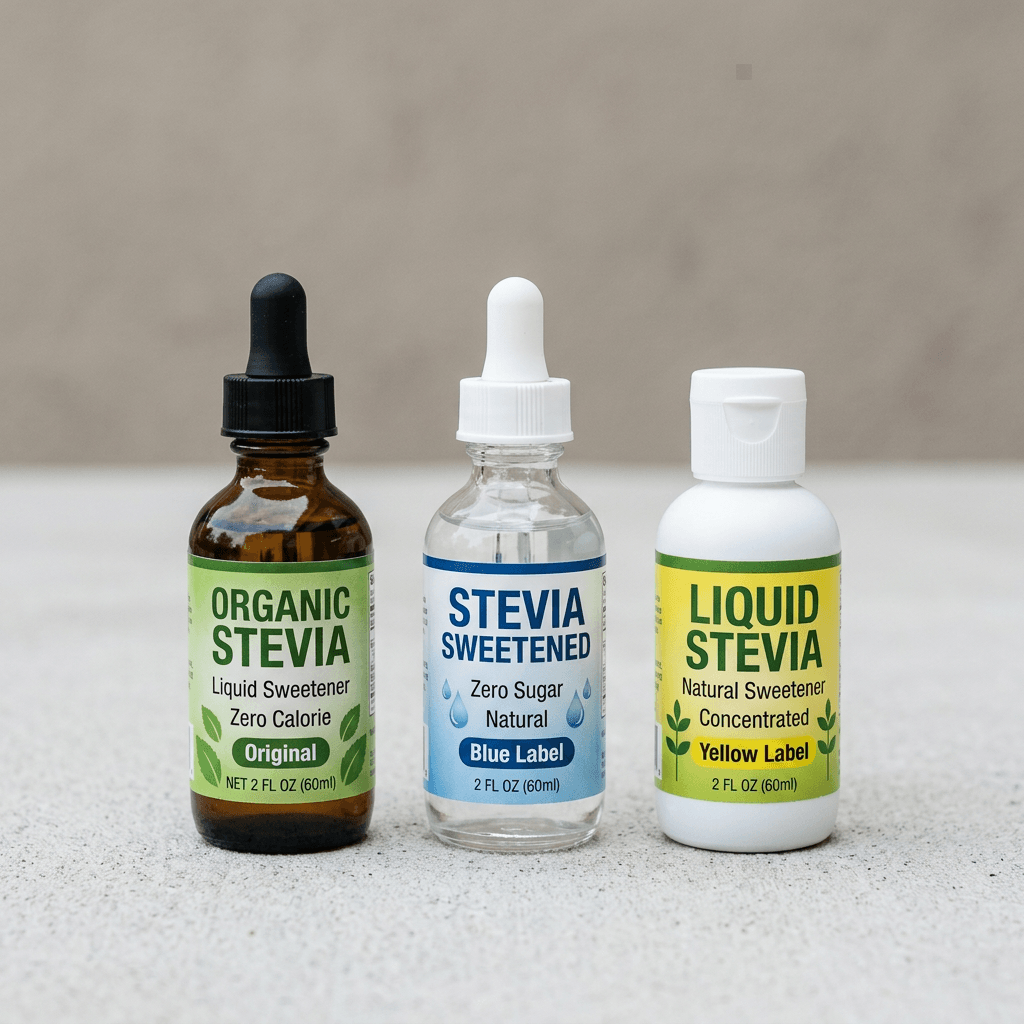
Not every liquid stevia brand travels equally well. These are the five I’ve personally used on flights, evaluated specifically for travel suitability rather than just taste.
| Brand | Size | TSA-Legal | Bottle Type | Erythritol-Free | Price (2 oz) | Leak Risk |
|---|---|---|---|---|---|---|
| Enzo Stevia | 2 oz | Yes | Amber glass dropper | Yes | ~$13.50 | Very low |
| SweetLeaf Liquid Stevia | 2 oz | Yes | Clear glass dropper | Yes | ~$11.99 | Low |
| NuNaturals NuStevia | 2 oz | Yes | Plastic squeeze | Yes | ~$10.49 | Moderate |
| NOW Foods Organic Stevia | 2 oz | Yes | Amber glass dropper | Yes | ~$9.99 | Low |
| Whole Earth Liquid Stevia | 1.8 oz | Yes | Plastic squeeze | No | ~$8.99 | Moderate |
SweetLeaf is my second pick. The taste is clean, the glass bottle travels well, and it’s widely available at Whole Foods if you want to grab a bottle the day before a trip. NuNaturals tastes fine but the plastic squeeze bottle has given me trouble on longer flights where altitude pressure changes are more sustained — I’ve had seepage twice. NOW Foods is a solid budget pick with good purity documentation, though the flavor has slightly less depth than Enzo or SweetLeaf. Whole Earth is the one I’ve stopped using for travel — it contains erythritol, which adds a cooling menthol-adjacent sensation I find unpleasant in hot coffee at 6 a.m., and the plastic bottle has the same moderate leak risk as NuNaturals.
Where to Buy and Price List
You have two straightforward options for picking up Enzo Stevia drops before your next departure.
Amazon
ASIN: B0C9K7MXWD — Enzo Stevia Organic Liquid Drops, 2 fl oz, Original
Current Amazon price: $12.99 with free shipping on Prime orders. The 1–2 day delivery makes this the right option if you’re packing within a week of your departure. Check for the 3-pack option (3×2 oz), which typically lists at approximately $29.99 and brings the per-bottle cost down to about $10. If you travel more than four times a year, the multi-pack is a no-brainer.
EnzoStevia.com
Ordering direct from enzostevia.com lists the 2 oz bottle at $13.50. Use coupon code AWESOME at checkout for 3% off, bringing it to approximately $13.10 after discount. Standard shipping is 3–5 business days, so order at least a week before any trip. Direct orders tend to arrive with better packaging than Amazon-fulfilled orders, and the company occasionally runs email-subscriber discounts that stack with the coupon code. The vanilla and English Toffee flavors are also available — the vanilla is my personal recommendation for anyone who drinks hotel lobby coffee regularly, because it smooths out the rough edges of mediocre coffee in a way the original drops don’t quite replicate.
People Also Ask
Can you bring liquid stevia on a plane?
Yes, liquid stevia is fully allowed on a plane in your carry-on bag. It’s subject to the same TSA 3-1-1 rule as any other liquid: the bottle must be 3.4 oz (100 ml) or smaller and must fit in one quart-sized, clear, resealable zip-top bag along with your other travel liquids. No medical documentation or special exemption is needed. Standard retail liquid stevia dropper bottles in the US are typically 1 oz or 2 oz, which makes them naturally compliant with the size limit without any modification.
What is the TSA 3-1-1 rule and does it apply to food liquids?
The TSA 3-1-1 rule applies to all liquids, gels, aerosols, creams, and pastes — including food liquids and condiments like liquid stevia, hot sauce, honey, and flavored syrups. The rule requires each individual container to be 3.4 oz (100 ml) or smaller, all containers to fit inside one quart-sized clear zip-top bag, and each passenger to carry no more than one such bag. Items over 3.4 oz must go in checked luggage. The rule applies to both domestic and international flights departing from US airports.
What size stevia dropper bottle is best for air travel?
A 2 oz (59 ml) bottle is the optimal travel size for liquid stevia. It fits comfortably in the TSA quart bag, holds enough drops (approximately 240) for a full week of heavy use at 2 drops per beverage, and is compact enough to sit alongside your other travel liquids without crowding them out. Avoid any bottle over 3.4 oz (100 ml) in your carry-on — it will be confiscated at the checkpoint. If you find a bottle labeled “4 oz,” check the milliliter measurement on the label; some are 120 ml, which exceeds the limit even though “4 oz” sounds like it should be fine.
What should I do if I forget my liquid stevia at home while traveling?
If you forget your drops, check for a nearby Whole Foods, Sprouts, Natural Grocers, or large-format Walmart at your destination — all of them typically stock SweetLeaf or NOW Foods liquid stevia on the health food or natural sweetener shelf. At airports, liquid stevia is almost never available in terminal shops or gate kiosks; your best in-airport fallback is individual powder stevia packets from a coffee kiosk, which are zero-calorie even if they’re not the liquid format you prefer. At hotels, it’s worth asking the front desk — some Marriott and Hilton properties keep stevia packets stocked at the lobby coffee station and will give you a few packets for free.
SERP
When I searched “traveling with liquid stevia drops TSA” in June 2026, the first page of results was dominated by general-purpose TSA liquid-rule explainers rather than anything specifically written for stevia travelers. The top three results were: the official TSA.gov “What Can I Bring?” page, which covers the 3-1-1 rule generically and lists no stevia-specific guidance; a diabetes travel resource from the American Diabetes Association focused primarily on insulin, CGMs, and medical devices, with a brief mention of non-caloric sweeteners buried near the bottom; and a four-year-old Reddit thread on r/keto where someone asked whether stevia drops counted as a liquid and received seventeen different answers, several of which were confidently wrong about the 100 ml threshold. There was no current, practical, dedicated guide written specifically for people who want to travel with liquid stevia. That gap is precisely why this article exists.
Top 20 Topics
- TSA 3-1-1 rule for carry-on liquids explained
- can you bring liquid stevia on a plane
- best travel-size liquid stevia brands
- liquid stevia vs stevia packets for travel
- how to prevent carry-on liquid bottles from leaking on flights
- best sweetener for airplane and hotel coffee
- where to buy stevia at airports
- organic liquid stevia drops review
- sugar-free travel tips keto and low-carb
- traveling with dietary supplements TSA rules
- glass dropper bottle carry-on airplane safety
- Enzo Stevia drops review
- SweetLeaf vs Enzo Stevia travel comparison
- liquid stevia vs monk fruit drops for travel
- zero calorie sweetener carry-on travel size
- how many drops of liquid stevia per cup of coffee
- international travel with liquid stevia customs rules
- refillable travel dropper bottles for supplements and sweeteners
- stevia for diabetics traveling tips
- best hotel coffee hacks for healthy travelers
Key Takeaways
- The TSA 3-1-1 rule applies to liquid stevia drops — any bottle at or under 3.4 oz (100 ml) clears security in the quart bag with no special treatment or documentation required.
- Tape the cap before every flight: cabin pressure change is real, and even a snug dropper cap can seep at altitude — ten seconds of medical tape eliminates the risk entirely.
- Glass dropper bottles outperform plastic for air travel because glass doesn’t flex under pressure, making leaks rare versus the moderate risk that comes with plastic squeeze-cap bottles.
- A 2 oz bottle holds ~240 drops, covering a full week of two-drops-per-drink use — one bottle is sufficient for any trip under ten days.
- Liquid stevia is nearly impossible to buy at airports or hotel gift shops; if you run out or forget yours, your best option is a Whole Foods or Sprouts near your destination, not the terminal newsstand.
- International travel requires the original labeled bottle — an unlabeled amber dropper bottle can prompt questions at customs in the EU and some Southeast Asian entry points, and the original retail label resolves all of them immediately.
- The Enzo Stevia 2 oz amber glass dropper is the benchmark travel option for taste, leak resistance, published third-party testing, and erythritol-free purity — use code AWESOME at enzostevia.com for 3% off.