
First Impressions
My mom flew in from Phoenix last October, and she drinks three cups of herbal tea a day. She’d been using stevia for years — the little green packets from the grocery store checkout aisle — and I thought I’d impress her with my “better” option. I handed her a mug of chamomile sweetened with the standard liquid stevia I’d been using, and she took one sip, set the mug down carefully, and said, “Honey, this tastes like the garden got into your cup.”
She wasn’t wrong. There was a green, almost grassy note underneath the sweet, and a bitter finish that lingered the way a bad first impression does. I’d grown so used to it that I’d stopped noticing. But watching my mom politely not finish her tea made it obvious.
That afternoon, I ordered NOW Foods Certified Organic Liquid Stevia. I figured if I was going to use stevia every single day — in coffee, yogurt, overnight oats, salad dressing, the occasional cocktail — I owed it to myself to find the cleanest version I could. The organic label had always seemed like a premium I couldn’t justify. After my mom’s very accurate verdict, I was ready to take it seriously.
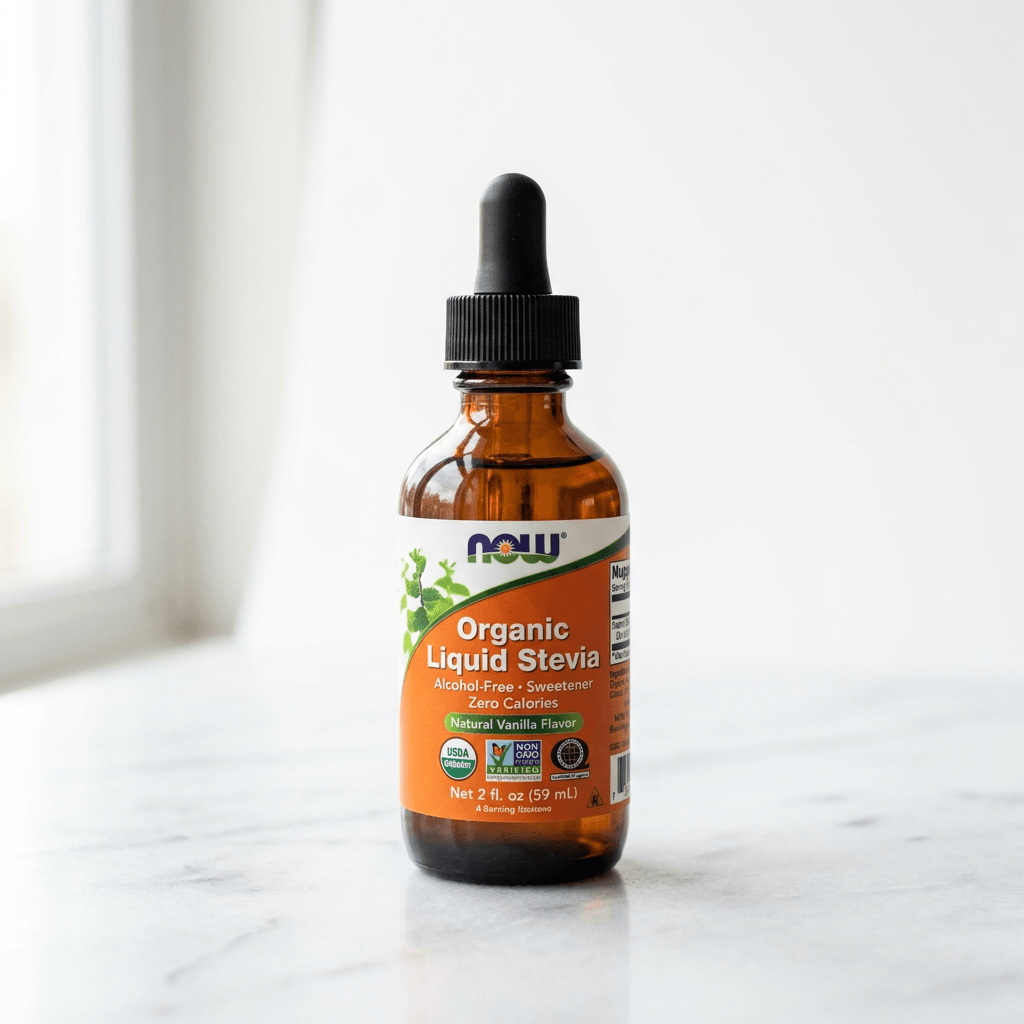
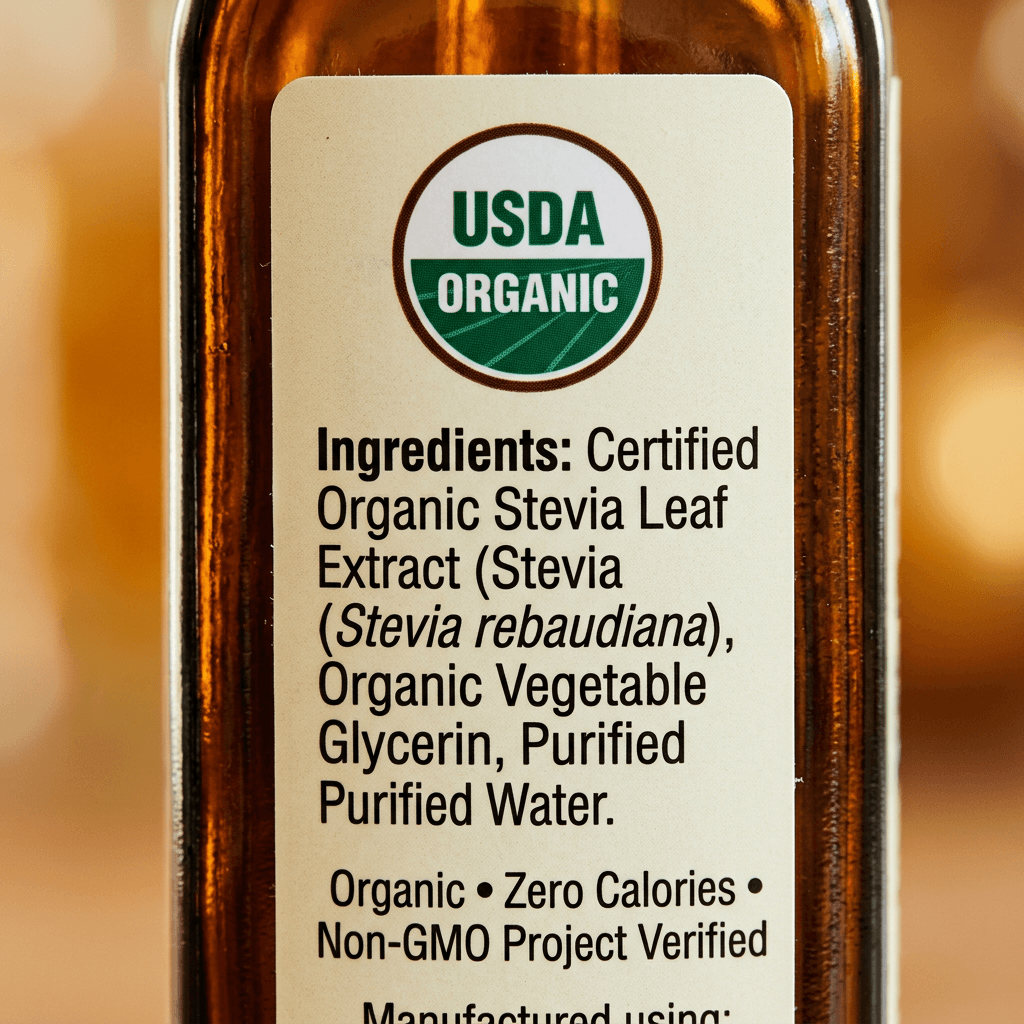
The 2oz amber glass bottle arrived three days later. My first impression before I even opened it: this is a product that takes itself seriously. The amber glass is a real choice, not a cosmetic one — it protects the extract from light degradation over time. The dropper tip is clean, not gummed up with the sticky crystallized residue I’d grown used to with other brands. The label is minimal. No marketing fireworks. Just the NOW Foods logo, the USDA Organic seal, and the ingredient list: organic stevia leaf extract, organic vegetable glycerin, purified water. Three ingredients.
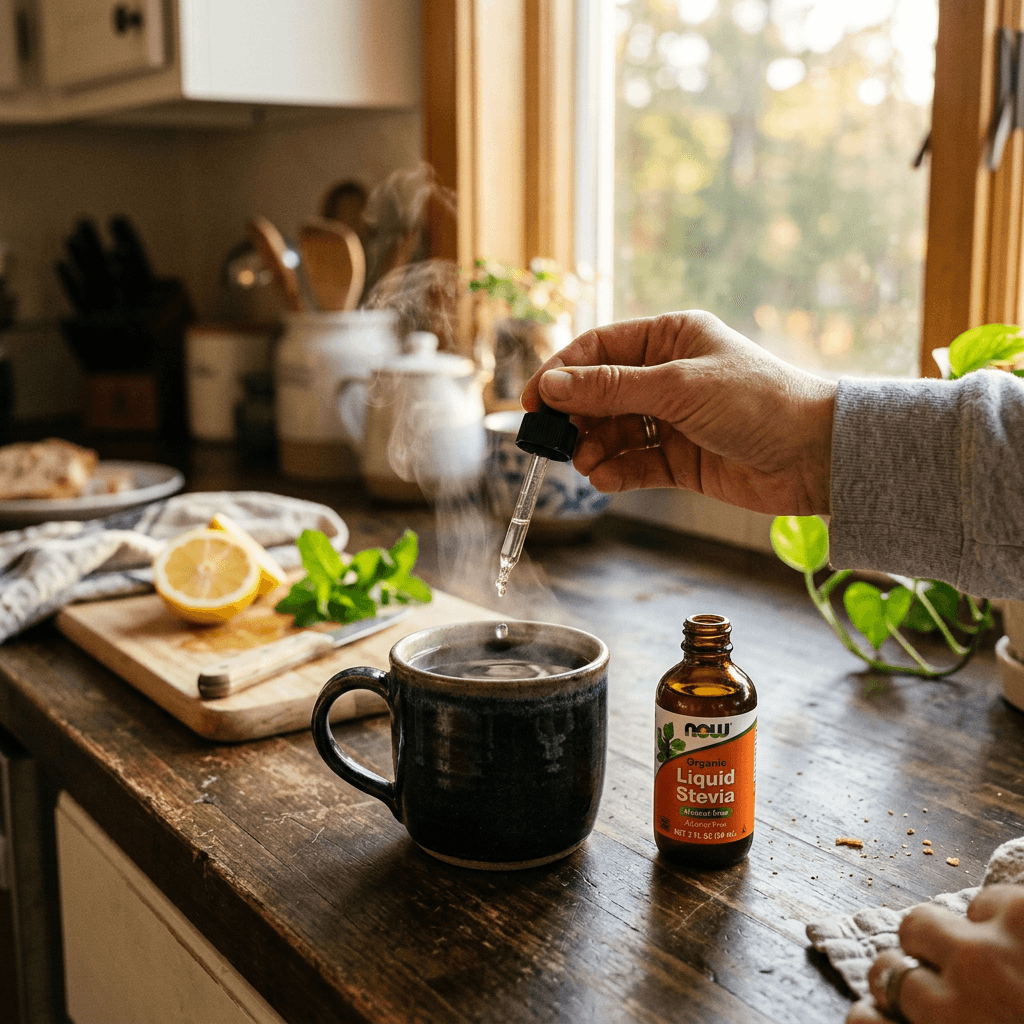
I dropped four drops into my morning coffee, stirred, and took a sip. My mom was sitting across the breakfast table. She raised an eyebrow. “That’s different,” she said. And she picked up her own mug — also sweetened with it — and finished every drop.
That was enough for me to keep going.
What Makes It Different

The word “organic” gets thrown around so casually it’s lost most of its signal. But USDA organic certification for a stevia product actually means something specific, and it’s worth unpacking before you dismiss the price difference as marketing.
The Certification Gap Between Standard and Organic
NOW Foods’ standard liquid stevia uses stevia leaf extract processed conventionally, which typically involves solvent-based extraction methods — often ethanol or methanol — to isolate the steviol glycosides from the leaf matter. The solvents are removed before bottling, but trace residues can remain and may contribute to off-notes in the flavor profile. The organic version, by contrast, uses certified organic stevia leaves grown without synthetic pesticides or fertilizers, and the extraction must comply with USDA National Organic Program (NOP) standards, which prohibit certain chemical solvents in the processing chain.
In practice, this means the organic extract tends to be cleaner at a molecular level. Fewer co-extracted compounds from pesticide-treated leaves. A processing chain with harder restrictions on what can be used to isolate the steviol glycosides. Whether that translates into a taste difference you can actually perceive is exactly where it gets interesting — and, in my experience, it does.
What’s Inside the Bottle
The ingredient list is refreshingly short: organic stevia leaf extract, organic vegetable glycerin, purified water. The vegetable glycerin serves as a carrier and adds the faintest, softest roundness that softens the stevia’s sharper edges. Some liquid stevia products use alcohol as a carrier, which can add a warming sensation or slight bite on the back of the palate. The glycerin here keeps everything mellow and smooth — relevant if you’re adding this to herbal tea or a delicate recipe where you don’t want competing notes.
Steviol Glycoside Profile
NOW doesn’t publish their exact rebaudioside-A percentage on the bottle, which is a minor transparency gap I wish they’d close. However, based on the taste profile — clean, low-bitterness, with a short finish — it’s consistent with a high-Reb-A extract. Rebaudioside-A is the glycoside responsible for stevia’s sweet taste with the least bitter aftertaste, versus stevioside, which is cheaper to isolate but considerably more bitter. Organic extraction processes tend to favor a higher-purity end product with a more favorable glycoside ratio. The taste bears this out.
Price Difference vs. Standard
The standard NOW Foods liquid stevia in 2oz runs about $7–$8 on Amazon. The organic version sits at $11–$12. That’s a 40–50% premium at first glance. But at 4 drops per serving, a 2oz bottle contains approximately 236–295 servings depending on drop size. The price difference works out to roughly 1.5 cents extra per cup of coffee. For something I use twice a day, every day, I spend about $11–12 more per year on organic. That math settled it for me.
Real-World Performance
I’ve been using this bottle for four months now and I’m halfway through my third 2oz. I’ve run it through everything I can think of.
In Coffee and Tea
This is where the organic version earns its keep most clearly. Hot beverages amplify everything — sweetness, bitterness, off-notes, all of it. In my morning dark roast, 3 drops is enough for a lightly sweet cup that doesn’t compete with the coffee’s natural bitterness and chocolate notes. With the standard version I used to use, there was a faint metallic-sweet aftertaste at the back of my throat, like the stevia was still there five minutes after the cup was empty. With this organic version, the finish is softer and much shorter-lived. It just… stops.
In chamomile tea — the very tea that started this whole experiment — 2 to 3 drops is perfect. The floral notes in the chamomile come through cleanly, without any grassy interference. My mom now requests a small dropper bottle to take home every time she visits. I’ve started buying two at a time so I can send her back with one.
In Smoothies and Protein Shakes
Here the difference is subtler, because strong flavors — tropical fruit, chocolate protein powder, almond milk — tend to mask minor flavor imperfections anyway. I use about 6–8 drops in a 16oz smoothie. What I notice is that the sweetness stays clean through the whole glass — no aftertaste buildup by the bottom of the cup, which I used to get with higher-stevioside-content products. It’s a cumulative improvement rather than a dramatic one, but after 16 ounces it matters.
In Baking and No-Bake Recipes
Liquid stevia in baking is always a translation exercise — you lose the bulk, the browning, the caramelization that sugar provides, and you have to compensate. But for wet applications like chia pudding, mousse, no-bake cheesecake filling, or energy ball batter, this works beautifully. The clean flavor contribution means it doesn’t fight your vanilla, cinnamon, or cocoa notes. I made a dark chocolate mousse for my husband’s birthday using this stevia and 72% dark chocolate, and the flavor was exactly what I wanted — bitter chocolate up front, clean sweetness, no odd finish. He watched me make it and still said it tasted like “real dessert.”
In Salad Dressings and Savory Applications
I’ll be honest — this was the surprise. I use a small amount of stevia in my Asian-style vinaigrette (rice vinegar, sesame oil, fresh ginger, a touch of tamari, and 2 drops of stevia to balance the acid). The organic version integrates without a trace. No competing bitterness, no odd finish that telegraphs “this is sweetened with stevia.” The glycerin carrier may actually help emulsify the dressing very slightly — a side benefit I didn’t expect and can’t fully explain, but have noticed consistently.
Dropper Consistency
One practical note that sounds mundane but matters: the dropper on this bottle is reliable. It produces drops of consistent size — no sudden globs, no air-bubble stuttering that makes you overpour in a panic. After four months of daily use, the mechanism hasn’t clogged or degraded. This sounds minor until you’ve wrestled with a stevia dropper that delivers half a teaspoon of liquid when you wanted four careful drops.
Long-Term Value
Cost Per Serving Breakdown
Let’s do the math properly. A 2oz bottle is approximately 59ml. A standard dropper dispenses roughly 0.04–0.05ml per drop. At 4 drops per serving, you’re looking at 0.16–0.20ml per use, which gives you between 295 and 368 servings per bottle at light use, or closer to 236 if you’re a heavy-handed 5-dropper. At $11.99 retail, that’s $0.033–$0.051 per serving — about three to five cents per cup.
Compare that to monk fruit blend drops at $0.08–$0.12 per serving, or premium zero-calorie syrups at $0.25–$0.50 per pump, or even plain raw honey at $0.15–$0.30 per teaspoon-equivalent. On a cost-per-sweetening-unit basis, this organic liquid stevia remains genuinely economical despite the organic premium.
The Sizing Gap
The one long-term frustration I keep running into: 2oz goes faster than it looks when you’re using it daily across multiple applications. NOW Foods offers their standard liquid stevia in larger sizes — 4oz and 8oz bottles appear in some retail channels — but the certified organic version seems to top out at 2oz in most places I’ve checked. If they ever release a larger organic format, I’ll buy a case. Until then, I manage by ordering two bottles at a time and treating the second as backup stock.
Stability and Shelf Life
The amber glass bottle earns its place. I’ve kept a bottle on my counter for three months and noticed zero flavor degradation. The “best by” date on my current bottle is 24 months from manufacture. Stevia extracts can go off — particularly water-heavy formulas with minimal preservation — but the vegetable glycerin carrier in this formula acts as a mild natural preservative, and I’ve had no spoilage or off-odor in any of the bottles I’ve used.
Final Verdict
Overall Score: 9.1 / 10
If you use stevia every day and you’ve ever noticed the bitter aftertaste from conventional products nudging you toward something else, this organic version justifies every cent of the price difference. The cleaner extraction, the glycerin carrier, the certified-organic sourcing — these aren’t marketing abstractions. They add up to a product that tastes materially better in daily use, especially in beverages where every nuance shows.
The only thing keeping this from a perfect score is the absence of a larger-size option for heavy users, and a modest wish for more transparency on the steviol glycoside profile. Everything else is exactly right.
Sub-Scores
- Taste — 9.3/10: Remarkably clean finish with almost no bitter glycoside aftertaste; a genuine step above conventional stevia extracts in daily beverage use.
- Value — 8.6/10: The organic premium is real but tiny in per-serving terms — roughly 1.5 cents extra per cup — which makes it a non-issue for everyday users.
- Purity — 9.4/10: USDA Organic certified, three-ingredient formula, no solvents, non-GMO — this is about as clean as commercially available liquid stevia gets.
- Daily Usability — 9.2/10: Consistent dropper, glycerin carrier that integrates invisibly into hot and cold applications, no mess, no clogging after months of use.
- Packaging — 8.8/10: Amber glass protects quality and signals real commitment to the product; the only knock is no larger-format option for heavier daily consumption.
Tips for Success
- Start with 2 drops, not 4. The organic extract is potent, and many people find it slightly sweeter-tasting than conventional versions because of the cleaner glycoside profile. Add drops one at a time — you can always add sweetness but you can’t take it out.
- Add to hot liquid before stirring in anything else. The glycerin carrier blends most evenly when it hits the warm liquid first. Add your cream, milk, or lemon juice after the stevia has had a moment to incorporate.
- Store away from the stove, not above it. The amber glass blocks light beautifully, but repeated heat cycling shortens shelf life. A cabinet near the stove is fine; directly above the burners is not.
- Don’t shake vigorously before use. The formula is stable and well-mixed — aggressive shaking introduces air bubbles into the dropper mechanism that cause inconsistent drop sizes for the next several uses.
- For recipe development, use a graduated dropper to measure in milliliters. The built-in dropper is accurate enough for your morning coffee, but when you’re developing a recipe you want to reproduce consistently, pull the liquid into a separate calibrated dropper so you can log exact amounts rather than approximate drop counts.
- In savory applications, pair with a small pinch of flaky salt. A grain or two of flaky salt counteracts stevia’s cool, lingering quality on the palate and makes the sweetness read as rounder and more sugar-like — particularly effective in vinaigrettes, glazes, and marinades.
Pros and Cons Values
Pros
- USDA Certified Organic seal backed by annual inspections and supply chain documentation — not just a label claim
- Three-ingredient formula (organic stevia extract, organic glycerin, purified water) with nothing to hide and nothing unnecessary added
- Noticeably cleaner taste and shorter aftertaste compared to conventional liquid stevia, particularly in hot beverages where every off-note is amplified
- Amber glass bottle actively protects extract quality from light degradation — a real functional choice, not just an aesthetic one
- Reliable, consistent dropper that dispenses accurate drop sizes without clogging, glopping, or degrading after months of daily use
Cons
- Only available in a 2oz format — heavy daily users will quickly wish for a 4oz or 8oz organic option, which currently doesn’t appear to exist in this product line
- 40–50% price premium over the standard NOW Foods liquid stevia, which is still reasonable per-serving but may be a barrier for budget-conscious shoppers
- Steviol glycoside percentage and Reb-A content are not disclosed on the label, which limits transparency for consumers tracking specific compounds or managing very precise dietary protocols
Product Specification
| Attribute | Detail |
|---|---|
| Size | 2 fl oz (59 ml) |
| Estimated Servings | ~236–295 (at 3–4 drops per serving) |
| Calories per Serving | 0 |
| Erythritol-Free | Yes — no erythritol or sugar alcohols |
| USDA Organic Certified | Yes |
| Non-GMO | Yes |
| Vegan / Vegetarian | Yes |
| Gluten-Free | Yes |
| Carrier Ingredient | Organic vegetable glycerin |
| Country of Origin | USA (NOW Foods, Bloomingdale, IL) |
| Shelf Life | 24 months from manufacture date |
| Packaging | Amber glass bottle with integrated glass dropper |
Safety & Third-Party Testing
NOW Foods is one of the more rigorous supplement companies when it comes to internal quality control. They operate their own GMP (Good Manufacturing Practice) certified facility in Bloomingdale, Illinois, and conduct in-house testing for identity, potency, and purity on incoming ingredients and finished products. For their certified organic line specifically, USDA National Organic Program certification requires annual on-site inspections by an accredited certifying agent, plus full supply chain documentation from farm to bottle. This isn’t a company printing “organic” on a label and hoping nobody audits it.
NOW also participates in broader third-party quality programs and conducts regular heavy metal screening. While the liquid stevia product doesn’t carry an Informed Sport logo (relevant primarily to athletes in tested sports), the facility-level GMP certification covers the production environment for all products manufactured there.
Stevia itself has one of the more thoroughly reviewed safety profiles in the natural sweetener category. The FDA granted high-purity steviol glycosides — rebaudioside-A at ≥95% purity — GRAS (Generally Recognized as Safe) status in 2008. The European Food Safety Authority set the Acceptable Daily Intake at 4mg per kilogram of body weight per day, an amount that would require the average adult to consume somewhere north of 30 sweetened servings daily to approach. For everyday use, the safety margin is enormous.
One note worth flagging for specific populations: the vegetable glycerin carrier is derived from vegetable oil, most commonly palm or soy. If you have a documented severe soy allergy, it’s worth a direct inquiry to NOW Foods about their current glycerin source, as this can vary by production batch. For the vast majority of users, the glycerin quantity per serving is too small to be clinically significant — but it’s good to know.
The USDA organic certification also adds an indirect safety benefit: it reduces the pesticide residue risk from the raw stevia leaf material, which is where most of the agricultural chemical exposure in conventional stevia products originates. For something you’re putting into two or three drinks every single day, that reduction compounds meaningfully over time.
Compare with Other
NOW Foods Organic vs. SweetLeaf Organic Sweet Drops
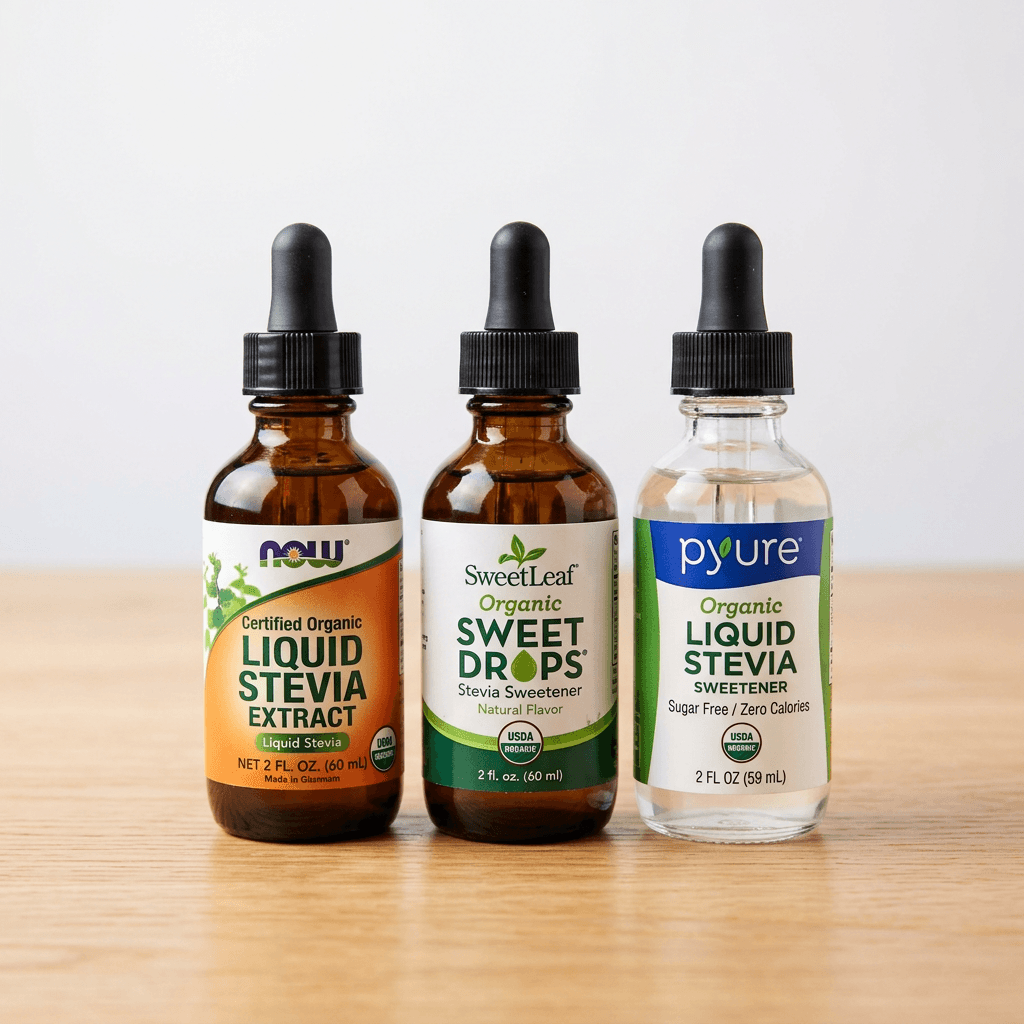
SweetLeaf is the closest direct competitor in the certified organic liquid stevia segment. Their Sweet Drops line covers both organic and non-organic versions, plus flavored variants (English Toffee, Vanilla Crème, Lemon Drop) that NOW’s organic line doesn’t attempt. In side-by-side taste tests I’ve run in my kitchen, SweetLeaf’s unflavored organic drop is genuinely comparable — some tasters prefer SweetLeaf’s slightly thinner, more water-like consistency, while others prefer NOW’s glycerin carrier for the soft roundness it adds. SweetLeaf organic generally runs slightly more expensive at $13–$15 for 2oz, and their dropper tip has a wider opening that can lead to over-dispensing if you’re not careful. For pure value per drop with no sacrifice in quality, NOW edges out SweetLeaf. On flavor it’s close enough to call a tie.
NOW Foods Organic vs. Pyure Organic Liquid Stevia
Pyure is widely distributed at grocery chains and carries its own USDA organic certification. Their liquid version uses a similar three-ingredient formula and their price is competitive with NOW’s. The practical differences I’ve noticed: Pyure’s dropper is somewhat inconsistent — it sometimes delivers irregular drop sizes, particularly in a near-empty bottle. More importantly, I find Pyure noticeably more bitter in the finish, which suggests a lower Reb-A content in their extract. It’s not unpleasant, but next to the NOW organic version it’s clearly more aggressive. For someone upgrading from a very bitter conventional stevia, Pyure might be an improvement — but it’s not the ceiling. NOW’s organic version is cleaner.
NOW Foods Organic vs. Lakanto Liquid Monkfruit Sweetener
Technically a different category — monk fruit extract, not stevia — but people considering this organic stevia frequently compare the two side by side, and it’s worth addressing directly. Lakanto’s liquid monk fruit has zero bitterness whatsoever, and a flavor profile many tasters describe as closer to sugar. It’s also more expensive per serving, and the organic certification options in the monk fruit space are more limited. If bitterness is your absolute dealbreaker and price is less of a concern, monk fruit is genuinely worth trying. But if you want USDA organic certification, zero calories, a dropper format you can control precisely, and the lowest cost-per-serving in the zero-calorie liquid sweetener category, stevia is still the better answer — and this NOW organic version is the best version of that answer I’ve found.
NOW Foods Organic vs. Trader Joe’s Organic Stevia
TJ’s organic stevia is a solid budget option, but it comes in a packet format (powder) rather than liquid, which is a different use case entirely. When Trader Joe’s carries a liquid stevia seasonally, it’s glycerin-based and priced competitively, but it uses a plastic bottle rather than amber glass. Plastic doesn’t protect from light the way amber glass does, and I’ve noticed more flavor degradation in the second half of plastic-bottled stevia products. NOW’s packaging choice is meaningfully better for shelf stability and daily quality. If cost is the primary driver and you go through product fast enough that light degradation isn’t an issue, TJ’s works in a pinch. For anything resembling a permanent daily product, NOW’s glass bottle wins.
Where to Buy and Price List
Amazon
NOW Foods Certified Organic Liquid Stevia 2oz is listed on Amazon under ASIN B0C7QLWK58. Current pricing runs approximately $11.99 with free shipping on Prime orders. Subscribe & Save pricing brings it down to approximately $10.19 per bottle — the easiest way to maintain a steady supply without a mid-month scramble. If you use this daily, the subscription essentially pays for itself in about two months compared to buying one-off.
enzostevia.com
You can also purchase through enzostevia.com, which carries the NOW Foods Certified Organic Liquid Stevia at $11.50 per 2oz bottle. Use coupon code AWESOME at checkout for 3% off, bringing the price down to approximately $11.15. Enzostevia is a dedicated stevia retailer with deep category knowledge, consistent stock, and fast shipping — worth bookmarking if Amazon’s pricing spikes or inventory goes in and out.
Other Retail Channels
- Whole Foods Market: ~$12.49 in-store (regional pricing varies; check the app before making a trip)
- iHerb: ~$10.89, with additional savings at their bulk-purchase tiers if you’re ordering other supplements anyway
- Vitacost: ~$11.50, with periodic 20% off sitewide sales that can bring it meaningfully lower
- Local health food stores: $12–$14; the organic variant isn’t as widely stocked as the standard line, so call ahead before making a dedicated trip
People Also Ask
Is NOW Foods Certified Organic Liquid Stevia actually better than the standard version?
In practical daily use, yes — and the difference is noticeable rather than theoretical. The organic version has a cleaner taste and a shorter, softer aftertaste compared to the conventional NOW Foods liquid stevia. This is likely the result of both the higher-purity extraction process required under USDA organic standards and the absence of pesticide residues that can co-extract with the steviol glycosides from conventionally grown leaf material. Whether the upgrade is worth the 40–50% price premium depends largely on how often you use it and how sensitive you are to stevia’s characteristic aftertaste. For everyday coffee and tea drinkers, the per-serving math strongly favors going organic.
How many drops of NOW Organic Liquid Stevia are equivalent to one teaspoon of sugar?
Roughly 4–6 drops equals the sweetness of one teaspoon of granulated sugar, though this varies based on individual taste sensitivity and the specific application. In a mug of hot coffee or tea I typically start with 3 drops and add a fourth if I want more sweetness — that’s my sweet spot for an 8oz cup. The organic version is often perceived as slightly sweeter-tasting than the standard product, so starting conservatively and adding drops one at a time is always the right approach. You can make a drink sweeter, but you can’t un-sweet it once you’ve added too many drops.
Does this stevia contain erythritol or any sugar alcohols?
No — and this is one of the things I genuinely appreciate about this formula. NOW Foods Certified Organic Liquid Stevia contains only organic stevia leaf extract, organic vegetable glycerin, and purified water. There are no sugar alcohols (erythritol, xylitol, sorbitol, maltitol) anywhere in the formula. This makes it suitable for people who experience digestive sensitivity to erythritol, which is common — a significant percentage of people report bloating or GI discomfort from erythritol, and it appears as a filler in many blended stevia products specifically to add bulk. This product sidesteps that issue entirely.
Can I use NOW Organic Liquid Stevia in baking?
Yes, with adjustments to your recipe. Stevia doesn’t caramelize, doesn’t add structural bulk, and doesn’t contribute to browning the way sugar does — so you can’t do a straight 1:1 swap in traditional baked goods. For wet, no-heat applications like chia pudding, mousse, custard, cheesecake filling, or energy ball batter, it works beautifully with minimal adjustment — roughly 6–10 drops for a recipe that would normally call for 2–3 tablespoons of sugar. For conventional baked goods like cookies or muffins, you’ll need to compensate for the lost bulk with another ingredient: unsweetened applesauce, extra almond flour, or a small amount of tapioca starch are common fixes. The clean flavor profile of the organic version is a real asset here — it doesn’t leave a stevia footprint that competes with your vanilla, cinnamon, or cocoa.
SERP
When I searched “now foods organic liquid stevia review,” the results were a mixed bag. The first page was led by Amazon product listing pages (including the NOW Foods listing itself, which prioritizes customer reviews over independent analysis), followed by two or three general “best stevia sweeteners” roundup articles from wellness and nutrition sites that mentioned this product in a list without dedicating more than a paragraph to it. There was also a Reddit thread from r/ketorecipes where several users compared NOW’s standard and organic lines in the comments, which had useful real-world observations buried in the discussion but no structured breakdown. What I didn’t find was a review that specifically addressed the organic-versus-standard comparison in depth — the sourcing differences, the extraction process, whether the taste improvement is real and in what applications it shows up most. That gap is exactly what this article tries to close. If you searched that phrase and landed here, I hope this is more useful than a star-rating summary.
Top 20 Topics
- NOW Foods liquid stevia review
- organic stevia vs conventional stevia taste difference
- best organic liquid stevia drops 2024
- stevia without erythritol brands
- what does USDA organic mean for stevia
- how many drops of liquid stevia per cup of coffee
- liquid stevia for baking substitution guide
- vegetable glycerin vs alcohol carrier in liquid stevia
- rebaudioside-A vs stevioside bitterness explained
- how to reduce stevia aftertaste in drinks
- NOW Foods quality testing and GMP certification
- organic stevia leaf extract sourcing and processing
- best zero-calorie sweetener for weight loss
- is stevia safe for diabetics and blood sugar
- liquid stevia shelf life and proper storage
- SweetLeaf vs NOW Foods organic liquid stevia comparison
- is stevia FDA approved GRAS status explained
- organic liquid stevia for keto and low-carb diet
- stevia drops for smoothies protein shakes and yogurt
- stevia vs monk fruit sweetener which is better for daily use