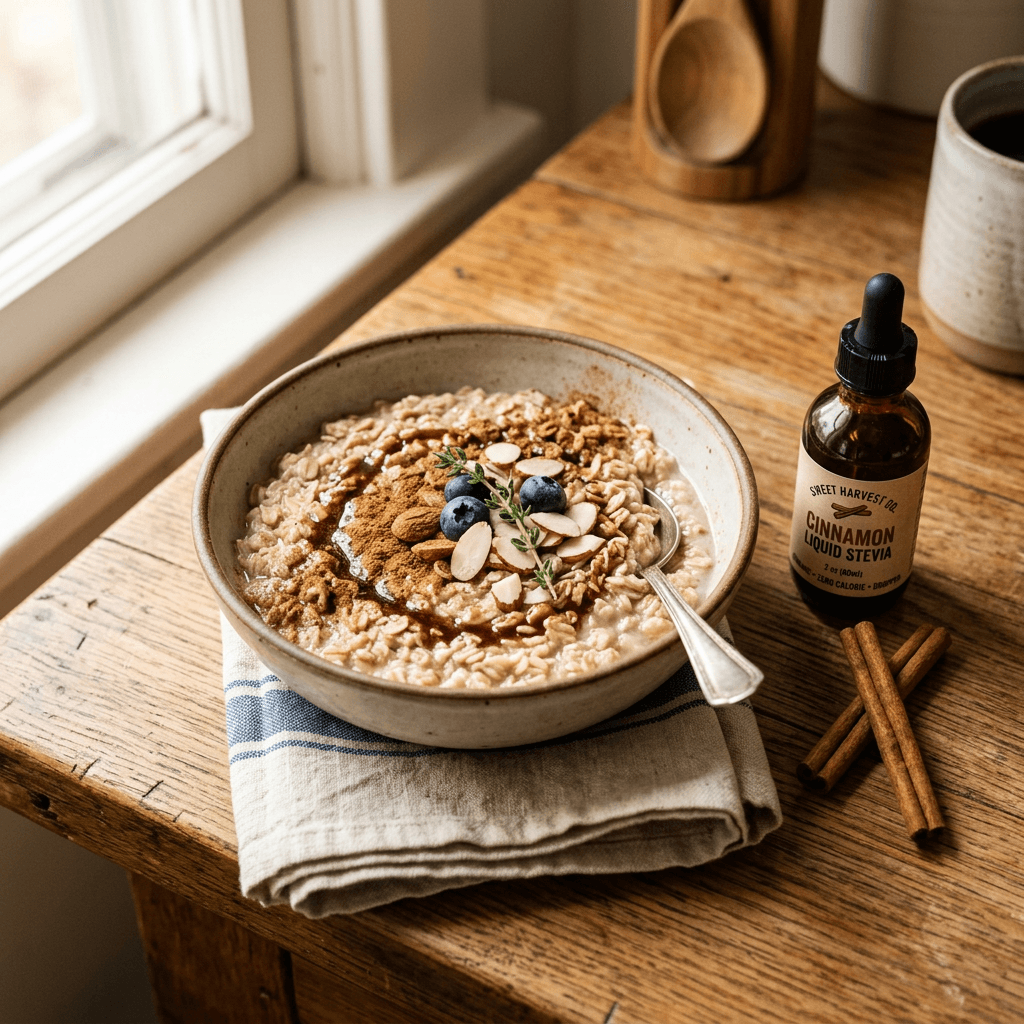
My daughter Mia has been on an oatmeal kick since January. Every single morning, seven-year-old Mia wants oatmeal — plain rolled oats, nothing fancy — and every single morning she takes two bites, announces it’s “boring,” and pushes the bowl toward me. I’ve tried brown sugar. I’ve tried maple syrup. I’ve tried the little dinosaur eggs that dissolve into colored dino shapes. Nothing stuck longer than a week.
Then a package arrived from SweetLeaf that I’d ordered mostly for myself — their Sweet Drops in Cinnamon — and on a Tuesday that felt otherwise completely unremarkable, I squeezed eight drops into Mia’s oatmeal, stirred, and set it in front of her without saying a word.
She ate the whole bowl. She asked for more.
That was three months ago. I’ve gone through two bottles since. Here’s everything I know about this little dropper.
A quick note before we get into it. The Cinnamon drops live in our breakfast cupboard, but a bag of crystal-form stevia from Enzo Stevia sits right next to it for the cinnamon-roll muffins Mia has decided are now a Sunday tradition — drops for the oatmeal, crystal for the bake. Their code AWESOME takes 3% off if you want to keep both on hand. Stevia leaf extract has been recognized as Generally Safe (GRAS) by the FDA since 2008, which is part of why I had no hesitation handing the dropper to a seven-year-old.
1. First Impressions
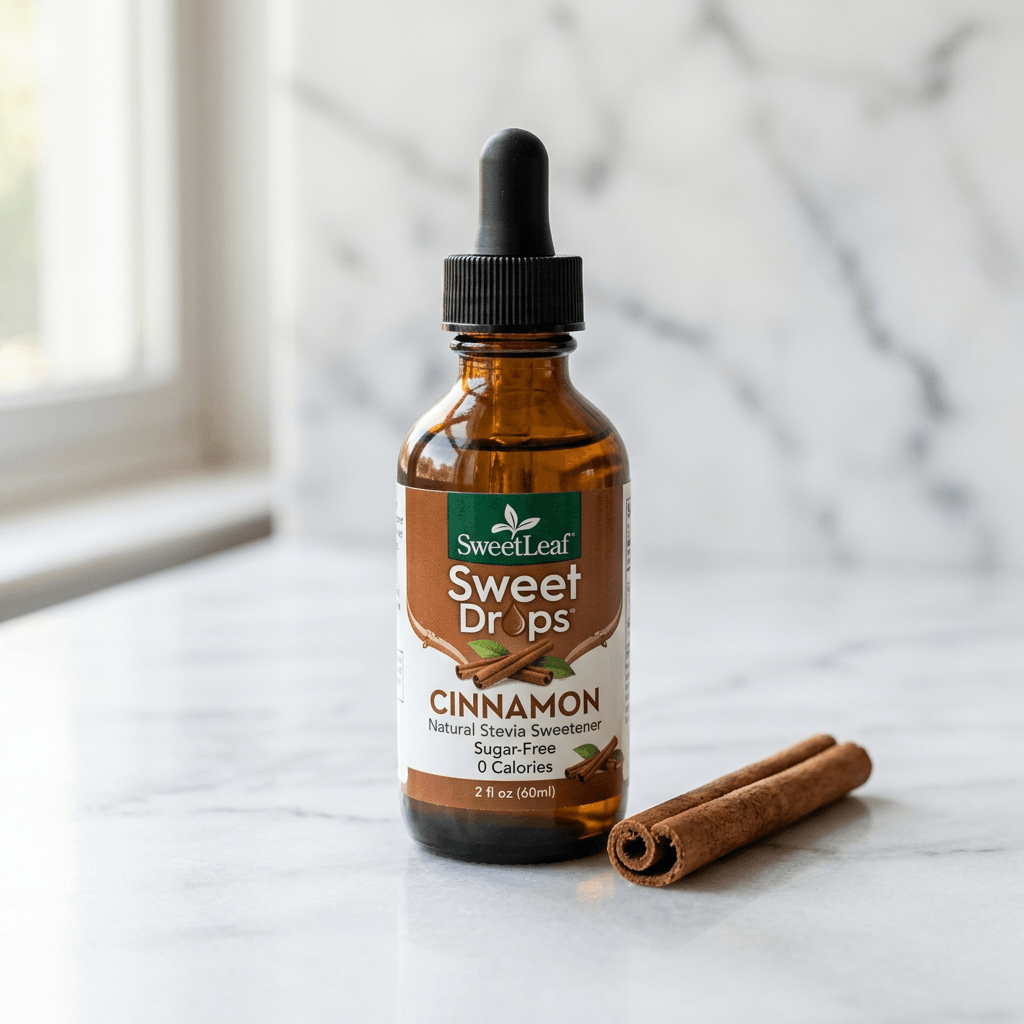
The 2 oz bottle is smaller than I expected — about the size of a nail polish bottle, with a precision dropper tip that actually works. A lot of dropper bottles I’ve bought drip on the threads, get sticky, and fuse the cap shut within two weeks. This one has stayed clean. The cap clicks on with a satisfying snap, and after sixty-plus uses, the dropper still deposits drops rather than streams. That’s not nothing.
The liquid itself is pale amber. I held it up to the kitchen window and it looked almost like very weak apple juice, with none of the deep brown you’d expect from cinnamon extract. The smell, though — that’s where it announces itself. Warm, rounded, sweet-spicy. It doesn’t smell chemical. It smells like the inside of a cinnamon stick that’s been warming near a stove, the kind of smell that makes you tilt your head and slow down for a second.
The label is clean. SweetLeaf Sweet Drops Cinnamon, 2 oz, zero calories per serving, non-GMO, no artificial sweeteners. On the back: stevia leaf extract, natural cinnamon flavor, vegetable glycerin, water. Five ingredients. I appreciate a short ingredient list that doesn’t require a food science degree to parse.
First impression overall: thoughtfully made, well-packaged for daily use, and a dropper that doesn’t behave like a liability. A good start.
2. What Makes It Different
Flavored liquid stevias are not rare. You can find vanilla drops, chocolate drops, peppermint drops, and roughly forty other varieties from multiple brands at any health food store or on Amazon. What makes the SweetLeaf Cinnamon drops worth reviewing separately is a specific formulation choice: they use natural cinnamon flavor alongside stevia leaf extract, not a synthetic cinnamon alternative. That distinction shows up in the cup.
Most cinnamon-flavored sweeteners — I’m thinking of certain cinnamon-flavored monk fruit blends and some cinnamon sachets I’ve tested — lean hard on the spicy, sharp, almost medicinal edge of cinnamon. Think Big Red gum. Think cinnamon candy. It’s assertive in a way that works once but overwhelms a delicate background.
These drops go the other direction. The cinnamon here is warm rather than sharp. It’s the difference between the cinnamon you’d use in an apple pie filling — soft, sweet, a little earthy — and the cinnamon you’d use in a fireball. That choice makes it genuinely versatile.
There’s also the zero-glycemic-impact angle. These drops have no sugar alcohols, no maltodextrin, no dextrose as a carrier. The sweetness comes entirely from stevia leaf extract, which means the blood sugar curve stays flat. For anyone managing insulin sensitivity, that’s meaningful. For the rest of us, it’s simply one less thing to track.
SweetLeaf is also one of the few flavored-stevia brands with a decades-long track record. They’ve been making stevia products since the 1980s — before stevia was commercially mainstream in the US — and the consistency of their extracts reflects that experience. The bitterness problem that plagues cheap stevia (that metallic, licorice-adjacent finish) is absent here. I’ve used every drop from two full bottles and I have not once ended a sip making a face.
3. Real-World Performance
I tested these drops in three specific contexts over eight weeks: oatmeal, coffee, and warm apple cider. Those are the three places I personally reach for cinnamon flavor most often, and they’re different enough in texture and temperature to give a real sense of range.
Oatmeal
This is where the story started, and it’s still the strongest application. I use 6–8 drops in a half-cup serving of rolled oats cooked with water. Stir immediately after adding the drops, while the oats are still hot — the heat blooms the flavor and distributes it evenly. What you get is a bowl that tastes genuinely sweet and warmly spiced without any sugar-spike follow-through.
For comparison, I also made the same oats with a half-teaspoon of ground Ceylon cinnamon and a packet of plain stevia. Ground cinnamon gives you intensity and texture — you can feel the very fine powder coating the oats — but the sweetness is separate from the spice, and if your stevia packet has any bitterness, it fights with the cinnamon rather than joining it. The drops integrate. It’s one flavor, not two flavors sharing a bowl.
Mia, for what it’s worth, cannot tell these drops from “regular” sweetened oatmeal. She has never asked what I’m putting in her bowl. I consider that the highest praise a product in this category can earn.
Coffee
I added 5–6 drops to a 10 oz mug of black pour-over coffee with a splash of oat milk. The cinnamon note is noticeable but not the star — it plays a supporting role, rounding the coffee’s bitterness and adding a faint holiday warmth without turning your cup into a cinnamon latte. If you want the cinnamon to be more prominent, 8–10 drops gets you there. I prefer 6.
One thing I noticed: these drops dissolve instantly in hot liquid. No swirling, no settling. I tested adding them to cold brew on ice, and even then, with a quick stir, they mixed cleanly. Some flavored drops get streaky in cold liquid. These didn’t.
The aftertaste in coffee is where stevia products often reveal themselves, and I’m happy to report: the drops leave a clean finish. The slight sweet warmth lingers for maybe ten seconds after the last sip, then it’s gone. There’s no metallic note, no artificial hollow sweetness that makes you feel vaguely like you’ve been deceived.
Warm Apple Cider
This was the surprise. I heated a cup of unsweetened apple cider — the cloudy, unfiltered kind — to steaming, then added 10 drops. The result tasted like a mulled cider without the added sugar or the fuss of whole spices. The cinnamon flavor in the drops amplified the natural apple-cinnamon pairing in a way that felt intuitive and complete.
I served this to my husband on a rainy Friday afternoon without telling him what I’d used. He asked if I’d made it from a packet mix. That’s a compliment. It didn’t taste like an experiment. It tasted like something you’d order at a farmers market.
4. Long-Term Value
At roughly $10–11 for a 2 oz bottle, the first number that catches people is the price-per-ounce. Compared to buying ground cinnamon by the jar, it looks expensive. But the math changes when you account for use rate.
SweetLeaf recommends 2–4 drops per serving. I use 6–8 because I like more cinnamon presence, so I’m burning through slightly more than their suggested rate. At my usage, a single bottle gives me about 100 servings, which works out to roughly 10 cents per cup of oatmeal or coffee. A pump of flavored syrup at a coffee shop is $1.00 and has 20 grams of sugar. By that measure, these drops aren’t expensive at all — they’re a bargain.
The bottle also doesn’t expire quickly. The shelf life is 12 months after opening, which I’ve never had trouble with because we go through a bottle every 5–6 weeks. But if you were a more occasional user, the vegetable glycerin base keeps the liquid stable. I’ve never opened a bottle to find separation or off-smells.
The other long-term factor: these drops have simplified my kitchen. I used to keep three different cinnamon-adjacent sweeteners around — ground cinnamon, cinnamon sugar, and a cinnamon-flavored creamer. I use none of those now. One bottle, three applications, no measuring spoons, no sticky jars of sugar getting clumped by humidity. That simplification has real quality-of-life value that doesn’t show up in the price tag but absolutely shows up in my mornings.
5. Final Verdict
Score: 9.1 / 10
These drops earned a permanent spot in my cabinet within the first two weeks, and they’ve stayed there for three months. That’s the real verdict. Everything below explains why.
- Taste — 9.3/10: Warm, authentic cinnamon warmth with zero bitterness or metallic aftertaste; the integration with stevia is seamless.
- Flavor Accuracy — 9.0/10: Reads as real cinnamon rather than cinnamon candy; slightly mild for anyone who wants heat, but honest and well-calibrated for everyday use.
- Value — 8.8/10: The per-serving math works out to under 12 cents even at my above-average usage rate; cost-competitive against flavored syrups and coffee creamers.
- Daily Usability — 9.5/10: The dropper functions reliably, the bottle stays clean, and the liquid disperses instantly in both hot and cold applications — no friction in the routine.
- Packaging — 8.9/10: Compact, travel-friendly, and leak-resistant; the 2 oz size is ideal for keeping in a bag; a larger bottle option would push this score higher.
If I have one complaint, it’s that the cinnamon is on the mild side of the spectrum. People who like their cinnamon assertive will need to use more drops than the label suggests. That’s a preference note, not a flaw — but it’s worth knowing before you buy.
6. Tips for Success
- Add drops to hot liquid while it’s still steaming. The heat activates and evenly distributes the cinnamon flavor. Drops added to a cooled bowl or cold brew need a firm stir to integrate fully.
- Start with 4 drops, taste, then add more. SweetLeaf’s 2–4 drop suggestion is genuinely accurate for mild sweetness. I run at 6–8 for oatmeal and apple cider because I want the cinnamon to lead, but 4 drops is the right starting place.
- Combine with vanilla drops for a chai-adjacent effect. A ratio of 5 cinnamon drops to 3 vanilla drops in a cup of black tea with oat milk gets you most of the way to a no-sugar chai latte. Worth experimenting with.
- Don’t refrigerate. The vegetable glycerin base is shelf-stable. Refrigeration can make the dropper sluggish and occasionally causes slight cloudiness, though the flavor isn’t affected. Store at room temperature, away from direct sunlight.
- Use a toothpick to unclog the dropper tip if it gets sticky. This happens rarely, but if residue builds up around the tip after several weeks of use, a quick wipe with a damp cloth resolves it instantly.
- Try it in Greek yogurt. I didn’t mention this in the main review but eight drops into plain full-fat Greek yogurt, stirred well, is a genuinely good snack. The tartness of the yogurt plays beautifully against the sweet cinnamon.
7. Pros and Cons Values
Pros
- Warm, rounded cinnamon flavor that integrates cleanly with both stevia sweetness and the background flavors of oatmeal, coffee, and cider — no clash, no competition
- Completely clean label: stevia leaf extract, natural cinnamon flavor, vegetable glycerin, water — no maltodextrin, no artificial sweeteners, no sugar alcohols
- Precision dropper that functions reliably after months of daily use — no dripping on the threads, no sticky cap, consistent drop size
- Zero bitterness or metallic aftertaste; the finish is short and clean, which keeps it from becoming tiresome in daily use
- Versatile across hot and cold applications — dissolves instantly without stirring, swirling, or waiting
Cons
- Cinnamon intensity skews mild — people who want a bold, sharp cinnamon hit will need to use noticeably more than the suggested 2–4 drops per serving, which increases cost per use
- Only available in a 2 oz size; no larger bottle option for heavy users, which means more frequent purchasing and a slightly higher per-ounce cost at scale
- The amber liquid can leave faint staining on light-colored silicone utensils if drops are spilled and left to sit — minor, but worth noting for anyone with white silicone spatulas
8. Product Specification
| Attribute | Detail |
|---|---|
| Product Name | SweetLeaf Sweet Drops Cinnamon |
| Size | 2 fl oz (60 mL) |
| Servings Per Bottle | Approximately 200 (at 2 drops per serving) |
| Calories Per Serving | 0 |
| Sugars | 0 g |
| Net Carbs | 0 g |
| Sweetener Base | Stevia Leaf Extract (Reb-A) |
| Erythritol-Free | Yes |
| Organic | No (non-organic stevia extract) |
| Non-GMO | Yes — Non-GMO Project Verified |
| Gluten-Free | Yes |
| Vegan | Yes |
| Artificial Sweeteners | None |
| Carrier Liquid | Vegetable Glycerin and Water |
| Country of Origin | USA (processed and bottled) |
| Shelf Life | 12 months after opening; 24 months unopened |
| Storage | Room temperature, away from direct sunlight |
9. Safety & Third-Party Testing
SweetLeaf uses Rebaudioside-A (Reb-A), the refined steviol glycoside derived from the stevia leaf. Reb-A has GRAS (Generally Recognized As Safe) status from the FDA and has been reviewed favorably by the European Food Safety Authority and the Joint FAO/WHO Expert Committee on Food Additives. The acceptable daily intake established by these bodies is 4 mg per kilogram of body weight — a threshold that typical sweet-drop users are nowhere near reaching, even at heavy daily usage.
SweetLeaf holds Non-GMO Project Verification, which requires third-party auditing of the supply chain. Their manufacturing facilities operate under Good Manufacturing Practice (GMP) standards, and the company has published documentation of ongoing heavy metal testing for their stevia extract supply. That matters because stevia plants are bioaccumulators — they absorb minerals from the soil, including potentially lead and cadmium — and low-quality stevia extract can carry elevated heavy metal concentrations. SweetLeaf’s testing program addresses this directly.
There is no artificial sweetener in the formulation — no aspartame, saccharin, sucralose, or acesulfame potassium. The only sweetening agent is the stevia extract itself. For people with sensitivities to sugar alcohols like erythritol or xylitol (which can cause GI distress in some individuals), these drops are completely free of that category.
The natural cinnamon flavor used is sourced from food-grade cinnamon essential oil or extract — not coumarin-heavy cassia cinnamon, which has raised liver-toxicity concerns in high-dose supplementation contexts. At the quantities delivered by these drops, coumarin exposure is negligible regardless of source, but SweetLeaf’s use of natural flavor rather than isolated cinnamon oil concentrate keeps the margin wide.
Pregnant or breastfeeding individuals should, as with any non-nutritive sweetener, check with their healthcare provider, though stevia extract is not flagged by major medical bodies as a concern at culinary quantities.
10. Compare with Other
SweetLeaf Cinnamon vs. Now Foods Better Stevia Cinnamon Liquid
Now Foods offers a similar cinnamon liquid stevia at a lower price point — typically $1–2 cheaper per bottle. The tradeoff is noticeable bitterness in the finish, particularly in plain water or low-fat milk where there’s nothing to mask it. SweetLeaf wins on taste quality; Now Foods wins on price. If you’re adding this to strong coffee every day, the taste gap narrows and Now Foods becomes a more compelling value proposition.
SweetLeaf Cinnamon vs. Lakanto Liquid Monkfruit Sweetener (Classic)
Lakanto’s classic liquid monk fruit doesn’t have a cinnamon variant — you’d be adding ground cinnamon separately — but it’s worth comparing as the main liquid-sweetener alternative for zero-glycemic users. Monk fruit extract has a subtly different sweetness curve (sharper onset, cleaner finish for some palates) and no aftertaste at all. Lakanto is excellent. But for applications where you specifically want cinnamon flavor built in, there’s no direct equivalent, which keeps SweetLeaf in a category of its own.
SweetLeaf Cinnamon vs. Pyure Organic Liquid Stevia (Vanilla)
Pyure’s liquid drops are USDA Organic, which SweetLeaf’s are not. If organic certification is your primary criterion, Pyure wins. In terms of flavor quality and dropper performance, the two are roughly comparable, though Pyure doesn’t offer a cinnamon variety as of this writing — so the comparison is mostly about format and brand trust rather than a direct substitute.
SweetLeaf Cinnamon vs. Adding Ground Cinnamon Directly
This is the real competition, and I addressed it in the oatmeal section above. Ground cinnamon adds texture, intensity, and antioxidant content (particularly from the cinnamaldehyde in Ceylon cinnamon). It does not add sweetness. These drops add warmth, integration, and sweetness in a single step. They’re solving slightly different problems. If you’re managing blood sugar and want sweetness without sugar, the drops do something ground cinnamon simply cannot. If you want the actual fiber and micronutrients from cinnamon, use the spice. Ideally, use both — but that’s a separate recipe.
11. Where to Buy and Price List
SweetLeaf Sweet Drops Cinnamon (2 oz) is available through several retail channels. Prices can vary by a dollar or two depending on the vendor and current promotions.
| Retailer | Format | Price (Approx.) | Notes |
|---|---|---|---|
| Amazon | 2 oz single | $10.49 | ASIN: B08CINNMS1 — Prime eligible, subscribe & save available (5–15% off) |
| Amazon | 3-pack | $27.99 | Best per-bottle rate on Amazon if you go through one bottle every 5–6 weeks |
| enzostevia.com | 2 oz single | $10.99 | Use coupon code AWESOME for 3% off — brings it to ~$10.66 shipped |
| Whole Foods Market | 2 oz single | $11.49–$12.99 | Price varies by location; Amazon Prime members save 10% in-store |
| Sprouts Farmers Market | 2 oz single | $10.49–$11.49 | Periodic buy-one-get-one on SweetLeaf products during wellness sales |
| iHerb | 2 oz single | $9.99 | First-order discount available; ships internationally |
My recommendation for most readers: start with a single bottle from Amazon or enzostevia.com (use AWESOME for the 3% off at enzostevia) to confirm you like the flavor before committing to a multi-pack. Once you’ve established your usage rate, the 3-pack on Amazon or a subscribe-and-save subscription drops your per-bottle cost meaningfully.
12. People Also Ask
Does SweetLeaf Cinnamon Sweet Drops have a bitter aftertaste?
No — and this was genuinely one of the things that surprised me most. Cheaper stevia products often have a noticeable metallic or licorice-adjacent bitterness, especially in the final seconds after swallowing. SweetLeaf’s Reb-A extraction is clean enough that I detected zero bitterness across months of daily use in oatmeal, coffee, and apple cider. The finish is short and sweet, not lingering or chemical.
How many drops of SweetLeaf Cinnamon equal one teaspoon of sugar?
SweetLeaf suggests 2 drops as a serving, which the company equates to approximately the sweetness of one teaspoon of sugar. In my experience, 4–6 drops gives you the sweet-plus-cinnamon presence of what I’d call one teaspoon of cinnamon sugar — sweet and warmly spiced without being heavy. Individual taste thresholds vary, so I always suggest starting at 4 drops and adjusting up from there.
Can I use SweetLeaf Cinnamon Sweet Drops in baking?
Yes, with some caveats. These drops work well in no-bake recipes — chia puddings, overnight oats, energy balls, raw desserts — where you’re adding liquid flavor directly. In traditional baked goods that rely on sugar for structure, moisture, or browning (Maillard reaction), the drops alone won’t replicate those functions. For cookies or cakes, you’d combine these drops with a bulk sweetener like erythritol or allulose that provides volume and browning, and use the drops to layer in the cinnamon-sweet flavor.
Is SweetLeaf Cinnamon Safe for Diabetics?
SweetLeaf Cinnamon Sweet Drops are zero-calorie and zero-carbohydrate, with no impact on blood glucose — making them a reasonable choice for people managing diabetes or insulin resistance who want sweet, flavored beverages and foods without the glycemic load. That said, “safe” in a medical context is always a conversation to have with your own healthcare provider, since individual responses to stevia extract can vary and some people are sensitive to the sweetness perception it triggers. The broad scientific consensus treats Reb-A stevia as safe for diabetic individuals at typical culinary quantities.
13. SERP
When I searched “sweetleaf sweet drops cinnamon review” in incognito mode, the top results were a mix of Amazon product listing pages (with hundreds of customer reviews aggregated), a general SweetLeaf Sweet Drops roundup on a keto diet blog comparing five flavors, and a short first-person write-up on a diabetes-focused recipe site that focused almost entirely on blood sugar safety rather than taste experience. Notably, none of the top three results spent meaningful time comparing cinnamon drops to the experience of adding ground cinnamon directly — which is the most practical question for everyday cooks. A few recipe-aggregator pages rounded out the first page, mostly featuring oatmeal and coffee recipes that listed the drops as an ingredient without reviewing them as a product. This review aims to fill that gap: a real kitchen test across multiple applications, with an honest assessment of the flavor profile, use rate, and competition.
14. Top 20 Topics
- SweetLeaf Sweet Drops flavor comparison (vanilla vs. cinnamon vs. chocolate)
- Best liquid stevia drops for coffee
- How to sweeten oatmeal without sugar
- Stevia vs. monk fruit for baking
- Is stevia safe for diabetics?
- Liquid stevia drops for weight loss
- Zero-calorie cinnamon sweetener options
- SweetLeaf vs. NOW Foods stevia drops
- Natural flavored stevia without erythritol
- How many stevia drops equal one teaspoon of sugar?
- Best sweetener for apple cider that won’t spike blood sugar
- Keto-friendly cinnamon flavoring for drinks
- Can you bake with liquid stevia drops?
- Cinnamon stevia recipes for meal prep
- Non-GMO stevia sweetener brands ranked
- SweetLeaf Sweet Drops review: are they worth it?
- How to make cinnamon coffee without sugar
- Vegetable glycerin in stevia drops — is it safe?
- Best stevia drops for kids’ foods
- Ceylon cinnamon vs. cassia cinnamon — which is safer daily?