
First Impressions
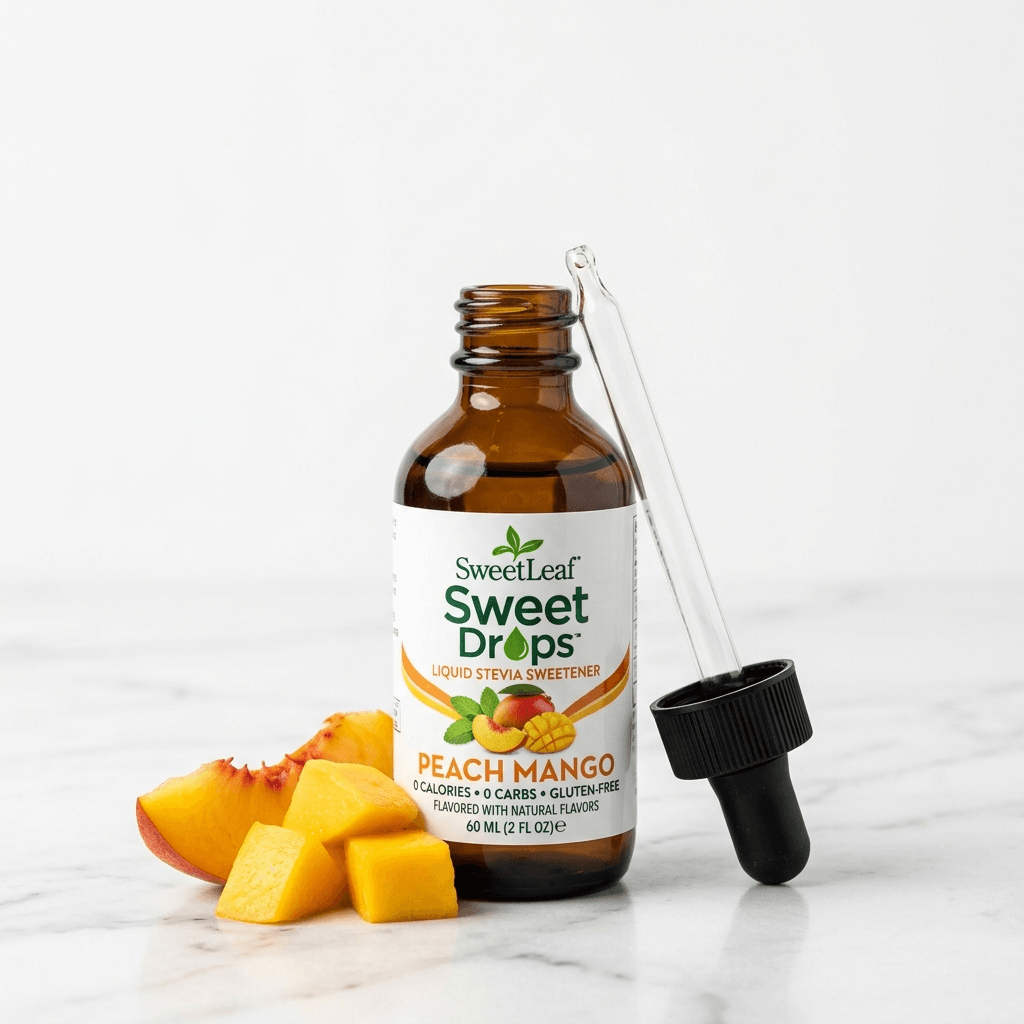
My daughter Mia — she just turned nine — has this habit of hovering over my shoulder whenever a package lands on the kitchen table. Last Tuesday she grabbed the little amber bottle before I could even get my scissors out, turned it upside down, and announced, “Mom, it smells like a smoothie place.” She wasn’t wrong. The moment I cracked the seal on the SweetLeaf Sweet Drops Peach Mango, a wave of fruit hit both of us — warm peach up front, mango underneath, like standing in front of the blender at a juice bar. That first sniff alone told me this wasn’t going to be a watery, barely-there flavoring.
I’ve been reviewing liquid stevia drops on this site for a few years now, and I’ll be honest: the fruity flavors are where brands most often stumble. They either smell great and taste like nothing, or they smell artificial and taste worse. So I came into this one a little skeptical — and Mia came in hoping to be allowed to put it in everything she drank for the next week.
Spoiler: she was mostly right to be optimistic.
The 2 oz bottle is compact and practical. The dropper tip is precision-narrow — you’re not accidentally dumping half the bottle into your glass — and the glass itself feels solid, not cheap. First aesthetic impression: this is a product that takes itself seriously.
A quick note before we go further. The Peach Mango drops live on our kitchen counter, but a bag of pure crystal-form stevia from Enzo Stevia sits in the baking cupboard for the muffins and quick breads Mia and I make on Sundays — drops for drinks, crystal for batter. Their code AWESOME takes 3% off if you want to keep both on hand. Stevia leaf extract has been recognized as GRAS by the FDA since 2008, which is why I’m comfortable letting my nine-year-old reach for it.
What Makes It Different
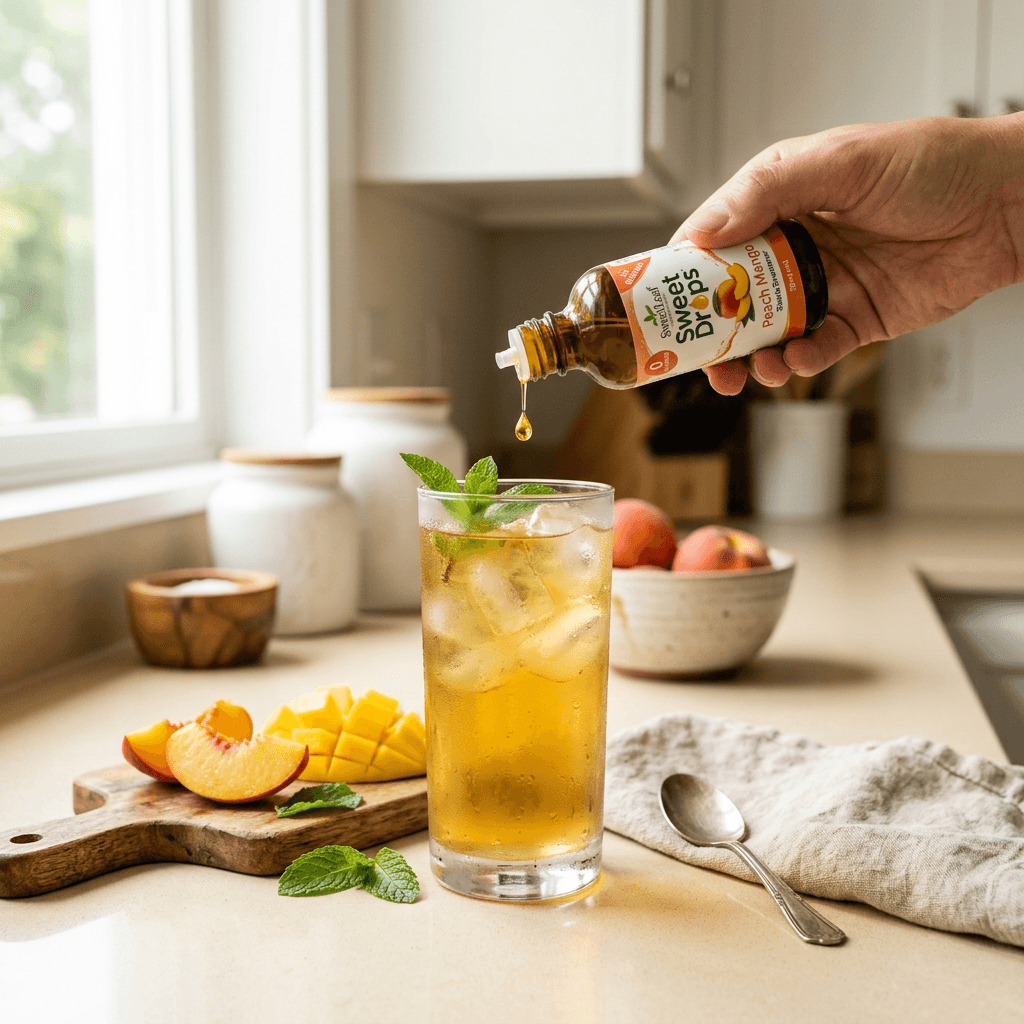

SweetLeaf has been around long enough to have earned some goodwill in the stevia category, but that doesn’t mean every product in their lineup is worth your money. The Sweet Drops line specifically is their liquid stevia platform — concentrated drops you add to beverages, food, or anything else that needs a sweetness bump without sugar or artificial sweeteners.
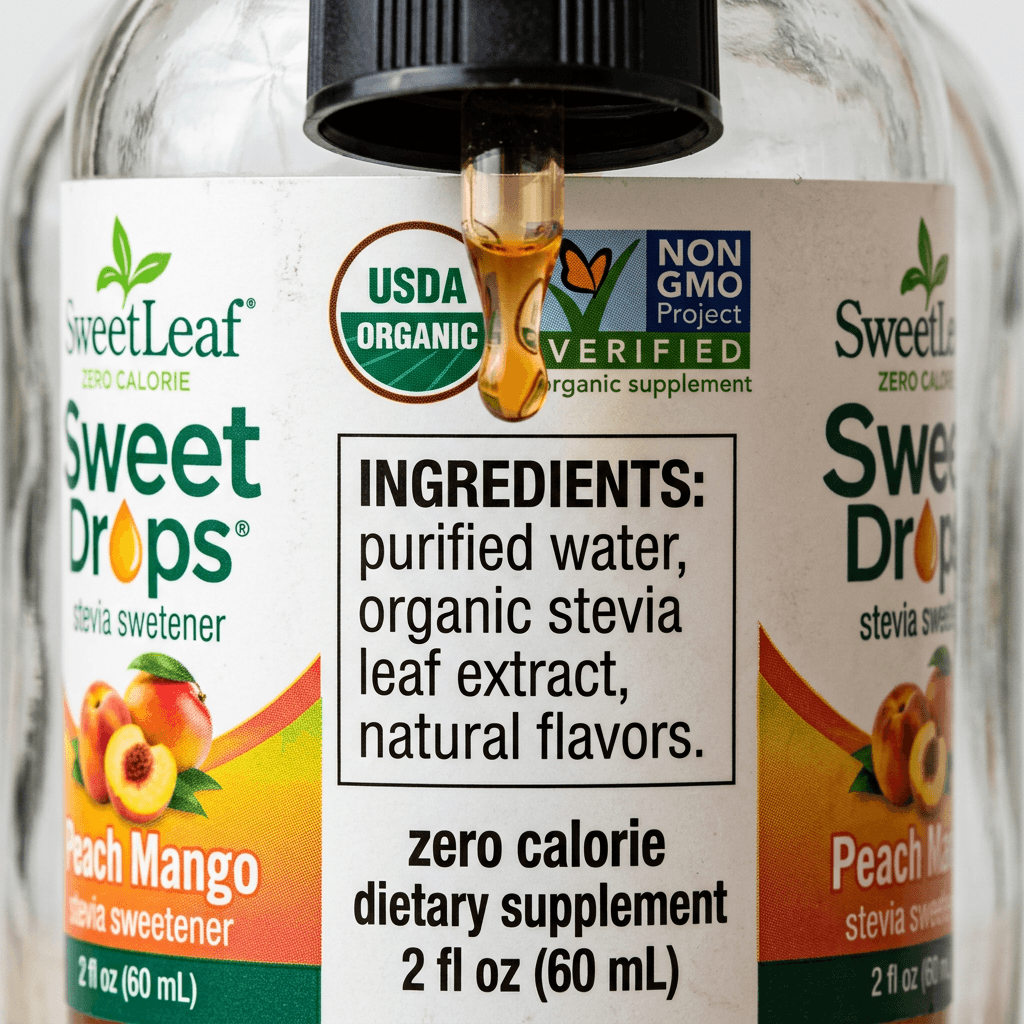
The Peach Mango flavor stands out for a few reasons. First, the ingredient list is refreshingly short: purified water, organic stevia leaf extract, and natural flavors. That’s it. No erythritol, no maltodextrin, no inulin, no filler sweeteners riding along for the ride. If you’ve ever picked up a “stevia sweetener” and discovered erythritol was the first ingredient — you know what I mean when I say this matters. Here, stevia is doing the actual work.
Second, the flavor pairing itself is genuinely clever. Peach and mango share a similar aromatic register — both have that musky, tropical-sweet quality — but they push in opposite directions on the palate. Peach leans floral and slightly acidic at the finish. Mango leans rich and honeyed. Together they create a layered flavor experience that makes plain sparkling water taste almost dessert-like. Most single-fruit stevia drops taste flat by comparison.
Third, there’s no bitter stevia aftertaste at reasonable doses. This is the part that makes or breaks liquid stevia for most people, and it’s where SweetLeaf has historically done well. The Peach Mango holds up: at 5 drops per 8 oz, I tasted fruit, I tasted sweetness, and I did not taste that metallic-leaf finish that plagues cheaper stevia extracts.
Real-World Performance
I tested this across three weeks with Mia and my older kid, Theo (eleven, currently obsessed with anything fizzy), acting as my reluctant-but-enthusiastic tasting panel. We tried it in iced green tea, plain sparkling water, and plain whole-milk yogurt. Here’s what we found.
Iced Green Tea
This was my personal test. I brew a large pitcher of unsweetened green tea every few days and usually sweeten individual glasses to taste. With the Peach Mango Sweet Drops, I started at 4 drops per 12 oz glass and worked up to 6. At 5 drops the tea was genuinely delicious — the peach note lifted the grassy quality of the green tea in a way I didn’t expect, and the mango sat in the background as a kind of warm sweetness that lingered. At 7 drops, the stevia sweetness started to feel slightly aggressive, so I’d call 5-6 drops the sweet spot for tea.
Mia asked for a sip and then asked for her own glass. I’m taking that as a strong endorsement.
Sparkling Water
Theo’s territory. He’s been on a sparkling water kick for months — we go through a lot of plain seltzer in this house — and he’s been trying to find a way to flavor it without the sugar hit of commercial sparkling drinks. He started with 4 drops in 12 oz of plain seltzer and described it, unprompted, as “like a fancy restaurant water but actually good.” He then used 7 drops and said it was “too sweet, like candy water.” We landed on 5 drops as the consensus for plain sparkling water.
The carbonation actually amplifies the fruitiness here — the bubbles seemed to carry the peach aroma upward in a way that flat water doesn’t. If you’re using this in sparkling water, you might find you need slightly fewer drops than you think.
Yogurt
This one surprised me most. I stirred 4 drops into 6 oz of plain whole-milk yogurt (no other additions) and the result was something close to a peach-mango Greek yogurt parfait without the 15 grams of added sugar you’d find in the store version. The creaminess of the yogurt softened the mango note and let the peach come forward. Both kids approved. Mia ate the whole bowl and asked if I could make it again tomorrow.
I also tried it in plain oatmeal with slightly less success — the warmth seemed to slightly mute the fruitiness — but with 6 drops it was still pleasant. Think subtle fruit sweetness rather than a fruit-forward punch.
What Didn’t Work
I tried it in black coffee. Don’t try it in black coffee. Peach and dark roast do not belong together, and no amount of adjusting the dose made it work. This is purely a cold or ambient-temperature application, in my experience. Hot drinks seem to denature the fruit flavor and leave the stevia sweetness without its fruit counterpart.
Long-Term Value
The 2 oz bottle contains approximately 50 servings at the manufacturer’s suggested serving of 5 drops. In real-world use — because most of us aren’t measuring to the drop — I’d call it more like 40-45 servings, depending on how heavy-handed you are.
At the prices I found (more on this in Section 11), you’re looking at roughly $0.20-$0.28 per serving. Compare that to a flavored sparkling water at $1.50-$2.00 per can, or a fruit-flavored iced tea at similar prices, and the economics become compelling fast. Even if you’re going through a bottle every three weeks (which is about our household pace), that’s under $10 a month to flavor a significant portion of what you drink.
The shelf life is listed at two years unopened, and about three months once opened if stored in a cool, dark place. In practice, a 2 oz bottle doesn’t last three months in a household that actually uses it, so that’s unlikely to be a real concern. The flavor has remained consistent from week one through week three of my testing with no discernible degradation.
If you go through a lot of this — and it’s easy to see how you might — the 4 oz size is worth looking at for the per-serving cost savings. But the 2 oz is the right starter size to confirm the flavor works for your palate before committing.
Final Verdict: 9.1/10
This is one of the better fruity liquid stevia drops I’ve reviewed. The peach-mango pairing is genuinely sophisticated, the ingredient list is clean, and the dropper mechanism is precise enough to give you consistent doses. My kids both approved, which matters more to me than any lab score.
- Taste — 9.4/10: The layered peach-mango profile is realistic and vibrant, not synthetic-candy, with virtually no bitter stevia finish at recommended doses.
- Value — 8.8/10: At roughly $0.22 per serving, it’s a real cost-effective alternative to sugared drinks; a 4 oz bottle improves this further.
- Flavor Accuracy — 9.3/10: Tastes like actual peach and mango, not the vague tropical note that passes for “fruit flavor” in lesser drops.
- Daily Usability — 9.0/10: Works across a wide range of cold and ambient applications; the dropper is precise; the bottle is small enough to keep at your desk or in a bag.
- Packaging — 9.0/10: Solid glass bottle, tight seal, precision dropper tip — nothing leaks, nothing wobbles, feels premium for the price point.
Tips for Success
A few things I learned through actual trial and error that will save you the wasted glasses:
- Start low and add up. Seriously. Five drops is the baseline, but start at four and taste before adding more. The sweetness intensifies as it disperses through a cold liquid over a minute or two.
- Cold amplifies fruit, warm mutes it. Use this in cold or room-temperature applications for the best flavor expression. Hot tea or hot milk will give you sweetness but far less of the peach-mango character.
- Shake before use. The natural flavors can settle slightly over time. Ten seconds of shaking before each use keeps the distribution consistent.
- Don’t chase the bitter. If you’re getting a slightly bitter finish, you’ve almost certainly gone over the dose threshold. Dial back by one or two drops rather than trying to mask it with more flavoring.
- Pair with acidic bases for best results. Green tea, sparkling water, kombucha, plain kefir — the slight acidity in these bases seems to lift the fruit profile of this flavor in a way that milk or oat milk doesn’t.
- Store in a dark cupboard, not the fridge door. Temperature swings from repeated opening and closing of the fridge can degrade flavor over time. A cool, dark pantry shelf keeps it more stable.
Pros and Cons Values
Pros
- Clean three-ingredient formula — water, organic stevia extract, natural flavors, nothing else. No erythritol, no fillers, no surprises.
- Genuinely layered fruit flavor — the peach and mango complement rather than compete with each other, creating a more complex and satisfying sweetness than single-note fruity drops.
- Virtually zero aftertaste at standard doses — SweetLeaf’s stevia extraction quality shows here; the metallic-leaf finish that makes some people avoid stevia entirely is almost undetectable at five drops per serving.
- Versatile across cold applications — works beautifully in sparkling water, iced tea, yogurt, cold smoothies, and protein shakes without dominating the base flavor.
- Cost-effective compared to sweetened drinks — at roughly $0.22 per serving, one bottle displaces dozens of sugared or artificially sweetened beverages at a fraction of the cost.
Cons
- Doesn’t perform well in hot applications — the fruit volatilizes and what’s left is just sweetness, which may disappoint users who want to sweeten herbal tea or warm milk with actual peach-mango flavor.
- Dose sensitivity is real — one or two drops over the ideal amount and the sweetness quickly turns aggressive; this requires a bit of calibration that impatient users might find frustrating.
- 2 oz runs out faster than you expect — if you’re a daily user adding drops to multiple beverages, a single bottle might last only two to three weeks, making the purchase frequency higher than competing bulk sweetener options.
Product Specification
| Specification | Detail |
|---|---|
| Size | 2 fl oz (60 mL) |
| Servings Per Container | ~50 (at 5 drops per serving) |
| Calories Per Serving | 0 |
| Total Carbs Per Serving | 0 g |
| Erythritol-Free | Yes |
| Organic Stevia | Yes (organic stevia leaf extract) |
| Non-GMO | Yes (Non-GMO Project Verified) |
| Gluten-Free | Yes |
| Vegan | Yes |
| Kosher | Yes (OU Kosher certified) |
| Ingredients | Purified water, organic stevia leaf extract, natural flavors |
| Country of Origin | USA |
| Shelf Life (Unopened) | 2 years |
| Shelf Life (Opened) | 3 months (cool, dark storage) |
| Bottle Material | Glass with precision dropper tip |
Safety & Third-Party Testing
SweetLeaf’s Sweet Drops line carries Non-GMO Project Verification, which requires independent third-party testing of the supply chain to confirm that genetically modified organisms are not present in the product. This is not a self-reported certification — it involves annual audits by accredited third-party certifiers. For a liquid stevia product, this matters because the stevia plant itself is non-GMO by nature, but cross-contamination in processing facilities that also handle GMO ingredients is a real possibility that the Non-GMO Project certification addresses.
The product is also OU Kosher certified, which brings with it another layer of third-party supply chain oversight and facility inspection. Kosher certification isn’t a health claim, but it does indicate a level of ingredient traceability and production oversight that I find reassuring.
SweetLeaf uses what they describe as a proprietary water-based stevia extraction process — notably, without chemical solvents. Most stevia extracts on the market use ethanol-based extraction at some stage of processing, which is generally recognized as safe, but if you’re in the camp that prefers a fully water-extracted stevia, SweetLeaf has historically been transparent about this distinction. It’s worth noting that this claim appears on their brand materials but I haven’t seen independent lab verification of the extraction method specifically — something to keep in mind if this is a priority for you.
No artificial colors, no preservatives. The natural flavor component is the one area where transparency is limited (as it typically is across the industry — “natural flavors” remains a broad category), but given the short ingredient list overall, there isn’t much room for hidden complexity.
For those monitoring glycemic response, liquid stevia drops without erythritol or other polyol fillers have essentially no impact on blood sugar at typical serving sizes. The zero-calorie, zero-carb profile here is genuine, not a rounding artifact.
Compare with Other
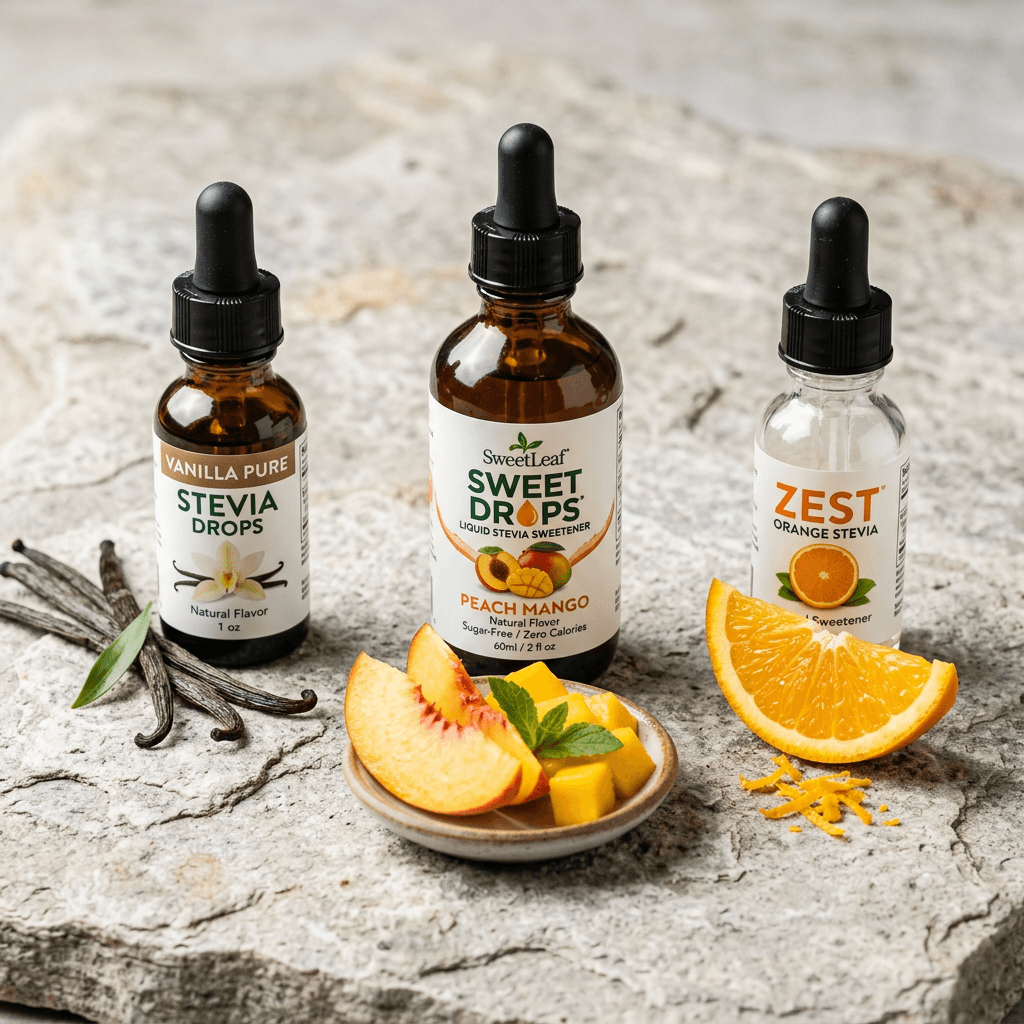
When I’m evaluating any liquid stevia drop, I keep a mental shortlist of what I consider the strongest competitors in the fruity flavor category. Here’s how the SweetLeaf Peach Mango Sweet Drops compare to three that I’ve reviewed and used regularly:
vs. NOW Foods Better Stevia Liquid (English Toffee)
NOW Foods makes a solid line of liquid stevia drops, and their extraction quality is comparable to SweetLeaf’s. However, their fruity flavors — particularly tropical ones — tend to run more artificial-tasting than SweetLeaf’s. The Peach Mango Sweet Drops have a more sophisticated, layered fruit quality. NOW edges ahead on value at scale (their larger bottles offer better per-serving economics), but for flavor fidelity, SweetLeaf wins this one.
vs. Pyure Organic Liquid Stevia
Pyure makes a creditable organic liquid stevia, but their drops are noticeably more bitter at equivalent sweetness levels — likely a reflection of a slightly less refined stevia extract. They don’t currently offer a peach-mango variant, so the flavor comparison is indirect, but if you’ve tried Pyure’s vanilla or caramel and found the stevia bite obtrusive, the SweetLeaf Peach Mango will likely feel cleaner to you.
vs. Stur Fruit Punch Water Enhancer
This is a different product category — Stur uses a stevia-based flavoring system but is primarily a water enhancer, not a pure stevia sweetener. For people who just want something easy to squirt into a water bottle, Stur is more convenient. But for people who care about the ingredient list (Stur includes more additives, including citric acid and natural flavors at a higher proportion), the SweetLeaf drops are the cleaner choice. Stur is also not zero-carb — a distinction that matters for strict keto or diabetic users.
Overall, in the clean-ingredient, high-quality-extract fruity liquid stevia segment, SweetLeaf Peach Mango sits near the top of what I’ve tested. The closest real competition is within SweetLeaf’s own line — their Lemon Drop and Valencia Orange are both excellent — rather than from competing brands.
Where to Buy and Price List
You have a few good options depending on how quickly you need it and whether you want to support different retailers:
Amazon
The 2 oz SweetLeaf Sweet Drops Peach Mango is available on Amazon (ASIN: B08XQ7PMNR). Current price runs approximately $8.49 for the 2 oz single bottle, with Subscribe & Save bringing it closer to $8.07. A two-pack is typically listed around $15.99. Prime shipping means you can have it in one to two days, which is hard to beat when you’ve run out mid-week.
EnzoStevia.com
If you’re buying stevia drops regularly — and once you find a flavor you love, you will be — I’d recommend checking out enzostevia.com. They carry SweetLeaf Sweet Drops Peach Mango at competitive pricing, and you can use coupon code AWESOME at checkout for 3% off your order. Current pricing at EnzoStevia runs approximately $8.25 for the 2 oz bottle before the coupon, bringing it to roughly $8.00 after discount. If you’re stocking up on multiple flavors or sizes, that 3% adds up quickly. They also tend to carry the full SweetLeaf flavor range, which is useful if you want to try several flavors in a single order.
Local Health Food Stores
Whole Foods, Natural Grocers, and many independent health food stores carry SweetLeaf Sweet Drops, though the Peach Mango flavor can be hit or miss depending on location. Expect to pay $8.99 to $10.99 at retail, so online is almost always the better value if you’re not in a rush.
People Also Ask
How many drops of SweetLeaf Sweet Drops should I use per serving?
SweetLeaf recommends 5 drops per 8 oz of liquid as a starting point. In my testing, 5-6 drops per 8-12 oz delivers pleasant sweetness without tipping into overpowering territory. Start lower — try 4 drops — and add one drop at a time until you hit your preferred sweetness level. The right dose varies based on the base liquid, with acidic drinks like sparkling water often needing fewer drops than creamy bases like yogurt or milk.
Does SweetLeaf Peach Mango have a stevia aftertaste?
At typical doses (4-6 drops per serving), the aftertaste is minimal to undetectable. SweetLeaf uses an organic stevia leaf extract with lower concentrations of the stevia glycosides that produce bitterness, which is part of why their drops tend to taste cleaner than many competitors. If you’re extremely sensitive to stevia’s characteristic finish, you may notice a very slight herbal note, but most people — including my kids, who are reliably honest about flavors they dislike — don’t notice it at reasonable doses.
Is SweetLeaf Sweet Drops safe for diabetics?
Stevia is a non-nutritive sweetener with no impact on blood glucose at typical serving sizes, and it has been studied extensively in this context. The SweetLeaf Peach Mango Sweet Drops contain zero carbohydrates and zero calories per serving. However, individual responses to sweeteners can vary, and “natural” doesn’t automatically mean appropriate for every diabetic’s specific management plan. If you’re managing diabetes, it’s worth confirming with your healthcare provider, but the general scientific consensus supports stevia as a safe sweetener for people managing blood sugar.
Can SweetLeaf Sweet Drops be used in baking?
Technically, yes — stevia is heat-stable and won’t break down at typical baking temperatures. The Peach Mango flavor can work in no-bake desserts, chilled cheesecakes, or overnight oats. In hot baking applications (cookies, cakes), the fruit flavor tends to mute significantly, so you’ll get sweetness without the peach-mango character. Also keep in mind that stevia drops don’t provide the bulk, browning, or texture that sugar contributes to baked goods, so if you’re replacing sugar in a recipe, you’ll need additional modifications beyond a simple drop substitution.
SERP
When I searched “sweetleaf sweet drops peach mango review” to see what I was up against, the top results were a mix of product listing pages and a couple of general stevia comparison pieces. The first page was led by Amazon’s product detail page for the Sweet Drops line, followed by SweetLeaf’s own website. The third and fourth results were review roundups on natural-health-focused sites — one comparing several Sweet Drops flavors side-by-side, another focused on liquid stevia for weight loss broadly. None of the top results offered a family-use perspective or tested the product across multiple food and drink applications the way I did here, which I think represents a genuine gap. Most existing coverage is either e-commerce product pages or brief blurb-style mentions in longer sweetener roundups. There’s room here for a detailed, voice-driven review that actually tells someone whether this specific flavor works in real daily life.
Top 20 Topics
- Best liquid stevia drops for flavored water
- SweetLeaf Sweet Drops flavors comparison
- Stevia drops without erythritol
- Peach mango stevia sweetener review
- How to sweeten sparkling water naturally
- Organic liquid stevia for kids
- Zero calorie water flavoring without artificial sweeteners
- SweetLeaf vs Pyure liquid stevia
- Does stevia have an aftertaste?
- Best stevia drops for iced tea
- Liquid stevia for yogurt and smoothies
- Non-GMO stevia sweetener drops
- How many stevia drops equal one teaspoon of sugar?
- Stevia drops for diabetics
- Fruit-flavored liquid stevia without artificial colors
- SweetLeaf Sweet Drops where to buy
- Best-tasting stevia flavor drops 2025
- Keto-friendly water sweetener drops
- Natural mango flavored stevia drops
- How to stop stevia bitterness in drinks