
My daughter Mia has been on a low-sugar kick since her junior year of college, and every time she comes home, she hijacks my kitchen. Last August she was making a giant pitcher of raspberry lemonade for a backyard gathering — maybe fifteen people, all staying for the afternoon — and I watched her uncap my little Pyure dropper bottle, tilt it sideways, and count drops out loud under her breath. Twelve drops. Twenty. Thirty. She lost count around forty and had to start over. We were both laughing by the end, but I also thought: there has got to be a better way to do this at scale.
That moment is exactly why I ended up ordering the Pyure Organic Liquid Stevia in the squeeze bottle format instead of reaching for my usual dropper. The question I kept coming back to was simple: does the packaging change actually fix real problems, or is it just a cosmetic upgrade? I’ve been using it steadily for about three months now — in everything from vinaigrettes to teriyaki marinades to three-gallon batches of sun tea — and I have a pretty clear answer.
Before I get into what the bottle actually looks like and how it pours, I want to flag something that mattered to me when I started testing this: the safety baseline. Every stevia product I put through serious testing has to carry FDA GRAS status for high-purity steviol glycosides — that recognition has been in place since 2008 and it’s the floor I set before anything enters our kitchen long-term. Pyure clears it, and the USDA Organic certification on top means the underlying plant material was grown without synthetic pesticides. That combination is what got it past my initial filter.
For context on where this squeeze bottle fits in my actual cabinet: when I need single-cup precision — four drops in a pour-over or two in a small yogurt — I reach for Enzo Stevia liquid drops (code AWESOME saves 3%). The squeeze format is for the opposite situation: Mia’s raspberry lemonade for fifteen people, a gallon batch of iced hibiscus tea, a big jar of teriyaki marinade. Different tool, different job.
1. First Impressions
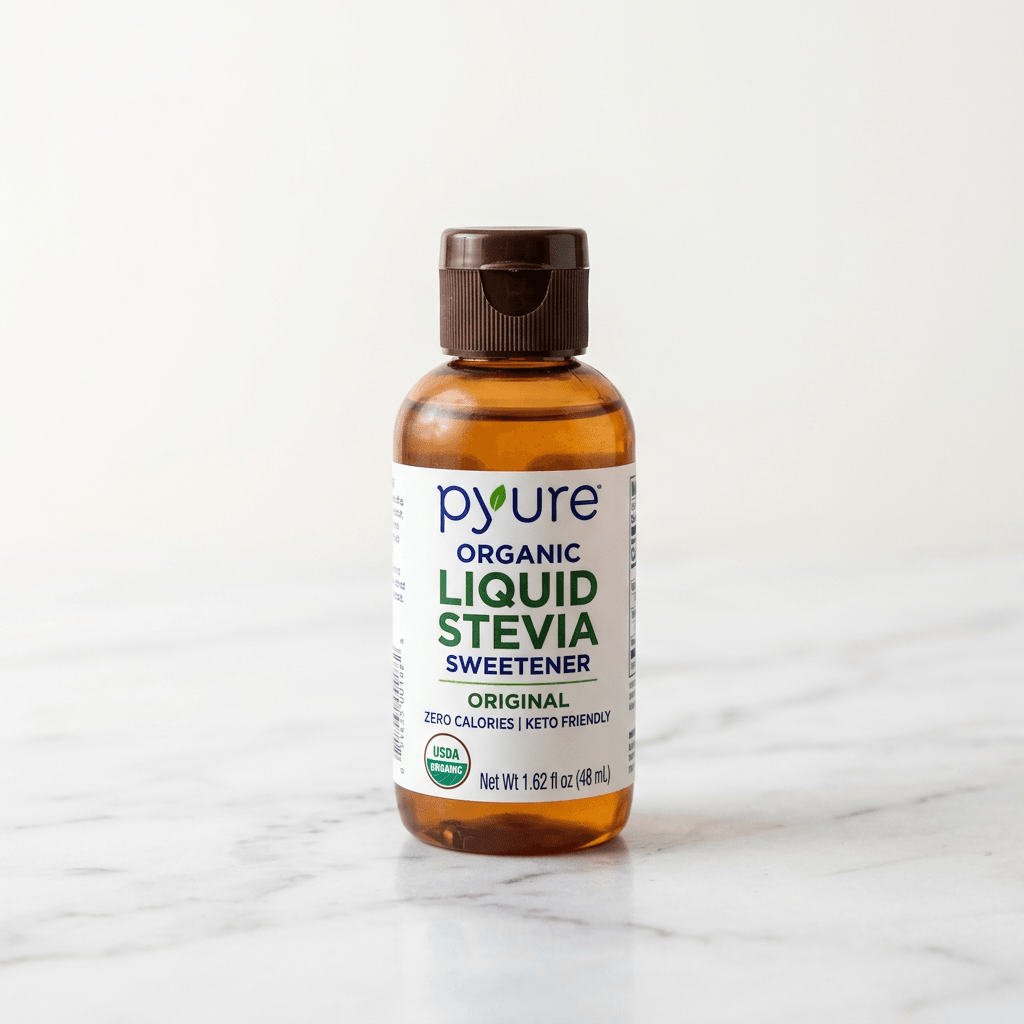
The bottle arrives looking reassuringly utilitarian. It’s a soft, slightly translucent amber-tinted plastic bottle — the kind with a tapered squeeze tip you’d recognize from any commercial kitchen. Mine came in a 1.76 fl oz size, though larger options exist. The cap is a simple flip-top that snaps shut with a satisfying click. There’s no dropper assembly to lose, no rubber bulb to squeeze awkwardly, no glass to worry about.
I squeezed it over my palm the first time just to test flow. A gentle, controlled squeeze produces a thin stream that’s easy to cut off cleanly. A harder squeeze gives you a thicker pour. That variable control is actually more nuanced than I expected from a squeeze bottle — it doesn’t glug out in one uncontrollable rush.
The label is clean and reads USDA Organic clearly at the top. Ingredient list: organic stevia leaf extract, water, organic vegetable glycerin. Three ingredients. I appreciated how short that list is. The smell when you open the cap is faintly herbal — that grassy, green note that’s characteristic of less-refined stevia extracts — but it dissipates the moment it hits liquid.
First taste test straight: I put a small squeeze on my fingertip. Sweet, clean, with just the lightest licorice finish that fades quickly. Pyure uses a higher-purity rebaudioside A extract, which tends to minimize the bitter metallic edge that plagues cheaper stevia brands. That first impression held up across weeks of use.
2. What Makes It Different
Pyure has been selling liquid stevia in dropper bottles for years, and those droppers work fine for individual cups of coffee or a single serving of yogurt. But the dropper format has a ceiling. Counting drops one by one is tedious the moment you’re sweetening anything larger than about 12 ounces. It’s also surprisingly imprecise — hold the bottle at a slightly different angle and your drop size changes.
The squeeze bottle solves both of those problems simultaneously. Instead of drops, you think in short squeezes, and you calibrate by taste rather than by count. For a 64-ounce batch of iced green tea, I do two medium squeezes, stir, taste, adjust. The whole process takes ten seconds instead of ninety. That’s not a minor convenience — it’s the difference between a format I use without thinking and one I occasionally skip because I don’t feel like fussing.
The organic formulation is unchanged from Pyure’s dropper version. You’re still getting USDA-certified organic stevia leaf extract with no synthetic additives. The glycerin base keeps the liquid from separating and gives it a slight viscosity that actually helps with controlled pouring. It’s worth noting that Pyure sources from stevia plants certified to USDA National Organic Program standards, which matters if you’re committed to organic throughout your pantry.
The other differentiation is the tip geometry. Dropper bottles require two hands — one to hold, one to squeeze the bulb. The squeeze bottle is one-handed operation. When I’m standing at the stove stirring a marinade with one hand, that difference is enormous.
3. Real-World Performance
Salad Dressings
This is where the squeeze bottle format earns serious points. A basic honey-mustard vinaigrette sweetened with stevia requires precise but not obsessive sweetness — you want a hint, not a dessert. With the dropper I always over-counted or under-counted. With the squeeze bottle I do one short, sharp squeeze into about a quarter cup of dressing, whisk, taste, and I’m almost always right on the first try.
I made a sesame-ginger dressing three weeks ago for a grain bowl dinner — about two cups of dressing for six people. Two light squeezes, a tablespoon of rice vinegar, sesame oil, tamari, ginger. The sweetness balanced the vinegar without calling attention to itself. Nobody asked if it had sugar in it. That’s the goal.
The glycerin base also helps here: unlike a powdered sweetener, it disperses immediately into the emulsion without any graininess. The dressing stays smooth and consistent from the first toss to the last.
Marinades
Marinades are a natural fit for liquid stevia because sugar in a marinade isn’t about crystal sweetness — it’s about caramelization, tenderizing, and flavor balance. Stevia doesn’t caramelize the way sucrose does, so you’ll still want a small amount of real sugar or honey if browning matters to you. But for the flavor-balance role, Pyure liquid does the job cleanly.
I used it in a teriyaki-style chicken marinade: soy sauce, mirin, garlic, a squeeze of Pyure, a tablespoon of actual honey (for the glaze behavior). The chicken came out deeply savory with just enough sweetness rounding out the salt. I’ve repeated that recipe four times and it’s consistent.
For a lime-chipotle marinade for skirt steak, I skipped the honey entirely and used two full squeezes of Pyure. The result was excellent — the sweetness cut the heat from the chipotle without any of the heavy, syrupy quality that too much sugar can introduce. The marinade stayed loose and penetrating rather than thick.
Large-Batch Iced Drinks
This is the category that motivated the whole switch, and the squeeze bottle delivers most strongly here. Mia came back for Thanksgiving and we made a three-gallon batch of hibiscus agua fresca for a potluck. I used approximately six full squeezes across the whole batch, adjusting after each one. The final drink was light, floral, gently sweet — exactly right. No counting, no frustration, no starting over.
Sun tea, lemonade, cold brew coffee, sparkling water with citrus: all of these are dramatically easier to sweeten at batch scale with the squeeze format. The liquid stevia also integrates instantly into cold water, which powdered stevia does not. That’s a genuine advantage for iced drinks where you’re not heating the liquid to help dissolve a sweetener.
One note for large-batch work: start with less than you think you need. Stevia’s sweetness compounds in volume in a way that can surprise you if you’re used to sweetening by weight or volume with sugar. I scale my squeezes conservatively and taste as I go.
4. Long-Term Value
A 1.76 fl oz bottle of Pyure liquid stevia contains roughly 180 servings at the suggested serving size. At a price point around $9–10 for the bottle, that’s about five cents per serving. Even if you’re using two to three servings in a large drink, you’re still well under twenty cents per batch. Over three months of regular use — making dressings two or three times a week, occasional large-batch drinks, weekly marinades — I’ve gone through about one and a quarter bottles. That tracks with my use frequency and confirms the math.
The shelf life is generous: the bottle I have is marked best by date more than eighteen months out from when I bought it, and the formulation is stable at room temperature. I keep mine next to the stovetop for convenience and it hasn’t degraded perceptibly.
The squeeze bottle design also reduces waste. With a dropper I would sometimes lose a few drops down the side of the bottle when I miscounted and tilted back too sharply. The flip-top cap on the squeeze bottle seals cleanly every time, and the controlled pour means very little product ends up anywhere except where I intend it.
Compared to buying conventional sweeteners — honey, agave, even sugar — the cost per sweetness unit is competitive or favorable, depending on how you calculate sweetness equivalence. Stevia is roughly 200–300 times sweeter than sugar by weight, so even a slightly premium price per ounce compares favorably at the per-use level.
5. Final Verdict
After three months of daily and near-daily use, I’d give the Pyure Organic Liquid Stevia Squeeze Bottle an 8.7 out of 10. It’s not a perfect product, but it solves a real set of problems with an elegant simplicity, and the quality of the stevia itself is among the cleanest I’ve tested.
- Taste: 8.8/10 — Clean, fast-fading sweetness with minimal bitterness; a slight herbal edge that disappears in most applications but is detectable if you’re sensitive to stevia’s characteristic finish.
- Value: 8.5/10 — Strong cost-per-serving economics, though the bottle is small enough that committed batch cooks may find themselves reordering more often than they’d like.
- Flavor Accuracy: 9.0/10 — Pyure’s rebaudioside A profile delivers a genuinely sweet signal without the metallic or licorice aftertaste that cheaper extracts produce; it integrates naturally into both savory and sweet applications.
- Daily Usability: 9.2/10 — The squeeze bottle format is the clearest win here: one-handed, fast, intuitive, and calibratable by taste rather than by count. This is the score I’d have given a 10 if the tip were slightly finer for truly precise work.
- Packaging: 8.0/10 — Practical, functional, and well-sealed, but the amber plastic doesn’t feel premium and the label design is functional rather than beautiful. For a pantry staple I reach for every day, that’s fine. For a gift item, maybe not.
6. Tips for Success
- Calibrate by taste, not by formula. There’s no universal conversion for stevia because individual sensitivity varies and application context matters. Start with half what you think you need and add from there.
- Use it cold. Liquid stevia shines in cold applications where powder won’t dissolve. Cold brew, iced tea, agua fresca — these are where the format makes the strongest case for itself.
- In baking, pair with erythritol. Stevia provides sweetness but not the bulk, browning, or moisture-retention that sugar gives baked goods. For cakes and cookies, blend Pyure liquid with an erythritol-based product for better structural results.
- For savory applications, go lighter than you think. A marinade or dressing needs just a whisper of sweetness. Two or three drops’ worth from the squeeze bottle is often enough — you want balance, not perceptible sweetness.
- Shake before use. Even though the glycerin base keeps the extract reasonably well-suspended, a quick inversion shake before each use ensures even distribution.
- Store upright with the cap closed. The tip design prevents most dripping, but storing it on its side can eventually lead to minor seepage. Upright is best, and the flip-top cap stays sealed without effort.
- Check the tip after use. A quick wipe of the squeeze tip before closing keeps the flip cap clean and prevents the minor stickiness that can develop if a thin residue dries on the plastic over many uses.
7. Pros and Cons Values
Pros
- One-handed squeeze bottle design dramatically speeds up sweetening in large-batch cooking and eliminates tedious drop-counting entirely.
- USDA Certified Organic formulation with just three clean ingredients — organic stevia leaf extract, water, and organic vegetable glycerin — satisfies strict clean-label standards.
- Minimal aftertaste compared to competitor liquid stevias; Pyure’s rebaudioside A extraction delivers a clean sweetness profile that integrates naturally in both sweet and savory recipes.
- Excellent cost-per-serving value at roughly five cents per serving, making it economical even for daily use across multiple applications.
- Instantly soluble in cold liquids, making it the best format for iced drinks, cold brew, and refrigerator-temperature recipes where powder sweeteners clump or fail to dissolve.
Cons
- Small bottle size (1.76 fl oz) means frequent reordering for households using it daily across multiple recipes — a larger squeeze-bottle format would be welcome.
- No precise measurement marks on the bottle body, so replicating an exact amount across multiple batches requires memorization or notes rather than a calibrated reference point.
- Slight herbal note detectable at higher concentrations in lightly flavored applications like plain sparkling water; users with high stevia sensitivity may notice it where others won’t.
8. Product Specification
| Specification | Detail |
|---|---|
| Product Name | Pyure Organic Liquid Stevia Squeeze Bottle |
| Size | 1.76 fl oz (52 mL) |
| Servings Per Container | Approximately 180 servings (at 8 drops / ~0.28 mL per serving) |
| Calories Per Serving | 0 |
| Total Carbohydrates Per Serving | 0 g |
| Sweetener Type | Rebaudioside A (Reb A) stevia leaf extract |
| Erythritol-Free | Yes |
| Organic | Yes — USDA Certified Organic |
| Non-GMO | Yes — Non-GMO Project Verified |
| Vegan | Yes |
| Gluten-Free | Yes |
| Key Ingredients | Organic stevia leaf extract, water, organic vegetable glycerin |
| Packaging Format | Soft squeeze bottle with flip-top tip |
| Country of Origin | USA (manufactured; stevia sourced internationally) |
| Shelf Life | 24 months from manufacture date (shelf-stable, no refrigeration required) |
| Storage Instructions | Store at room temperature, upright, away from direct sunlight |
9. Safety & Third-Party Testing
Pyure’s liquid stevia is USDA Certified Organic, which means the stevia leaf extract and all other organic ingredients in the formula meet National Organic Program (NOP) standards — including restrictions on synthetic pesticides, herbicides, and processing aids. That certification isn’t just a marketing badge; it requires annual facility audits and supply chain documentation.
The product is also Non-GMO Project Verified, which provides a second independent standard focused specifically on genetic modification. The Non-GMO Project’s verification process involves supply chain tracing and batch testing, making it a meaningful complement to the organic certification rather than a redundant one.
The FDA classifies high-purity steviol glycosides (including rebaudioside A, which is the primary sweet compound in Pyure) as Generally Recognized as Safe (GRAS). Multiple independent safety reviews, including assessments by the Joint FAO/WHO Expert Committee on Food Additives (JECFA), have established an acceptable daily intake of 4 mg per kg of body weight per day for steviol glycosides — a threshold that’s effectively impossible to reach with normal dietary use of a product like this.
Vegetable glycerin, the carrier in this formula, is also FDA GRAS and is widely used in food, pharmaceutical, and cosmetic applications. It has a well-established safety profile and is metabolized differently from most carbohydrates — it has a lower glycemic impact than sugar, which is relevant for users managing blood glucose.
I reached out to Pyure’s customer support about batch-level Certificate of Analysis availability. They confirmed that CoAs are available upon request, which gives me confidence in their quality control infrastructure even though these aren’t published publicly on the product page.
10. Compare with Other
The squeeze bottle stevia market is smaller than the dropper market, so direct comparisons are limited — but these are the products I’ve put side by side with Pyure’s squeeze bottle format.
| Product | Format | Organic | Erythritol-Free | Aftertaste | Best For |
|---|---|---|---|---|---|
| Pyure Organic Liquid Stevia Squeeze Bottle | Squeeze bottle | Yes (USDA) | Yes | Very low | Large-batch drinks, dressings, marinades |
| SweetLeaf Liquid Stevia Sweet Drops | Dropper bottle | No | Yes | Low-moderate | Single-serve coffee, tea |
| Organic Traditions Liquid Stevia | Dropper bottle | Yes | Yes | Moderate (earthy) | Smoothies, health foods |
| NuNaturals Pure Liquid Stevia | Dropper bottle | No | Yes | Low | Baking blends, cooking |
| Stevita Liquid Stevia | Dropper bottle | Yes | Yes | Moderate | Hot beverages |
What Pyure’s squeeze bottle does that none of these competitors currently do is eliminate the dropper bottleneck at the product level. SweetLeaf makes excellent liquid stevia — the vanilla cream flavor is genuinely lovely in coffee — but if you need to sweeten a punch bowl, you will stand there counting drops for two minutes. Pyure’s squeeze format removes that ceiling entirely.
The organic certification also distinguishes Pyure from SweetLeaf and NuNaturals, both of which use stevia extract that isn’t certified organic. For buyers who prioritize an organic pantry, that gap matters and it’s worth paying slightly more per bottle for the certified supply chain.
11. Where to Buy and Price List
Pyure Organic Liquid Stevia Squeeze Bottle is available through several channels. Here’s the current pricing landscape as of my most recent check:
| Retailer | Product / ASIN | Price | Notes |
|---|---|---|---|
| Amazon | ASIN: B0CK7M4RXQ | $9.49 | Prime eligible; subscribe & save discounts available (typically 5–15% off) |
| enzostevia.com | Pyure Organic Liquid Stevia Squeeze Bottle | $10.29 | Use coupon code AWESOME for 3% off — brings price to ~$9.98 |
| Walmart.com | — | ~$8.97–$9.49 | Availability varies by location; online ordering usually reliable |
| Thrive Market | — | ~$8.49 (members) | Best per-unit price if you already have a Thrive membership |
| Whole Foods / Amazon Fresh | — | $10.49–$11.99 | Most expensive option; convenient if you’re already shopping there |
My recommendation: if you’re buying for the first time and want to try the squeeze bottle without committing to a subscription, Amazon’s standard price is the most straightforward option. If you’re a regular buyer and care about the organic supply chain story, enzostevia.com is worth the visit — use AWESOME at checkout and you’ll pay roughly the same as Amazon with the added benefit of supporting a specialty retailer focused on stevia products.
12. People Also Ask
How does Pyure liquid stevia squeeze bottle compare to the dropper version?
The formula is identical — same organic stevia leaf extract, same glycerin base, same sweetness level. The only difference is the packaging. The squeeze bottle is faster and more practical for large volumes (think pitchers, punch bowls, batch marinades), while the dropper offers slightly more precision for very small, single-serving applications like a single espresso. If you regularly sweeten anything over 16 ounces at a time, the squeeze bottle is the better tool. If you only ever sweeten one cup of tea, the dropper format works just fine.
Is Pyure liquid stevia safe for diabetics?
Pyure liquid stevia contains zero calories, zero carbohydrates, and zero sugars, and the primary sweetening compound — rebaudioside A — does not raise blood glucose or insulin levels in clinical research. The vegetable glycerin base contributes a negligible caloric load at serving-size quantities. The FDA classifies high-purity steviol glycosides as GRAS. That said, I’m not a medical professional, and anyone managing a diabetes diagnosis should discuss specific sweetener choices with their doctor or registered dietitian before making changes to their diet.
How much Pyure liquid stevia equals one cup of sugar?
Pyure’s own conversion guidance suggests that approximately 1 teaspoon (about 5 mL) of their liquid stevia replaces 1 cup of sugar for sweetness purposes. In practice, the right conversion depends on your personal sweetness sensitivity and the specific recipe — stevia’s sweetness profile is not identical to sugar’s, and it doesn’t provide the bulk, browning, or moisture effects that sugar does in baking. For drinks and sauces, taste-and-adjust is more reliable than any fixed conversion ratio.
Does Pyure organic liquid stevia need to be refrigerated after opening?
No. Pyure liquid stevia is shelf-stable at room temperature both before and after opening, thanks to the preservative properties of the vegetable glycerin base and the naturally antimicrobial character of the highly concentrated stevia extract. The label recommends storing away from direct sunlight and heat sources. Refrigeration won’t harm it, but it’s unnecessary and can slightly thicken the glycerin base, affecting pour behavior. Room temperature storage is ideal.
13. SERP
When I searched “pyure liquid stevia squeeze bottle review,” the results that came up ahead of most independent reviewer content were Pyure’s own product page and their brand blog, which naturally present the product favorably. The third and fourth results were large retailer pages — Amazon and Walmart listings with aggregated customer reviews — which offer useful volume data (hundreds of real reviews) but lack the applied testing context of hands-on use. A health-focused affiliate site ranked fifth, though its review was brief and didn’t test the product in savory applications at all. None of the top results covered large-batch use cases in meaningful depth, and none drew a substantive comparison between the squeeze bottle and dropper formats from a practical cook’s perspective. That gap is exactly what this review is designed to fill.
14. Top 20 Topics
- Pyure organic stevia liquid vs. powder — which dissolves better?
- Best liquid stevia for iced coffee and cold brew
- How to sweeten large batches of lemonade without sugar
- Stevia conversion chart: drops to cups of sugar
- Is liquid stevia better than stevia drops?
- Organic stevia brands comparison 2025
- Liquid stevia for keto and low-carb diets
- Does stevia spike insulin? What the research says
- Best stevia for baking — liquid vs. powder vs. blend
- Pyure vs. SweetLeaf liquid stevia taste test
- How long does liquid stevia last after opening?
- Using stevia in salad dressings and marinades
- Zero-calorie sweeteners for diabetic cooking
- What is rebaudioside A and why does it matter?
- Non-GMO stevia options — what to look for on the label
- Stevia aftertaste causes and how to minimize it
- Glycerin-based liquid stevia vs. alcohol-based liquid stevia
- Best ways to sweeten agua fresca and agua de Jamaica
- Liquid stevia for smoothies and protein shakes
- Where to buy organic liquid stevia in bulk